
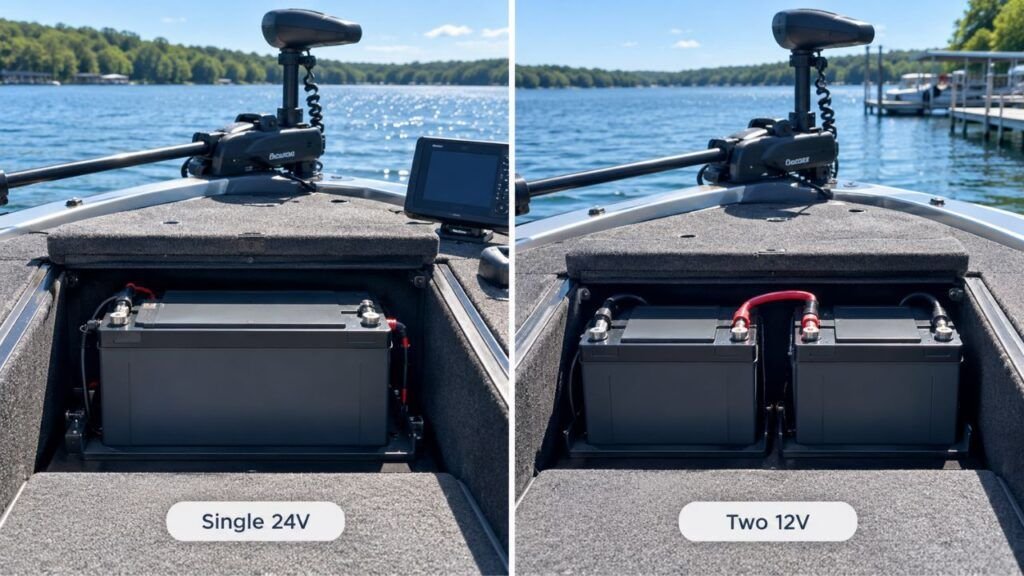
A single 24V lithium battery is usually the simpler choice for a trolling motor, while two 12V lithium batteries offer more placement and charging flexibility. If both setups provide similar usable watt-hours and discharge capability, their trolling motor runtime should also be very similar.
The better setup depends on your boat, battery compartment, charger, and fishing habits. Below, I’ll compare runtime, wiring, BMS behavior, charging, weight, space, cost, and reliability.
Key Takeaways
- A single 24V battery usually provides the cleanest installation.
- Two 12V batteries must be connected in series for 24V.
- Two 12V 100Ah batteries in series still provide 100Ah.
- Comparable 24V battery setups should deliver similar usable runtime.
- Two batteries require more terminals, cables, and connection points.
- Two 12V batteries can be easier to lift individually.
- Both 12V batteries should closely match when connected in series.
- Not every 12V lithium battery supports series connections.
- Either battery failing can stop a two-battery 24V system.
- Charger compatibility can strongly influence which setup makes sense.
Single 24V Lithium vs Two 12V Batteries: Quick Comparison
Both configurations can properly power a 24V trolling motor. The biggest differences involve installation, charging, BMS design, handling, and serviceability.
| Factor | Single 24V Lithium Battery | Two 12V Lithium Batteries in Series |
| System voltage | 24V-class | 24V-class |
| Example capacity | 24V 100Ah | Two 12V 100Ah batteries create 24V 100Ah |
| Stored energy | Similar when capacities match | Similar when capacities match |
| Expected runtime | Similar with equal usable energy | Similar with equal usable energy |
| Battery cases | One | Two |
| BMS units | One | Two |
| Series jumper | Not needed | Required |
| External connections | Fewer | More |
| Installation | Usually simpler | Requires correct series wiring |
| Placement flexibility | Less | More |
| Individual lifting | One larger battery | Two smaller batteries |
| Charging | Dedicated compatible 24V charger | Compatible 24V or isolated multi-bank charging |
| Failure behavior | Battery or BMS failure stops motor | Either battery or BMS can stop motor |
| Best use | Simple new installation | Flexible or existing two-battery setup |
Neither option automatically wins in every boat. What matters is how well the complete system fits your needs.
Are One 24V Battery and Two 12V Batteries Electrically the Same?
They can be very similar electrically when capacity and specifications match. However, the batteries are packaged and managed differently.
What Happens When Two 12V Batteries Are Wired in Series?
Series wiring adds battery voltage while keeping amp-hour capacity unchanged.
For example, consider two 12V 100Ah lithium batteries.
When properly connected in series, they create approximately:
24V 100Ah
They do not create a 24V 200Ah battery bank.
With LiFePO4 batteries, actual nominal voltages are commonly around 12.8V each. Two together therefore create approximately a 25.6V nominal system.
That voltage is commonly marketed as a 24V battery system.
How Does That Compare With a 24V 100Ah Battery?
A dedicated 24V 100Ah lithium battery stores roughly similar energy.
You can compare stored energy using watt-hours:
Watt-hours = Voltage × Amp-hours
A 25.6V 100Ah battery stores about:
25.6 × 100 = 2,560Wh
Two 12.8V 100Ah batteries together also store about:
2 × 12.8 × 100 = 2,560Wh
So, simply choosing two battery cases does not double runtime.
Will One Setup Run the Trolling Motor Longer?
Not automatically.
If usable energy and discharge capability are similar, runtime should be similar.
Actual runtime depends on several factors:
- Trolling motor current draw
- Speed setting
- Boat weight
- Wind strength
- Current and waves
- Heavy vegetation
- Propeller condition
- Battery temperature
- BMS discharge limits
- Actual usable battery capacity
A single 24V battery may perform differently from another model. However, that difference comes from specifications, not battery count alone.
Advantages and Disadvantages of a Single 24V Lithium Battery
A dedicated 24V lithium battery keeps the electrical system simple. That simplicity can be especially valuable inside crowded boat compartments.
Advantages include:
- Only one battery case needs mounting.
- No external series jumper cable is required.
- Fewer terminals need inspection and maintenance.
- Wiring is easier to understand and troubleshoot.
- One BMS manages the complete battery pack.
- One battery monitor may cover the entire system.
- There is no mismatch between separate 12V batteries.
- A dedicated 24V charger creates a straightforward setup.
Possible disadvantages include:
- The complete battery may be heavier to lift.
- One large case may not fit awkward compartments.
- A battery failure removes your complete 24V power source.
- A dedicated 24V lithium charger may be required.
- The battery cannot normally power standard 12V equipment directly.
- Replacing the battery means replacing the complete 24V pack.
For a new installation, I usually favor simplicity where possible. Fewer connections also mean fewer places for problems to develop.
Advantages and Disadvantages of Two 12V Lithium Batteries in Series
Two 12V lithium batteries can be an equally practical solution. They simply require more attention during selection and installation.
Advantages include:
- Each battery may be easier to lift individually.
- Two smaller cases provide more placement flexibility.
- Many boats already have two battery trays installed.
- 12V lithium batteries are widely available.
- Each battery can be checked individually.
- Existing compatible multi-bank chargers may remain useful.
- One battery may later serve another suitable 12V application.
Possible disadvantages include:
- You need an additional series jumper cable.
- More terminals create more possible connection problems.
- Both batteries should be closely matched.
- Two separate BMS units control the series bank.
- Either battery disconnecting can stop the trolling motor.
- Battery state of charge can become mismatched.
- Some 12V lithium batteries cannot be connected in series.
Never assume your batteries allow series operation.
Check the battery manufacturer’s specifications before making the connection.
Does Using Two 12V Batteries Give You More Redundancy?
Not in the way many boat owners expect.
Your 24V trolling motor requires the complete 24V circuit. Both 12V batteries are therefore needed during normal operation.
Suppose one battery’s BMS shuts down from low voltage. The series circuit opens, and the trolling motor normally stops.
The same problem occurs if one battery develops a serious fault. A loose jumper connection can also interrupt the entire system.
You still have one healthy 12V battery available. However, it cannot normally operate a trolling motor designed for 24V.
That means two 12V batteries provide serviceability and flexibility, not true trolling motor redundancy.
There can still be practical advantages after a failure. You can test each battery separately and identify the problem.
But don’t choose dual batteries expecting automatic backup power.
One BMS vs Two BMSs: Does It Matter?
Lithium batteries depend heavily on their Battery Management Systems. The BMS protects the cells and controls important operating limits.
How a Single 24V Battery Manages Its Cells
A dedicated 24V lithium battery normally has one integrated BMS.
That BMS monitors cells throughout the battery pack and may protect against:
- Overcharging
- Excessive discharge
- Overcurrent
- Short circuits
- High temperature
- Low charging temperature
If the BMS detects an unsafe condition, it can disconnect output.
That protection is valuable, but it also means a BMS shutdown stops the trolling motor.
What Happens With Two 12V Battery BMSs?
Each 12V lithium battery normally has its own BMS.
That means your 24V system contains two independent protection systems.
If either BMS disconnects its battery, current cannot continue flowing through the series circuit.
For example, one battery may reach its low-voltage cutoff first. Its BMS can disconnect even while the second battery still has usable charge.
This is another reason closely matched batteries are important.
Which BMS Arrangement Is More Reliable?
Neither arrangement is automatically more reliable.
A single 24V battery gives you one integrated battery-management system. Two 12V batteries give you two separately managed battery packs.
Battery quality matters more than simply counting BMS units.
Pay particular attention to maximum continuous discharge current.
Your BMS must safely support your trolling motor’s maximum current demand.
A large Ah rating alone does not guarantee sufficient discharge capability.
Charging a Single 24V Battery vs Two 12V Batteries
Charging is one area where your existing boat setup matters greatly. A battery configuration that matches your charger can save considerable hassle.
Charging a Single 24V Lithium Battery
A dedicated 24V battery generally needs a compatible lithium charger.
The charger should match:
- Battery voltage
- LiFePO4 chemistry
- Charging voltage requirements
- Recommended charging current
- Battery manufacturer specifications
Do not choose a charger only because its label says 24V.
Check that its charging profile suits your specific lithium battery.
Charging Two 12V Lithium Batteries in Series
You may have more than one charging option.
Some series-approved batteries can be charged as a complete 24V bank. That requires a compatible 24V lithium charger and manufacturer approval.
Another option is an isolated two-bank onboard charger.
Each charger bank connects to one 12V battery separately. This allows each battery to receive its own charging output.
The charger must support lithium batteries and series-bank installations.
Always follow the charger and battery manufacturers’ instructions.
Which Setup Works Better With an Existing Onboard Charger?
This depends on what is already installed.
Suppose your boat has a suitable two-bank lithium charger. Two 12V batteries may integrate easily without replacing that equipment.
Starting from scratch changes the situation.
One 24V battery paired with one appropriate charger can create a cleaner system.
Don’t compare battery prices without considering your charger.
Changing charging equipment can significantly affect your total upgrade cost.
Why Battery Balance Matters With Two 12V Batteries
Two series-connected batteries work best when they remain closely matched.
Ideally, both batteries should have the same:
- Brand
- Model
- Chemistry
- Capacity
- BMS specifications
- Age
- Charge level
Avoid combining one heavily used battery with one brand-new battery.
Their usable capacities and internal behavior may differ noticeably.
Before initially connecting batteries in series, follow their manufacturer’s balancing instructions.
Wiring and Installation Differences
Both configurations require proper marine wiring and circuit protection. However, the two-battery system introduces additional connection points.
How Two 12V Batteries Create 24V
The batteries must be wired in series, not parallel.
A simplified arrangement looks like this:
Battery 1 positive → Battery 2 negative
That connection becomes your series jumper.
The remaining negative terminal and positive terminal supply the trolling motor.
Series wiring raises system voltage.
Parallel wiring does something different and should not replace proper series wiring.
If you’re uncertain about the terminals, follow your motor manufacturer’s diagram.
Why a Single 24V Battery Is Simpler
A single battery removes the external series jumper.
You also have fewer battery terminals, connections, and hold-down components.
That can make the battery compartment easier to inspect.
Marine electrical connections face vibration, moisture, and corrosion. Reducing unnecessary connection points can make maintenance easier.
Simple wiring also helps during troubleshooting.
There are simply fewer places to check.
Circuit Breaker and Wire Gauge Still Matter
Don’t reduce wire size simply because you’re using lithium batteries.
Cable size should be based on:
- Motor maximum current
- Cable run length
- Acceptable voltage drop
- Trolling motor manufacturer requirements
Longer cable runs may require larger conductors.
Use marine-grade cable and properly crimped terminals where required.
Your trolling motor circuit should also have suitable overcurrent protection.
Use the breaker size recommended for your specific trolling motor.
Place and install protection according to manufacturer instructions.
Can You Run 12V Electronics From One Battery in a Two-Battery Series Bank?
This is something I would avoid unless your equipment manufacturer specifically supports it.
It can be tempting to connect a fish finder, lights, or another 12V accessory to only one battery.
The problem is unequal discharge.
One battery supplies the extra 12V load while the other does not. Their state of charge can gradually become different.
That imbalance can complicate charging and series-bank performance.
A cleaner solution is usually a separate 12V electronics battery.
Another option may be a properly selected 24V-to-12V DC converter.
Whichever approach you use, follow the equipment manufacturer’s wiring requirements.
Marine electrical systems become troublesome when unrelated circuits share improper grounds or battery connections.
Which Setup Takes Less Space and Weight?
A single 24V battery often creates a cleaner overall footprint. However, don’t assume it is always smaller or lighter.
Actual battery dimensions vary widely.
Compare the exact models you’re considering instead of comparing voltage labels.
For two 12V batteries, remember to account for:
- Both battery cases
- Battery trays
- Installation clearance
- Series jumper
- Terminal access
- Combined weight
Then compare those measurements with the single 24V battery.
One large battery may save total compartment space.
However, two smaller batteries can fit into separate narrow spaces.
Weight distribution matters as well, particularly in smaller boats.
Try to keep heavy batteries low and properly secured.
Avoid creating unnecessary side-to-side imbalance.
Which Setup Is Easier to Handle and Replace?
Two 12V batteries often win when individual lifting matters.
For example, suppose your two batteries weigh 25 pounds each. Moving them separately may be much easier than lifting one 50-pound battery.
That matters when batteries sit beneath tight hatches.
It can also matter in smaller fishing boats or kayaks.
A single 24V battery has one important advantage, though.
You only remove, connect, inspect, and secure one battery.
Replacement is also straightforward because there is no battery pair to match.
With two 12V batteries, replacing only one deserves extra consideration.
An old battery and new battery may behave differently under load.
If one battery fails after years of service, replacing the pair may sometimes make more sense.
Follow the battery manufacturer’s recommendations for your specific situation.
Which Setup Costs Less?
There is no universal cheapest configuration because battery prices change regularly.
Compare the complete installed system instead of battery prices alone.
Include the cost of:
- Battery or batteries
- Battery trays
- Series jumper cable
- Terminals and connectors
- Circuit breaker
- Charger
- Battery monitor
- Installation hardware
- Professional installation when required
- Future replacement costs
Two inexpensive 12V batteries might initially look cheaper.
However, additional hardware or charger changes can narrow that difference.
The opposite can also happen.
If your boat already has a compatible two-bank charger and battery trays, dual 12V batteries may reduce conversion costs.
Focus on total ownership cost rather than the cheapest battery listing.
Single 24V vs Two 12V Batteries for Different Types of Boaters
The easiest way to decide is matching the configuration to your boat. Think about your existing equipment before replacing anything.
Choose a Single 24V Lithium Battery If…
A dedicated 24V battery usually makes sense when:
- You’re building a new 24V trolling motor system.
- You want fewer cables and external connections.
- Your compartment fits one battery comfortably.
- You prefer one battery to monitor.
- You want simple troubleshooting.
- You’re buying a new compatible charger anyway.
- You want the cleanest possible installation.
For many new lithium installations, this is my preferred approach.
You reduce hardware without sacrificing comparable stored energy.
Choose Two 12V Lithium Batteries If…
Two 12V batteries can make more sense when:
- Your boat already has two suitable battery trays.
- You already own a compatible multi-bank charger.
- Smaller batteries are easier to lift.
- You need flexible battery placement.
- One large 24V battery will not fit properly.
- You want easier individual battery testing.
- Your battery manufacturer approves series operation.
There is nothing inherently wrong with this configuration.
It simply requires more attention to matching and wiring.
Avoid Two 12V Batteries If…
I would avoid the setup when:
- The batteries use different chemistries.
- Their capacities are different.
- One battery is significantly older.
- Their BMS specifications differ substantially.
- The manufacturer prohibits series connections.
- The BMS cannot support motor current.
- You plan to heavily load only one battery with 12V accessories.
Starting with a properly matched pair prevents many future problems.
What Battery Specs Matter More Than 24V vs Two 12V?
Battery configuration gets plenty of attention, but specifications matter more. A poorly matched battery remains a poor choice regardless of configuration.
Check these specifications before buying:
- Correct voltage for your trolling motor
- Battery capacity in Ah
- Stored energy in Wh
- Usable battery capacity
- Maximum continuous discharge current
- BMS overcurrent limits
- Manufacturer-approved series capability
- Charging voltage
- Recommended charging current
- Low-temperature charging protection
- Operating temperature range
- Water-resistance rating
- Terminal type
- Physical dimensions
- Weight
- Warranty coverage
- Manufacturer support
Continuous discharge current deserves special attention.
Imagine your trolling motor can demand more current than the BMS allows. The BMS may disconnect even though plenty of capacity remains.
That’s why I would never choose a trolling motor battery using Ah alone.
Check your trolling motor’s specifications first.
Then choose a battery that safely meets those requirements.
Common Mistakes to Avoid
A few mistakes repeatedly cause confusion with 24V lithium systems.
- Thinking two 100Ah batteries in series become 200Ah.
- Assuming two batteries automatically provide longer runtime.
- Treating two 12V batteries as true trolling motor redundancy.
- Connecting the batteries in parallel instead of series.
- Combining batteries with different capacities.
- Mixing different battery chemistries.
- Combining an old battery with a new one.
- Assuming every lithium battery supports series wiring.
- Ignoring maximum BMS discharge current.
- Using an incompatible charging profile.
- Installing an undersized series jumper.
- Ignoring manufacturer wire-size recommendations.
- Forgetting proper circuit protection.
- Pulling large 12V loads from only one battery.
- Comparing batteries using Ah without comparing voltage.
- Buying before measuring the actual battery compartment.
Avoiding these mistakes makes either battery configuration much easier to live with.
Final Verdict: Is One 24V Battery Better Than Two 12V Batteries?
For most boaters building a new 24V lithium trolling motor system, I would lean toward one dedicated 24V lithium battery. It reduces external wiring, removes the series jumper, simplifies monitoring, and gives you fewer battery connections to maintain.
Two matching 12V lithium batteries remain an excellent option, though. They can be easier to handle, easier to place, and better suited to boats already equipped with dual battery trays and compatible multi-bank chargers.
Most importantly, don’t expect a major runtime difference just because one system uses one battery and another uses two. Compare usable watt-hours, BMS discharge capability, charger compatibility, size, weight, and manufacturer requirements. Those details matter far more than the number of battery cases.
Related FAQs
Is One 24V 100Ah Battery the Same as Two 12V 100Ah Batteries?
They are roughly equivalent in voltage, amp-hour capacity, and stored energy when the specifications match. Two 12V 100Ah batteries connected in series create approximately a 24V 100Ah system, not 200Ah.
Do Two 12V Batteries in Series Give 200Ah?
No. Series wiring adds voltage while the amp-hour capacity stays unchanged. Two 12V 100Ah batteries in series therefore provide approximately 24V at 100Ah.
Do Two 12V Batteries Last Longer Than One 24V Battery?
Not simply because there are two batteries. If both configurations provide similar usable watt-hours and discharge capability, their trolling motor runtime should be similar under the same operating conditions.
Can I Replace Two 12V Trolling Motor Batteries With One 24V Lithium Battery?
Usually, yes, if the trolling motor requires 24V and the new battery provides suitable capacity and discharge current. You must also make sure your charger and circuit protection remain compatible.
Can I Wire Any Two 12V Lithium Batteries in Series?
No. Some lithium batteries and BMS designs do not support series operation. Always verify the maximum supported series configuration with the battery manufacturer before connecting them.
Can I Charge Two 12V Lithium Batteries in Series With a 24V Charger?
Sometimes. Both batteries must support series charging, and the charger must use the correct lithium charging profile. Follow the battery manufacturer’s charging instructions before using this method.
Can I Use a Two-Bank 12V Charger on Batteries Wired in Series?
Yes, many isolated multi-bank marine chargers can charge each 12V battery separately while they form a series bank. However, the charger must support lithium batteries and the specific installation.
What Happens If One 12V Battery Dies in a 24V Series Setup?
The 24V trolling motor normally stops because the series circuit needs both batteries. One healthy 12V battery alone cannot normally operate a motor designed for 24V.
Does a Single 24V Battery Have Better BMS Protection?
Not automatically. BMS quality, current rating, temperature protection, and manufacturer design matter more than whether the system uses one BMS or two separate BMS units.
Can I Run My Fish Finder From One Battery in a 24V Series Bank?
It is generally better to avoid heavily loading only one battery because uneven 12V loads can create imbalance. A separate electronics battery or suitable DC converter is usually cleaner.
Is a Single 24V Lithium Battery Better for an 80-Lb-Thrust Trolling Motor?
A single 24V lithium battery can work very well when its voltage, capacity, and maximum discharge current meet the motor’s requirements. Always size the battery using the trolling motor manufacturer’s electrical specifications.

Ryan Carter writes practical battery guides focused on troubleshooting, everyday use, and smarter buying decisions. His experience with lithium batteries, RV and automotive power, and home backup systems helps readers choose reliable solutions with confidence.















