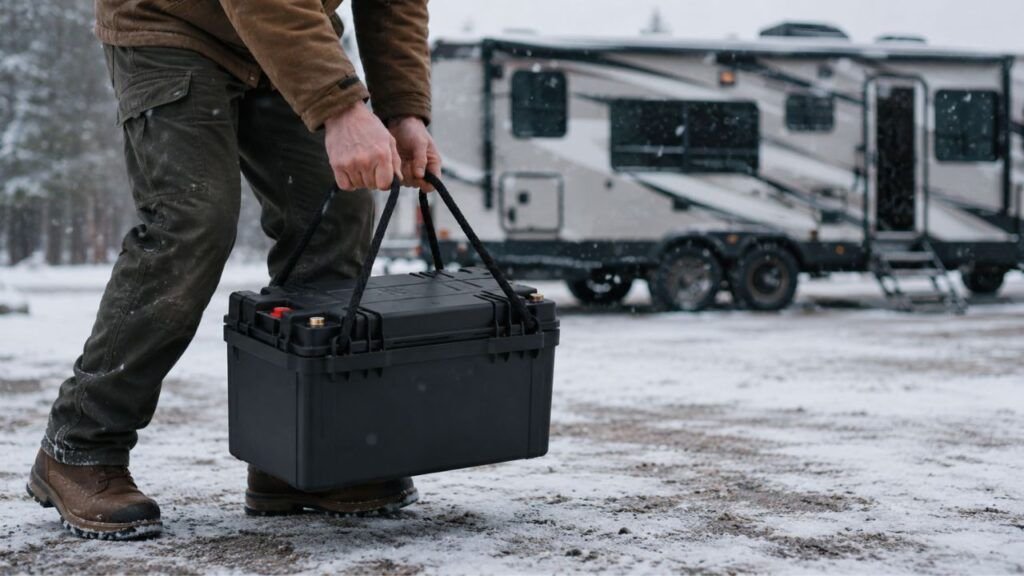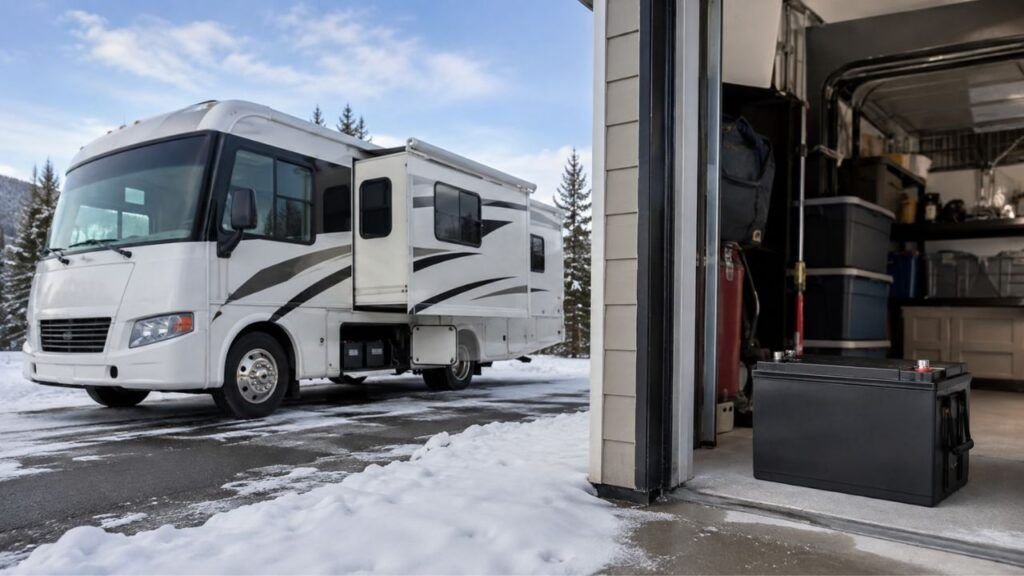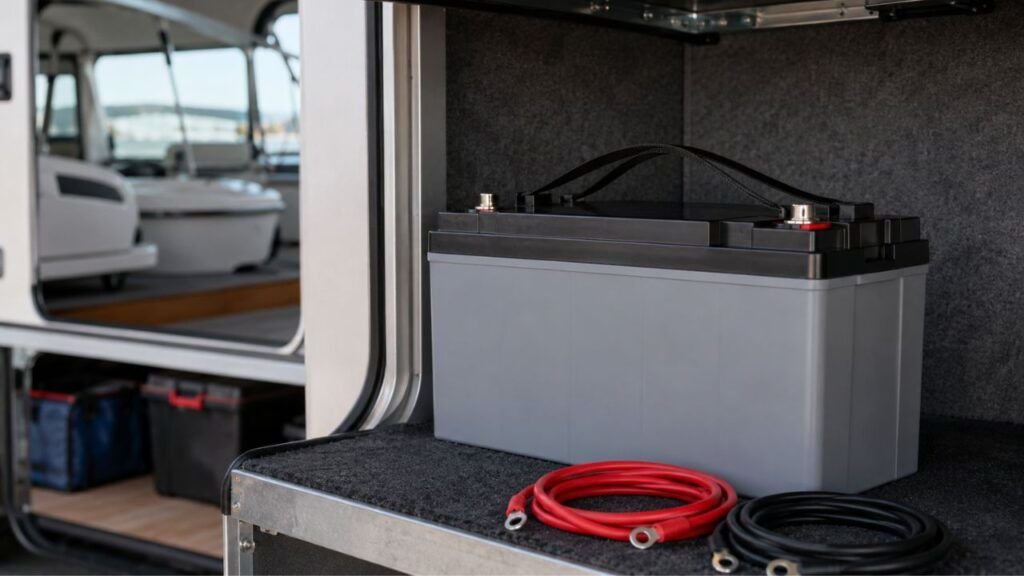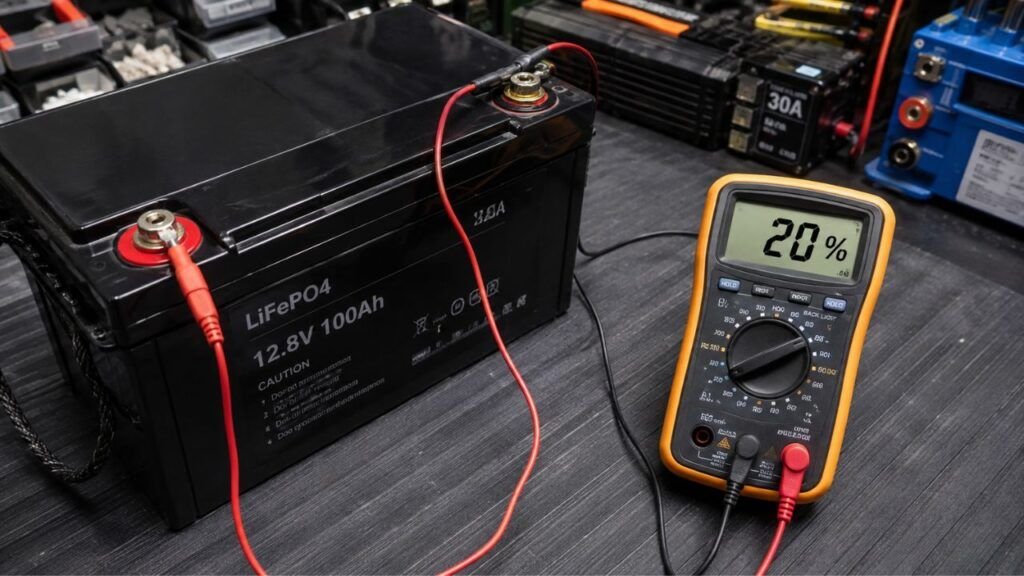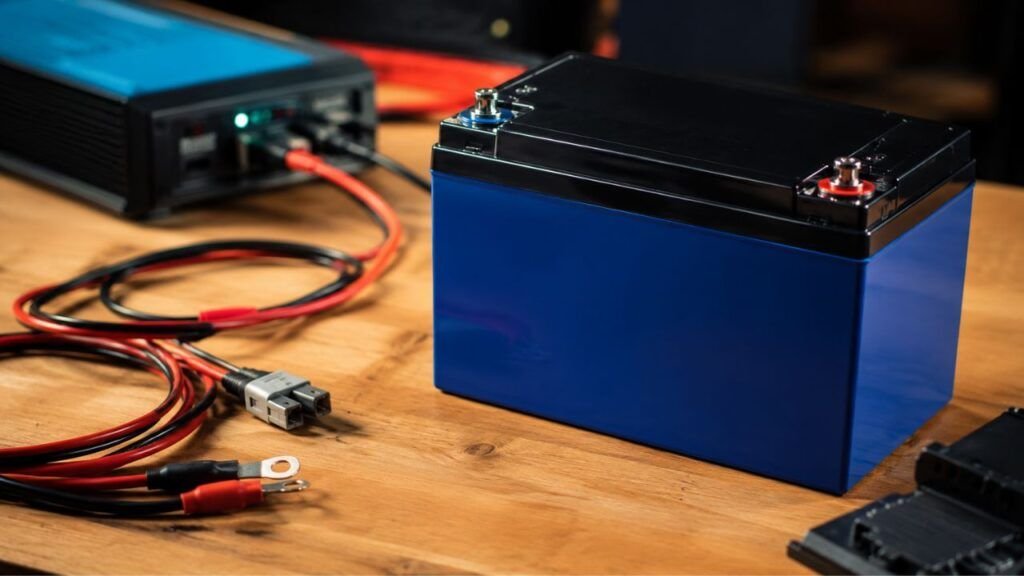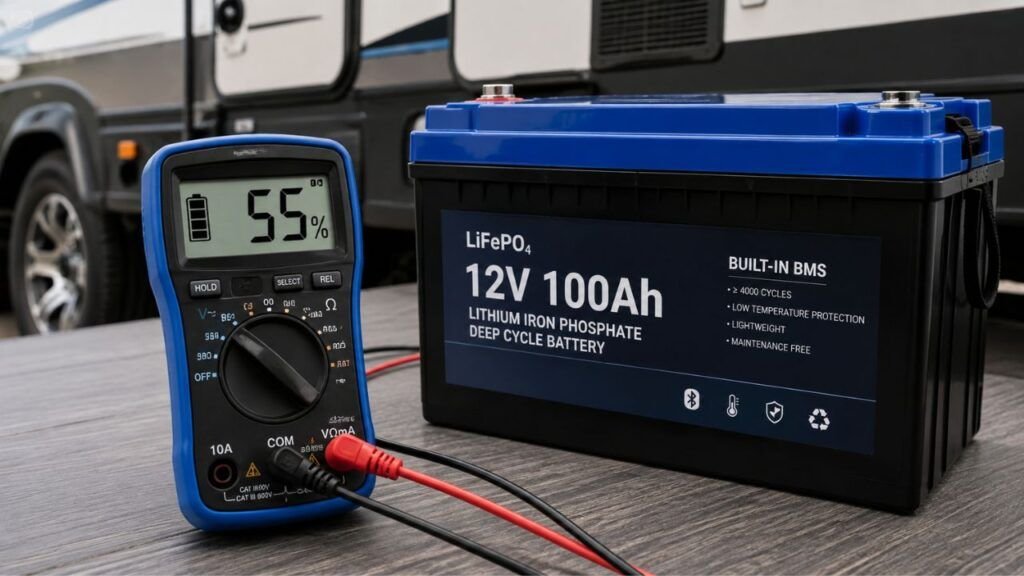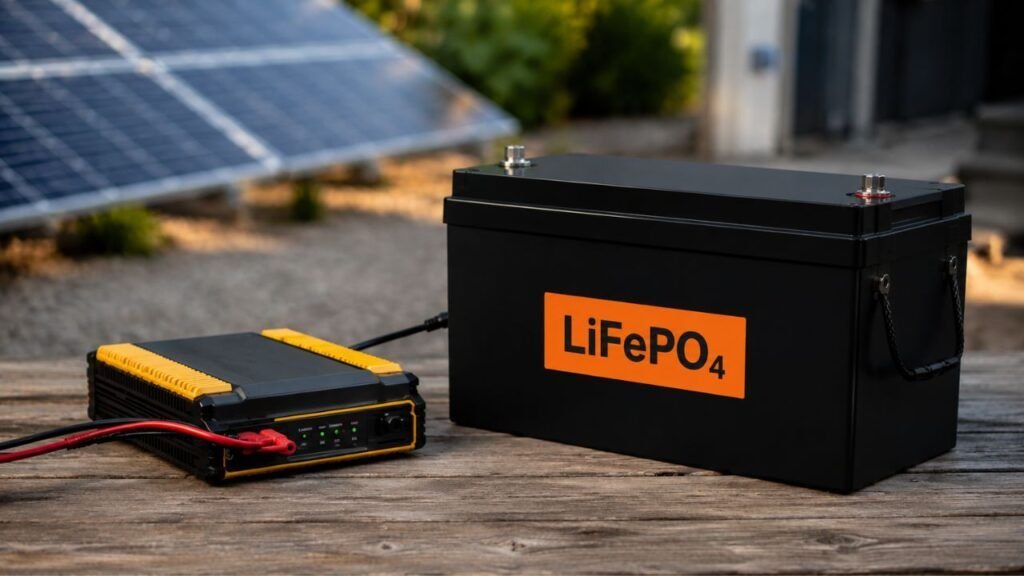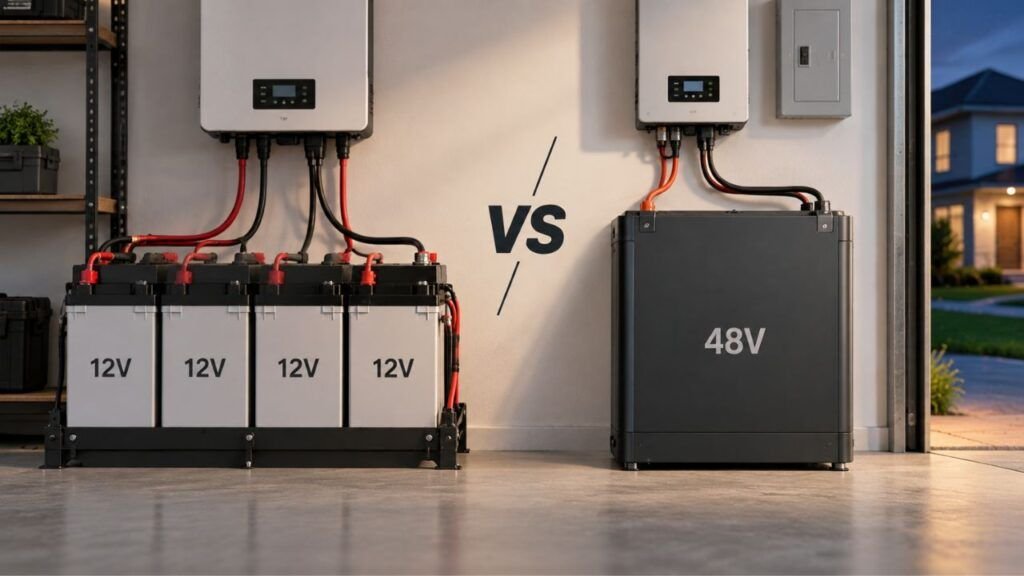
A lithium battery may stop charging in cold weather because its Battery Management System, or BMS, detects that the cells are too cold to charge safely. The BMS then blocks incoming charge current to prevent lithium plating and permanent cell damage. Many LiFePO4 batteries use protection near freezing temperatures, although exact limits vary by battery.
If your battery suddenly refuses solar, shore power, or charger input during winter, that does not automatically mean something has failed. Below, I’ll explain why this happens, how to confirm cold protection is responsible, and how to safely get your battery charging again.
Key Takeaways
- A cold lithium battery may intentionally stop accepting charge.
- The BMS can disable charging while still allowing discharge.
- Around 32°F is common, but it is not universal.
- Internal battery temperature matters more than outside air temperature.
- Charging cold cells can cause harmful lithium plating.
- Self-heating batteries warm themselves before normal charging begins.
- Never bypass low-temperature protection to force a charge.
- Charging usually resumes after the battery safely warms.
Why Does a Lithium Battery Stop Accepting a Charge When It Gets Cold?
Cold temperatures change both lithium battery chemistry and BMS behavior. The charging system may be ready, while the battery intentionally refuses current.
The BMS Detects an Unsafe Battery Temperature
Most modern deep-cycle lithium batteries contain a Battery Management System.
The BMS continuously watches important operating conditions, including:
- Cell voltage
- Battery current
- High temperature
- Low temperature
- Overcharging
- Excessive discharge
- Short-circuit conditions
When internal temperature drops below the battery’s programmed charging limit, the BMS may disable its charging pathway.
That is why your charger can appear completely normal. It may even show charging voltage.
However, little or no current actually enters the battery cells.
In many batteries, only charging gets blocked. You may still power lights, an inverter, RV appliances, or other equipment.
That behavior often confuses people.
The battery works when you use electricity, but refuses electricity when you try putting it back.
That usually points toward low-temperature charge protection rather than a completely dead battery.
Cold Slows Lithium-Ion Movement Inside the Cells
Charging a lithium battery requires lithium ions to move through its electrolyte.
Those ions eventually enter the graphite structure inside the negative electrode.
Warm conditions make this process relatively easy. Colder conditions slow everything down.
As temperature falls:
- Ion movement becomes slower.
- Internal resistance increases.
- Chemical reactions become less efficient.
- Charge acceptance decreases.
- Voltage behavior can become less predictable.
The battery therefore becomes increasingly difficult to charge normally.
Cold operation alone can reduce available performance. Cold charging creates the greater concern.
Lithium Plating Becomes the Bigger Charging Risk
Under normal conditions, lithium ions move into the graphite anode while charging.
They become safely stored within its structure.
When the cells become very cold, this process slows dramatically.
Incoming lithium may arrive faster than the anode can absorb it. Some lithium can then collect on the anode’s surface as metallic lithium.
That process is called lithium plating.
Lithium plating can lead to:
- Permanent capacity loss
- Increasing internal resistance
- Faster battery aging
- Reduced future charging performance
- Greater potential for internal cell damage
Repeated or severe plating can create much larger battery problems.
The low-temperature BMS cutoff exists mainly to prevent this situation.
So when your battery refuses charging, the protection system may actually be protecting your investment.
Does Every Lithium Battery Stop Charging at 32°F?
No. You should not treat 32°F as one universal charging cutoff for every lithium battery.
Many LiFePO4 batteries use a low-temperature charging threshold somewhere around freezing. However, exact limits depend on the battery design.
Several things can change the allowed charging temperature:
- Lithium chemistry
- Individual cell design
- BMS programming
- Charging current
- Battery construction
- Built-in heating
- Manufacturer specifications
One battery may stop charging around 32°F.
Another may stop somewhat earlier.
A different model may require temperatures closer to 40°F before charging becomes available.
Special cold-weather batteries may support charging below freezing using internal heating or another approved charging strategy.
The safest rule is simple.
Follow the minimum charging temperature listed for your specific battery.
Do not assume another brand’s limits apply to yours.
Lithium Battery Charging Behavior at Different Temperatures
A lithium battery can behave very differently as temperatures change. The following table shows what you may notice during common winter conditions.
| Battery Condition | What You May Notice | What the Battery May Do | What You Should Do |
| Comfortably above minimum charging temperature | Charging looks normal | Accepts normal charging current | Charge normally |
| Approaching the cold limit | Charging may slow or behave differently | May limit or eventually block charging | Monitor battery temperature |
| At or below BMS cutoff | Charger works but battery gains little charge | BMS blocks incoming charge current | Allow battery to warm |
| Self-heating battery is cold | Charger runs but SOC barely rises | Incoming power may operate heaters first | Let heating complete |
| Battery reaches recovery temperature | Charging suddenly starts again | BMS reconnects charging pathway | Continue monitoring |
| Extremely cold conditions | Lower output and greater voltage sag | Some batteries may also restrict discharge | Follow manufacturer limits |
These are general behavior patterns rather than universal temperature specifications.
Your battery manual should always determine the actual temperature limits.
Why Can a Lithium Battery Discharge in the Cold but Not Charge?
This is one of the strangest things you may notice during winter.
Your lithium battery might still run your equipment perfectly well. Then your charger connects and nothing happens.
Charging and discharging involve different electrochemical conditions inside the cells.
The main lithium-plating concern happens while lithium ions are moving toward and entering the graphite anode during charging.
That means charging usually requires a narrower temperature range.
Discharging can often continue at significantly colder temperatures.
For example, an RV battery might still operate:
- Interior lights
- Water pumps
- Furnace blowers
- 12-volt refrigerators
- Small inverter loads
But the same battery might refuse power coming from:
- Solar panels
- Shore power
- A converter charger
- A generator
- A DC-to-DC charger
- An alternator charging system
So don’t assume that a battery accepting loads must also be warm enough for charging.
Those are two separate operating conditions.
Why Doesn’t Charging Restart Immediately Above 32°F?
You may expect charging to restart the moment temperatures reach 33°F.
Sometimes it does not.
One reason is something called temperature hysteresis.
A BMS may use one temperature for stopping charge and another temperature for allowing charge again.
For example, imagine a battery stops charging around freezing.
Instead of reconnecting immediately after gaining one degree, the system may wait until the cells warm several additional degrees.
This prevents repeated switching like this:
Charge on.
Charge off.
Charge on.
Charge off.
Without a recovery gap, small temperature fluctuations could cause constant cycling around the cutoff point.
There is another important reason charging may remain blocked.
The weather temperature and actual battery temperature are not necessarily equal.
Your weather app might show 36°F while the battery cells remain below freezing.
Large batteries can take considerable time to warm internally.
That is especially true after sitting outside overnight.
Battery Temperature vs. Outside Temperature: Which One Matters?
The temperature that matters most is the battery’s internal temperature.
Your BMS does not usually make charging decisions using the local weather report.
It relies on temperature sensors located within the battery system.
That can create several situations that seem confusing.
Imagine your RV battery sits inside an insulated compartment.
Outside temperature falls to 25°F overnight.
The insulated battery may remain warmer than freezing for several hours. Charging could continue normally.
Now consider the opposite situation.
The morning temperature rises from 25°F to 38°F.
Your battery stayed outside all night and became thoroughly cold.
Even though the air has warmed, its internal cells might still remain below the charging threshold.
Charging may therefore remain disabled.
Battery temperature can be influenced by:
- Battery size
- Installation location
- Insulation
- Wind exposure
- Previous charging
- Previous discharging
- Nearby heat sources
- Enclosure ventilation
- Length of cold exposure
When troubleshooting winter charging problems, check the battery itself whenever possible.
How Can I Tell If Low-Temperature Protection Is Why My Battery Won’t Charge?
Cold protection is common, but it should not become your automatic diagnosis. A few checks can help separate a normal cold cutoff from another charging problem.
Check the Battery or BMS App
Bluetooth lithium batteries make this much easier.
Open the manufacturer’s monitoring app and look at the reported battery temperature.
You may also see messages such as:
- Low temperature
- Charge disabled
- Charge protection
- Low-temperature protection
- Charge MOS off
- Charging prohibited
The wording varies between manufacturers.
If the battery shows a low-temperature warning, you have a strong clue.
Check the Actual Battery Temperature
If your battery does not have Bluetooth, check its physical temperature.
A thermometer attached near the battery can provide a useful estimate.
However, remember that surface temperature may differ from internal cell temperature.
A very large battery can remain cold inside even after the outer case begins warming.
Whenever possible, trust the battery’s own temperature sensor.
See Whether the Battery Still Powers Loads
Try a normal, reasonable load if conditions allow.
If the battery still powers equipment but refuses charging, cold-charge protection becomes more likely.
This does not prove the diagnosis.
However, it helps distinguish low-temperature charging protection from complete BMS shutdown.
Check the Charger and Charging Source
Make sure the charging source actually works.
Verify things like:
- Charger input power
- Charger output voltage
- Correct lithium charging profile
- Breakers
- Fuses
- Battery cables
- Terminal tightness
- Solar controller operation
A failed charger can look surprisingly similar to BMS charge protection.
Check for Other BMS Protection Modes
Temperature is only one reason a lithium battery stops charging.
Other possibilities include:
- High cell voltage
- Overvoltage protection
- Excessive charging current
- High-temperature protection
- Very low battery voltage
- BMS sleep mode
- Faulty temperature sensor
- Communication problems
If warming the battery does not restore charging, investigate these possibilities next.
What Should You Do When a Lithium Battery Stops Charging From the Cold?
When cold protection activates, your goal is not forcing more electricity into the battery. Your goal is safely getting the cells back inside their approved charging range.
- Stop trying to force charging: Repeatedly reconnecting chargers will not solve an active cold-temperature cutoff.
- Confirm the battery is actually cold: Check the BMS app, battery monitor, temperature sensor, or battery compartment.
- Confirm the charger itself is working: Make sure voltage is available and no fuse has failed.
- Allow the battery to warm gradually: Use a safe location or approved heating method.
- Wait for the battery’s recovery temperature: Do not assume reaching exactly 32°F guarantees charging.
- Reconnect or restart charging when allowed: Many modern systems automatically resume without intervention.
- Watch the first charging cycle: Check current, voltage, temperature, and BMS status.
Most importantly, never bypass the BMS simply because it stopped charging.
That protection exists because the cells are outside their approved charging conditions.
How Can You Safely Warm a Lithium Battery Before Charging?
Warming the battery safely is usually the simplest solution. You want slow, controlled heat rather than intense localized heating.
You can:
- Move a removable battery into a warmer location.
- Use a manufacturer-approved battery heating pad.
- Install batteries inside an insulated compartment.
- Use a thermostatically controlled battery heater.
- Allow a self-heating battery to complete its warming cycle.
- Reduce direct exposure to winter wind.
- Charge during warmer parts of the day when practical.
Avoid using improvised high-heat methods.
Do not use:
- Open flames
- Torches
- Heat guns pointed directly at the battery
- Uncontrolled heating elements
- Space heaters pressed against the battery case
Heating one section rapidly can create uneven internal temperatures.
Gentle, controlled warming is a much better approach.
How Do Self-Heating Lithium Batteries Charge Below Freezing?
Self-heating lithium batteries are designed for systems that regularly face cold charging conditions. Instead of simply waiting for warmer weather, they use integrated heaters to raise cell temperature.
Where Does the Heating Power Come From?
Many self-heating designs use incoming charging power.
For example, your solar controller or shore charger supplies electricity.
Instead of immediately charging the cells, the battery directs some incoming power toward internal heating elements.
Those heaters warm the battery.
Once the cells reach an acceptable temperature, normal charging starts.
Exact operation depends on the battery design.
Why Doesn’t the Battery Percentage Increase Immediately?
This can be confusing the first time you see it.
You connect the charger.
The charger appears active.
However, the battery’s state of charge barely changes.
That can happen because the incoming power is warming the battery rather than charging the cells.
In other words:
Power entering the battery system does not always mean power immediately entering the cells.
If you have a self-heating model, check its manual before assuming something failed.
When Does Normal Charging Begin?
Normal charging begins after the battery reaches its programmed safe temperature.
The BMS then allows charging current into the cells.
From your perspective, the charging current may suddenly increase.
That transition is normal for many heated battery designs.
Why Solar Charging Causes This Problem So Often in Winter
Solar battery systems create a perfect situation for cold-temperature protection. The charging source can wake up before the battery warms enough to accept energy.
Consider a typical winter morning.
Your lithium battery sits outside overnight.
Temperatures drop well below freezing.
At sunrise, your solar panels immediately begin producing electricity.
The solar charge controller wakes up.
However, the battery remains extremely cold.
The BMS detects the cell temperature and refuses charging.
You might look at your system and think the solar panels stopped working.
Then two hours later, charging suddenly begins.
Nothing necessarily changed with the solar equipment.
The sun warmed the surroundings and eventually warmed the battery.
Once the cells reached their recovery temperature, the BMS allowed charging again.
This is why winter solar troubleshooting should include battery temperature.
Panel voltage alone does not tell you whether the battery can accept charge.
Why an RV or Boat Lithium Battery May Stop Charging Overnight
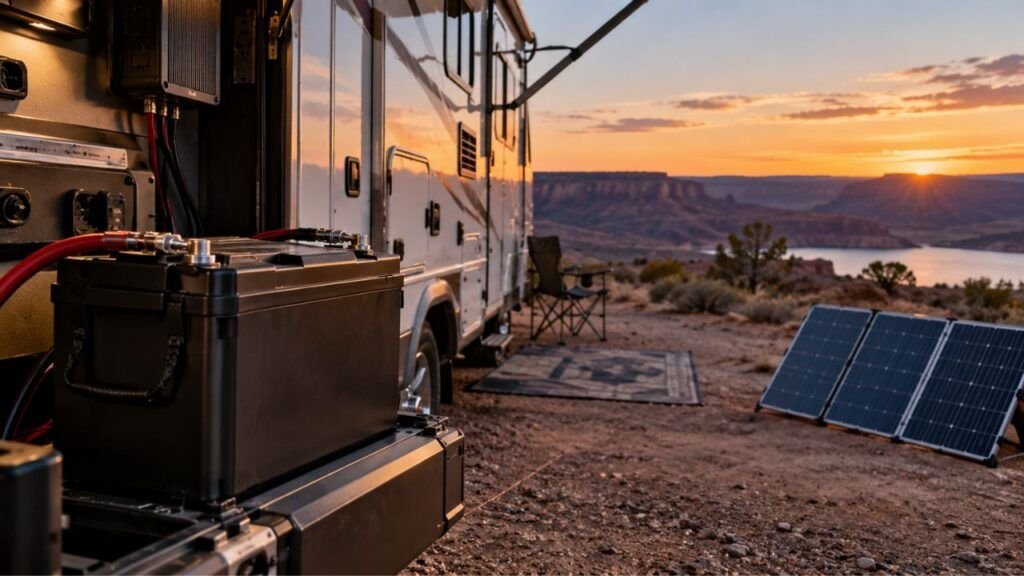
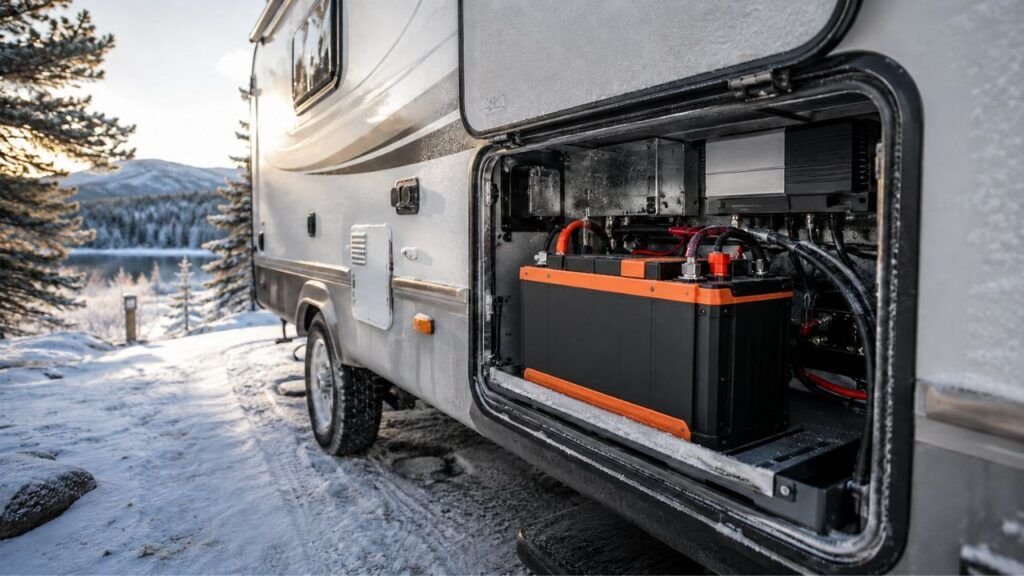
RV and marine systems are especially vulnerable because batteries often sit inside exterior compartments. Different charging sources can experience the same cold BMS cutoff.
Shore Power or Generator Charging
Your RV interior might feel comfortably warm.
However, the battery compartment underneath the RV could remain below freezing.
When you connect shore power, the converter charger starts normally.
The lithium battery may still refuse the charge.
Always think about battery location rather than cabin temperature.
Alternator or DC-to-DC Charging
Cold morning departures create another common problem.
You start the vehicle and expect alternator charging immediately.
However, the lithium house battery has been sitting cold overnight.
Its BMS may block charging until the cells warm.
A properly designed DC-to-DC system should respect the battery’s charging limits.
Solar Charging
Solar charging often begins during the coldest part of the morning.
That makes low-temperature protection especially noticeable.
The controller may show available solar power while battery charging remains limited.
Marine Battery Compartments
Boat batteries can remain cold for long periods.
Cold air, cold water, and unheated compartments all contribute.
A sunny afternoon does not necessarily mean the battery warmed quickly.
That matters especially when charging trolling motor or house batteries.
What Happens in a Multi-Battery Bank When One Battery Gets Too Cold?
Multi-battery systems can behave differently depending on how the bank is wired.
In a series battery bank, all batteries form one electrical chain.
If one battery’s BMS opens its charging pathway, charging for the entire series string may be interrupted.
Parallel banks work differently.
One cold battery may disconnect while another warmer battery continues accepting charge, depending on battery design and communication.
That can change current distribution within the bank.
You do not want to assume every battery will behave identically.
Check:
- Individual battery temperatures
- Individual BMS status
- Current distribution
- Manufacturer series/parallel limits
- Communication requirements
This becomes especially important in 24V, 36V, and 48V systems.
Does a Cold-Temperature BMS Cutoff Mean the Battery Is Damaged?
Usually, no.
A low-temperature cutoff normally means the battery’s protection system detected conditions that could become harmful.
The BMS then stopped charging before the cells were exposed to unnecessary risk.
Think about it this way:
Cold protection activating is not the damage.
It is the system trying to prevent damage.
You should become more concerned when:
- The battery has no low-temperature charging protection.
- Someone bypassed the BMS.
- Charging continued below approved temperatures.
- The wrong charging system was used.
- The battery repeatedly received high charging current while extremely cold.
If your battery warms normally and then resumes charging without faults, the cutoff itself is generally not a reason for panic.
Can Charging a Lithium Battery Below Freezing Permanently Damage It?
Yes, charging lithium cells below their approved temperature can cause permanent damage. How serious the risk becomes depends on the battery and charging conditions.
Possible consequences include:
- Lithium plating
- Permanent capacity loss
- Higher internal resistance
- Faster battery degradation
- Reduced cycle life
- Poorer future charging performance
- Potential internal damage in severe cases
However, avoid thinking of freezing as one magical temperature line.
Battery damage does not instantly occur because the thermometer passes from 33°F to 31°F.
Risk also depends on:
- Charging current
- Battery chemistry
- Cell temperature
- State of charge
- Cell construction
- Battery manufacturer specifications
This is another reason the battery’s manual matters.
A battery specifically engineered for cold charging may behave differently from a standard LiFePO4 battery.
Low-Temperature Cutoff vs. Self-Heating Battery: What’s the Difference?
Both features protect lithium batteries during winter, but they solve the problem differently.
Low-Temperature Cutoff Battery
- Detects unsafe charging temperatures.
- Stops incoming charging current.
- Protects the cells from cold charging.
- Does not automatically create heat.
- Waits until the battery warms sufficiently.
Self-Heating Battery
- Detects cold cell temperatures.
- Activates internal heating elements.
- Warms the cells before charging.
- Automatically transitions into normal charging.
- Works better for frequent winter charging.
A battery with low-temperature cutoff prevents unsafe charging.
A self-heating battery can actively help restore safe charging conditions.
How Can You Prevent Your Lithium Battery From Stopping Charge Every Winter?
If cold charging happens regularly, prevention is easier than repeated troubleshooting.
Consider these steps:
- Keep batteries inside protected compartments when possible.
- Insulate external battery boxes appropriately.
- Use approved thermostatically controlled heating pads.
- Choose self-heating batteries for frequent winter use.
- Monitor battery temperature through the BMS.
- Charge during warmer daytime periods when practical.
- Use compatible lithium charging equipment.
- Check temperature specifications before winter arrives.
- Protect batteries from direct wind exposure.
- Inspect battery heaters before freezing weather starts.
- Confirm every battery in a larger bank remains within limits.
Do not focus only on outside temperature.
Design your winter setup around actual cell temperature.
When Is a Heated Lithium Battery Worth Considering?
A heated lithium battery makes the most sense when freezing temperatures regularly interfere with charging.
Winter RV travelers are a good example.
If your RV battery sits in an exterior compartment, you may frequently wake up with solar or alternator charging blocked.
Heated batteries can also make sense for:
- Camper vans
- Boats
- Trolling motors
- Ice-fishing equipment
- Off-grid cabins
- Remote solar installations
- Outdoor backup systems
- Equipment stored in cold garages
You probably need heating less often when batteries stay inside conditioned spaces.
For occasional cold exposure, insulation and careful charging schedules may be enough.
For routine winter use, integrated heating can make the system much easier to manage.
Final Words
A lithium battery that stops charging on a freezing morning is not necessarily failing. In many cases, its BMS has deliberately blocked charging because the cells are too cold.
That protection matters because cold charging can promote lithium plating and permanent degradation. The right response is not forcing more current into the battery.
Check the battery temperature and BMS status first. Let the cells warm above the manufacturer’s recovery temperature, then allow charging to restart normally.
If winter charging is a regular part of your RV, marine, solar, or backup-power setup, consider insulation, controlled heating, or a self-heating battery. Those changes can prevent the same charging interruption every cold morning.
Related FAQs
Why Won’t My LiFePO4 Battery Charge Below 32°F?
Many LiFePO4 batteries have low-temperature BMS protection that blocks charging near freezing. This prevents harmful lithium plating. However, the exact cutoff differs by model, so check your battery’s specified minimum charging temperature.
Will a Lithium Battery Start Charging Again When It Warms Up?
Usually, yes. A battery with low-temperature protection normally allows charging again after its internal cells reach the programmed recovery temperature. Some batteries restart automatically, while others may require the charger to reconnect or begin another charging cycle.
Can I Use a Lithium Battery When the Temperature Is Below Freezing?
Many lithium batteries can still discharge below freezing even when charging is blocked. Available capacity and power may decrease as temperatures fall. Always stay within the manufacturer’s specified discharge temperature range.
Can I Charge a Lithium Battery at 30°F?
Do not assume 30°F is safe for every battery. Many standard LiFePO4 batteries restrict charging around this temperature. Some specialized batteries allow colder charging through heating or approved protocols. Follow the charging temperature listed by your battery manufacturer.
At What Temperature Does a Lithium Battery BMS Stop Charging?
Many LiFePO4 batteries stop accepting charge near freezing temperatures, but no universal cutoff applies. Some models use different shutdown and recovery temperatures. Check the specifications for your exact battery.
Why Does My Battery Show Voltage but Accept No Charging Current?
A charger can provide voltage while the battery’s BMS blocks charging current. Low-temperature protection is one possible cause. High voltage, another BMS fault, charger problems, or loose connections can produce similar symptoms.
Why Is My Lithium Battery Charging Slowly in Cold Weather?
Cold temperatures increase internal resistance and slow lithium-ion movement. Some systems also reduce charging current as temperatures approach the battery’s minimum charging limit. A self-heating battery may initially use incoming power for heating.
Can I Charge a Cold Lithium Battery With Solar Panels?
Solar panels can provide charging power, but the battery may still refuse it when cells are too cold. The BMS determines whether charging is allowed. Solar availability does not override the battery’s temperature protection.
How Long Does a Lithium Battery Need to Warm Before Charging?
There is no fixed warming time. Battery size, starting temperature, insulation, heating method, and recovery threshold all matter. Charging should begin when the internal battery temperature reaches the manufacturer’s approved range, not after an arbitrary number of minutes.
Can a Heated LiFePO4 Battery Charge Below Freezing?
Many heated LiFePO4 batteries are designed for this situation. Incoming power first runs internal heaters, which warm the cells. Normal charging begins after the battery reaches its programmed safe charging temperature.
Is Low-Temperature Protection the Same as a Dead Battery?
No. Low-temperature protection is normally temporary. The battery’s BMS blocks charging because conditions are unsafe. After the cells warm sufficiently, charging should become available again unless another problem exists.
Does Cold Weather Permanently Damage LiFePO4 Batteries?
Cold exposure itself does not automatically ruin a LiFePO4 battery. The greater concern is charging cells outside their approved low-temperature range. Proper BMS protection, heating, and winter storage practices help prevent permanent damage.
Can I Keep a Lithium Battery in an Unheated RV or Garage?
Often you can, provided the battery remains within its specified storage range. However, charging may need to stop when temperatures become too low. Protect the battery from moisture, extreme temperatures, and unintended charging during freezing conditions.
Should I Insulate My Lithium Battery in Winter?
Insulation can slow heat loss and help the battery remain above its charging cutoff longer. However, insulation cannot warm a battery that has already become deeply cold. Frequent winter charging may require controlled heating or a self-heating battery.

Ryan Carter writes practical battery guides focused on troubleshooting, everyday use, and smarter buying decisions. His experience with lithium batteries, RV and automotive power, and home backup systems helps readers choose reliable solutions with confidence.