
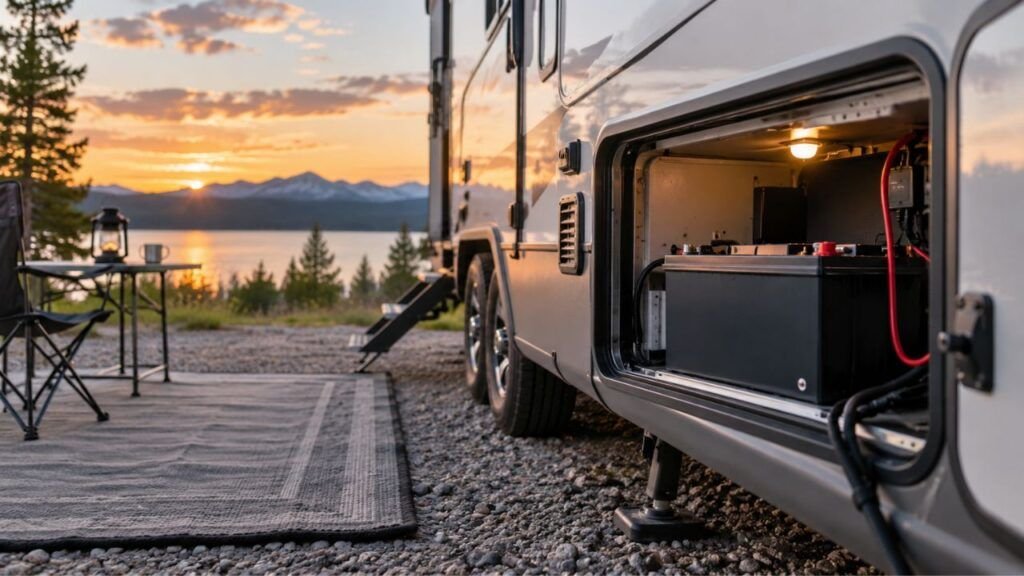
Yes, you can usually leave an RV lithium battery connected between short camping trips. If your RV will sit for only a few days or a couple of weeks, leaving a healthy LiFePO4 battery connected is normally fine as long as you control parasitic loads and use lithium-compatible charging equipment.
The answer changes when your RV sits longer, has unknown power drains, stays connected to shore power or solar, or faces freezing temperatures. I’ll walk you through each situation so you can decide whether leaving the battery connected actually makes sense for your RV.
Key Takeaways
- You normally do not need to disconnect an RV lithium battery between closely spaced trips.
- Parasitic loads can slowly drain a connected battery even when the RV seems turned off.
- Leaving the battery connected is different from continuously charging it.
- Turn the inverter off during storage unless you specifically need it running.
- Shore power and solar chargers should use settings suitable for LiFePO4 batteries.
- Your RV battery disconnect switch may not shut off every electrical load.
- Longer storage usually calls for greater battery isolation.
- Follow your battery manufacturer’s instructions for long-term storage charge level.
Can You Leave an RV Lithium Battery Connected Between Camping Trips?
For most RV owners, leaving a lithium house battery connected for several days or a couple of weeks is not a problem. LiFePO4 batteries have low self-discharge, and they tolerate sitting unused much better than traditional flooded lead-acid batteries.
However, your battery itself is only part of the equation.
The bigger issue is everything still connected to it.
Your propane detector, stereo memory, control boards, monitoring systems, USB outlets, inverter, and other electronics may continue drawing small amounts of current.
That means a battery can lose charge even when you haven’t intentionally turned anything on.
It also helps to separate three terms that RV owners often treat as the same thing.
A battery installed in the RV simply means you haven’t removed it.
A battery connected to the RV means electrical circuits can still draw power from it.
A battery being charged means shore power, solar, a converter, or another charging source is actively supplying energy.
You can therefore leave the battery installed while isolating it from most RV loads. You can also leave it connected without keeping it continuously on a charger.
For short breaks between camping trips, leaving it connected is generally the easiest approach.
For longer storage, complete or near-complete isolation becomes more worthwhile.
How Long Can an RV Lithium Battery Stay Connected Between Trips?
There is no exact number of days when leaving a lithium battery connected suddenly becomes unsafe. Your RV’s standby power consumption matters much more than the calendar.
| Time Until Your Next Trip | Leave Battery Connected? | Charging Situation | Practical Approach |
| A few days | Usually yes | Charging optional | Turn unnecessary loads off |
| 1–2 weeks | Usually yes | Solar or shore charging can help | Watch state of charge |
| 2–4 weeks | Depends on your RV | Parasitic draw becomes more important | Disconnect if your RV drains noticeably |
| 1 month or longer | Usually better isolated | Follow battery instructions | Shut down loads and prepare for storage |
| Seasonal storage | Usually isolate | Manufacturer guidance matters most | Follow the battery’s long-term storage procedure |
These timeframes are practical guidelines rather than strict battery limits.
An RV drawing almost no standby current may sit connected for several weeks without trouble. Another RV with an inverter, monitoring equipment, detectors, and control electronics could lose significant energy over the same period.
That is why checking your actual battery percentage gives you better information than relying only on a storage timeline.
Why Does an RV Lithium Battery Lose Charge While Sitting?
A lithium battery has a relatively low natural self-discharge rate, but your RV can still consume electricity while parked. Understanding those hidden loads makes it much easier to decide whether you should disconnect the battery.
Parasitic Loads Keep Drawing Power
Parasitic loads are small electrical draws that continue after you think everything has been turned off.
Common examples can include:
- Propane detectors
- Carbon monoxide detectors
- Stereo memory
- Control boards
- Tank monitoring systems
- USB outlets with indicator lights
- Digital clocks
- Leveling system electronics
- Wireless battery monitors
- Refrigerator control circuits
Each individual device may use very little electricity.
The problem appears when several devices draw power continuously for days or weeks.
A 200Ah battery may easily handle a small standby load for a weekend. The same load becomes more meaningful when the RV sits unattended for a month.
Your Inverter May Use Power Even With Nothing Plugged In
One of the first things I would check before storing your RV is the inverter.
An inverter converts battery DC power into 120-volt AC power. It usually consumes some electricity just by remaining switched on.
That consumption is called idle or standby draw.
You might have every household appliance turned off and still lose battery capacity because the inverter itself remains active.
Unless you need AC power while the RV is parked, turning the inverter off is usually a simple way to reduce storage drain.
Some Devices May Bypass the Battery Disconnect Switch
Your battery disconnect switch is useful, but don’t automatically assume it turns off absolutely everything.
RV manufacturers sometimes wire safety equipment or charging circuits directly to the battery.
Depending on your RV, certain detectors, solar equipment, emergency systems, or other circuits may stay energized even after you use the main disconnect.
If your battery percentage keeps dropping while the disconnect is off, something may still be drawing current.
Your RV wiring diagram or owner’s manual can help identify those circuits.
The Battery and Monitoring Electronics Use Small Amounts of Energy
The battery management system inside a lithium battery also needs a small amount of power.
Bluetooth battery monitors and external shunts may consume a little electricity as well.
These loads are normally tiny.
Still, tiny loads matter when the battery remains unattended for months rather than days.
The main goal isn’t to eliminate every microscopic power draw. It is to make sure the combined drain cannot pull the battery dangerously low before you return.
When Is It Fine to Leave an RV Lithium Battery Connected?
Leaving your battery connected is usually the simplest choice when your next trip is coming soon and your electrical system is behaving normally.
It generally makes sense to leave it connected when:
- Your next trip is within a few days or weeks.
- The battery still has plenty of charge.
- You have turned the inverter off.
- Unnecessary 12-volt appliances are switched off.
- Your RV does not have excessive parasitic drain.
- Your solar controller uses proper lithium settings.
- Your converter or charger is compatible with LiFePO4 batteries.
- Battery temperatures remain within its operating limits.
- You can check the battery state of charge before leaving again.
I would not disconnect a healthy lithium battery every time I returned from a weekend trip unless I had a specific reason.
The extra step often provides little benefit when the RV will be used again shortly.
When Should You Disconnect an RV Lithium Battery Between Trips?
Disconnecting becomes more useful as storage gets longer or the condition of the electrical system becomes less predictable.
I would seriously consider isolating the battery when:
- The RV may sit unused for a month or longer.
- You are unsure when your next trip will happen.
- Your battery noticeably loses charge while parked.
- No reliable charging source is available.
- The inverter or another large standby load remains active.
- Your charging equipment is not confirmed lithium-compatible.
- You are performing electrical maintenance.
- Cold weather could allow charging outside the battery’s temperature limits.
- Your battery manufacturer specifically recommends disconnection during storage.
The key idea is simple.
You are not disconnecting the battery because LiFePO4 chemistry suddenly becomes dangerous after several weeks.
You are disconnecting it to remove unnecessary loads and reduce the chance of an unattended battery being drained too far.
What If the RV Stays Plugged Into Shore Power Between Trips?
Keeping an RV connected to shore power can make between-trip battery management easier, but only when the charging system is appropriate for your lithium battery.
A Lithium-Compatible Converter Can Change the Answer
When your RV is connected to shore power, the converter normally changes 120-volt AC electricity into 12-volt DC power.
It can also recharge your house battery.
Many newer replacement converters include a dedicated lithium or LiFePO4 charging profile.
If yours does, leaving the battery connected between short trips is generally straightforward.
The converter can supply your RV’s 12-volt needs while maintaining the battery.
An Older Converter May Not Be Ideal for Lithium
Do not assume an older RV automatically has the correct charging profile.
Some older converters were designed around flooded lead-acid or AGM batteries.
That does not necessarily mean they will instantly damage a lithium battery. However, their charging voltage and charging behavior may not match what your battery manufacturer recommends.
Check the converter model number and look for:
- LiFePO4 compatibility
- Lithium charging mode
- Recommended charging voltage
- Automatic charging stages
- Manufacturer-approved battery types
If you cannot confirm compatibility, I would solve that issue before leaving the RV plugged in unattended for extended periods.
Should the Battery Disconnect Be On While Plugged Into Shore Power?
In many RVs, the battery disconnect needs to remain on for the converter to charge the battery.
But RV wiring layouts are not universal.
Some systems charge even with certain disconnect switches off. Others isolate the battery completely.
The easiest approach is to check your RV manual and verify what happens to battery voltage when shore power is connected.
If the voltage rises into the charger’s normal charging range, the converter is reaching the battery.
Can Solar Stay Connected to an RV Lithium Battery Between Trips?
Solar can work very well for maintaining an RV lithium battery between trips. Still, it should be treated as a charging system rather than a guarantee that your battery can never run low.
Solar Can Offset Parasitic Loads
If your RV sits outside with good sunlight, solar production can replace electricity consumed by small standby loads.
That can make leaving the battery connected much more practical.
However, solar output changes constantly.
Your panels may produce less energy because of:
- Heavy cloud cover
- Tree shade
- Covered storage
- Snow
- Dirt on the panels
- Short winter days
- Poor panel angle
That is why I wouldn’t rely on solar blindly.
Check your battery monitor occasionally and make sure the system is actually maintaining charge.
The Solar Charge Controller Must Have Suitable Lithium Settings
Your solar panels do not charge the battery directly.
The solar charge controller manages the voltage and current reaching the battery.
Make sure the controller has a LiFePO4 profile or settings that match your battery manufacturer’s specifications.
If the controller is configured for the wrong battery chemistry, leaving solar connected indefinitely may not be the best approach.
Turning Off the RV Battery Disconnect May Not Disconnect Solar
Solar wiring can bypass the RV’s main battery disconnect.
Your solar controller may therefore remain connected even after you switch the RV to storage mode.
Some systems also include a separate solar disconnect or fuse.
If you’re preparing your RV for long-term storage, confirm how your particular solar system is wired.
Don’t assume one switch isolates every charging source.
Does the Lithium Battery’s BMS Make It Safe to Leave Connected?
A battery management system provides an important layer of protection, but it should not be your entire storage strategy.
A typical LiFePO4 BMS may protect against conditions such as:
- Excessive charging voltage
- Excessive discharge
- Overcurrent
- Short circuits
- High temperature
- Low-temperature charging on supported models
If something goes outside the battery’s safe operating range, the BMS can disconnect the cells.
That protection is valuable.
However, I would treat the BMS as a backup rather than intentionally allowing the battery to drain until protection activates.
A better approach is to manage standby loads before they become a problem.
Your battery should ideally still have a healthy state of charge when you return to the RV rather than sitting in BMS shutdown for weeks.
Should an RV Lithium Battery Be Stored at 50%, 60%, 80%, or 100%?
There is no single storage percentage that applies perfectly to every RV lithium battery.
You will often see advice recommending 50%, 60%, or another specific state of charge for LiFePO4 storage.
Those numbers can be useful general guidance, but your battery manufacturer’s recommendation should come first.
Some manufacturers prefer partial charge during long-term storage.
Others recommend fully charging their batteries before disconnecting them for the off-season.
That difference is why I would not deliberately discharge a perfectly healthy battery to exactly 50% just because you will not use the RV for two weeks.
For short breaks, concentrate on shutting off unnecessary loads.
For seasonal storage, check your battery manual for:
- Recommended storage state of charge
- Storage temperature range
- Inspection intervals
- Whether the battery should be disconnected
- Whether periodic charging is required
Following the instructions for your exact battery gives you a much better answer than relying on a universal percentage.
What About Leaving the Battery Connected in Freezing Weather?
Cold weather deserves extra attention because storing a lithium battery in the cold and charging one in the cold are not the same thing.
Cold Storage and Cold Charging Are Different
Many LiFePO4 batteries can sit unused or provide discharge power at temperatures below freezing.
Charging is where the bigger concern appears.
Charging lithium cells below their approved temperature can cause permanent internal damage.
This matters if your RV has solar panels.
A cold battery may sit outside overnight and then receive solar charging as soon as the sun comes up.
If the battery has not warmed above its approved charging temperature, that can create a problem.
Check the Battery’s Exact Low-Temperature Charging Limit
You will often hear 32°F used as the universal lithium charging cutoff.
It is a useful general reference, but different batteries can have different limits.
Some manufacturers specify a charging limit above freezing.
Others use built-in BMS protection that stops charging at low temperatures.
Check your exact battery specifications instead of relying only on one temperature you found online.
Low-Temperature Cutoff or Heating Helps, but Verify the System
Some RV lithium batteries include automatic low-temperature charging protection.
Others include internal heaters.
A heated battery can be especially helpful for winter camping because it can warm the cells before allowing normal charging.
Still, make sure you understand what your battery actually does.
Do not assume every BMS includes cold-charge protection unless the manufacturer specifically says it does.
How to Leave Your RV Lithium Battery Connected Safely Between Trips
If you’re camping again soon, you don’t need to make battery storage complicated. A short routine before leaving the RV can prevent most problems.
- Check the battery state of charge. Make sure you aren’t parking the RV with an already depleted battery.
- Turn the inverter off. Unless you need AC power while stored, eliminate its standby consumption.
- Shut off unnecessary 12-volt loads. Turn off lights, fans, entertainment equipment, and other equipment you don’t need.
- Confirm your charging equipment is lithium-compatible. Check the converter and solar controller settings.
- Consider the weather. Make sure charging will not occur outside the battery’s approved temperature range.
- Understand your disconnect switch. Know which loads remain powered when it is switched off.
- Check the battery before your next trip. If the battery lost far more charge than expected, investigate the cause before simply recharging it.
Doing this once or twice will also help you learn how much energy your particular RV consumes while parked.
How to Disconnect an RV Lithium Battery for Longer Storage
When you’re parking the RV for a month or an entire season, a more complete shutdown can reduce unnecessary battery drain and make storage easier to manage.
Use the RV Battery Disconnect for Normal Isolation
Start with the RV’s battery disconnect switch if your system has one.
This usually removes power from most house circuits.
It is convenient because you don’t have to remove cables whenever the RV sits unused.
However, remember that some circuits may bypass the switch.
Use the Battery’s Power Switch or Full Isolation When Required
Some lithium batteries have their own physical on/off button.
Using that switch may shut down the battery more completely than the RV’s house disconnect.
Other manufacturers may recommend physically isolating the battery during long-term storage.
Follow the procedure supplied with your particular battery rather than assuming every lithium battery should be handled the same way.
Turn Charging Sources and Loads Off Before Disconnecting
Before fully isolating the battery, account for every major power path.
That may include:
- Shore power
- Solar charging
- Inverter/charger
- Generator charging
- Alternator or DC-to-DC charging
- Major 12-volt loads
The goal is to leave the battery in the storage condition recommended by its manufacturer without an unexpected charger or appliance remaining connected.
Battery Disconnect Switch vs Completely Disconnecting the Battery
Using the RV battery disconnect switch and completely disconnecting the battery are not necessarily the same thing.
The RV disconnect usually removes battery power from most house circuits.
Complete isolation means the battery is no longer supplying meaningful outside loads and is not receiving charging current from external equipment unless specifically required.
That difference matters during long-term storage.
If your battery continues losing charge even when the RV disconnect is off, check whether equipment bypasses that switch.
You may need to isolate another circuit, turn the battery itself off, remove a fuse, or follow another manufacturer-approved storage procedure.
For a weekend between trips, that level of isolation is rarely necessary.
For winter storage, it can be worthwhile.
Signs You Should Not Leave Your Lithium Battery Connected Unattended
Most healthy RV lithium systems can sit connected without drama. However, certain warning signs tell you that leaving everything connected deserves another look.
Watch for:
- Battery percentage dropping quickly over several days
- The battery reaching low-voltage protection during storage
- The inverter remaining on unexpectedly
- Unusual charger cycling
- Battery or charger becoming unusually warm
- No confirmed lithium mode on the converter
- Uncertain solar-controller settings
- Frequent BMS shutdowns
- Battery temperatures approaching prohibited charging conditions
If you notice one of these signs, don’t simply recharge the battery and ignore it.
Find out why the battery is losing energy or why the charging system is behaving unexpectedly.
Fixing that cause will make every future storage period easier.
A Simple Between-Trip Routine for Most RV Owners
If you’re camping again next weekend, keep things simple.
Turn off the inverter, shut down unnecessary loads, check the battery percentage, and leave the lithium battery connected if everything looks normal.
If your next trip is two or three weeks away, you can often follow the same routine. Just pay closer attention to parasitic drain.
If the RV will sit for a month or longer, I would start treating it as storage rather than a short break between trips.
At that point, follow your battery manufacturer’s storage instructions and isolate unnecessary loads.
For seasonal storage, I would rely on the battery manual rather than generic advice about exact charge percentages.
That approach keeps the battery protected without making routine RV ownership more complicated than it needs to be.
Final Verdict
Yes, you can normally leave an RV lithium battery connected between camping trips when those trips are reasonably close together.
You do not need to disconnect a healthy LiFePO4 battery every time you park your RV for a week or two.
What matters more is what remains connected to that battery.
Parasitic loads, inverter standby consumption, solar charging, converter compatibility, battery temperature, and storage duration all influence the right choice.
My simple rule is this: for short breaks, manage the loads; for long storage, isolate the battery according to its manufacturer’s instructions.
That gives you the convenience of leaving your RV ready for the next trip without unnecessarily draining or stressing the battery.
Related FAQs
Should I Disconnect My RV Lithium Battery When Not in Use?
You usually do not need to disconnect an RV lithium battery when the RV will only sit for a few days or weeks. For longer storage, disconnecting helps prevent parasitic loads from slowly draining the battery.
Should the RV Battery Disconnect Be On or Off Between Trips?
For short breaks, leaving the disconnect on is generally fine if your standby loads are small. For longer storage, turning it off can reduce battery drain, although some RV circuits may remain powered.
Should the Battery Disconnect Be On When Plugged Into Shore Power?
In many RVs, the battery disconnect must be on for the converter to charge the battery from shore power. Wiring varies, so check your RV manual or verify that battery voltage rises when shore power is connected.
How Long Can an RV Lithium Battery Sit Without Charging?
A properly stored LiFePO4 battery can sit for a long time because its self-discharge rate is low. However, connected RV electronics can drain it much faster, so storage time depends heavily on parasitic loads.
Will an RV Lithium Battery Drain With the Disconnect Switch Off?
It can. Certain safety devices, solar equipment, monitoring systems, or other circuits may bypass the main disconnect. The battery’s BMS and Bluetooth electronics can also consume a small amount of power.
Can I Leave Solar Connected to My RV Lithium Battery?
Yes, properly configured solar can remain connected and help offset standby loads. Make sure the charge controller uses settings suitable for your battery and provides appropriate low-temperature charging protection.
Does a Lithium Battery Need a Trickle Charger Between Camping Trips?
Usually not. LiFePO4 batteries have low self-discharge and generally do not require the same continuous trickle charging approach associated with some lead-acid batteries. Use a charger specifically approved for lithium if charging is needed.
Is It Bad to Leave an RV Lithium Battery at 100%?
Leaving a lithium battery fully charged for a short period is normally not a concern. For storage lasting months, follow the battery manufacturer’s recommended state of charge rather than assuming 100% or 50% is always correct.
Can an RV Lithium Battery Stay Connected All Winter?
It can physically remain installed, but winter storage needs more planning. Long-term parasitic loads should be eliminated, and the battery must not be charged below its manufacturer’s approved charging temperature.
Can a Lithium Battery Remain in an RV Below Freezing?
Many LiFePO4 batteries can remain stored or supply power below freezing, but their charging limits may be much warmer. Always check the temperature specifications for your exact battery.
Does the BMS Stop an RV Lithium Battery From Going Completely Dead?
A BMS can disconnect the battery when voltage becomes too low, but you should not rely on that as your normal storage strategy. Prevent excessive discharge by controlling parasitic loads before the BMS needs to intervene.
Should I Turn My RV Inverter Off Between Camping Trips?
Yes, in most cases. An inverter can consume battery power even when no AC appliances are operating, so turning it off between trips is one of the easiest ways to reduce unnecessary battery drain.

Ryan Carter writes practical battery guides focused on troubleshooting, everyday use, and smarter buying decisions. His experience with lithium batteries, RV and automotive power, and home backup systems helps readers choose reliable solutions with confidence.















