
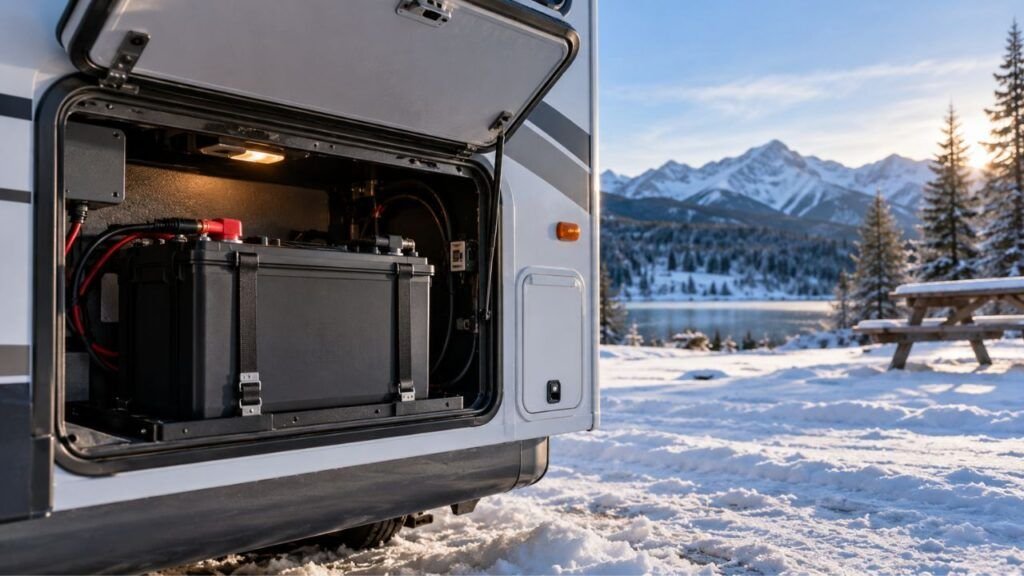
Yes, a heated lithium battery is worth it for an RV if you regularly camp below freezing and your battery sits in an exterior or unheated compartment. The heating system helps the battery reach a safe temperature before charging, which can keep solar, generator, shore power, and alternator charging available during cold weather.
If your battery stays warm inside the RV, you may not need heating at all. Below, I’ll help you decide whether the added cost makes sense based on your camping habits, battery location, charging setup, and winter temperatures.
Key Takeaways
- Heated lithium batteries mainly solve a cold-charging problem.
- Many LiFePO4 batteries can still discharge below freezing.
- Low-temperature protection does not mean the battery can heat itself.
- Exterior battery installations benefit most from self-heating.
- Winter solar charging may be delayed while the battery warms.
- Heated batteries cost more and consume some energy for warming.
- Fair-weather RVers often do not need the heating feature.
- Always follow your battery manufacturer’s temperature limits.
Why Freezing Temperatures Matter to an RV Lithium Battery
Cold weather does not affect every battery function in the same way. The biggest issue with LiFePO4 batteries usually appears when you try to recharge cells that are below their safe charging temperature.
Charging a Cold Lithium Battery Is the Main Concern
Most RV lithium batteries use lithium iron phosphate, commonly called LiFePO4.
These batteries handle cold weather fairly well while supplying power. Charging them when the cells are too cold is different.
When a lithium battery receives charging current at very low temperatures, lithium can deposit on parts of the cells where it should not. This process may permanently reduce capacity and shorten battery life.
That is why many modern RV lithium batteries include low-temperature charging protection.
The protection usually stops incoming charging current when internal cell temperatures fall below the manufacturer’s limit.
You might still have plenty of energy inside the battery. Your solar panels or converter simply cannot recharge it until the cells warm again.
Discharging Below Freezing Is Different
A cold lithium battery does not necessarily stop powering your RV.
Many LiFePO4 batteries can continue discharging below 32°F. Some are rated for discharge at temperatures well below freezing.
That means your furnace blower, lights, water pump, refrigerator controls, and other 12-volt equipment may continue operating overnight.
The battery’s exact discharge limit depends on its design.
So, do not assume that a temperature below freezing automatically means your lithium battery becomes useless.
Charging and discharging have different temperature limits.
What Low-Temperature BMS Protection Actually Does
The battery management system, or BMS, watches several operating conditions inside the battery.
Temperature is one of them.
If the cells become too cold, a low-temperature cutoff can block charging current before damage occurs.
That is valuable protection, but it does not solve the charging problem.
A regular lithium battery with cold protection may simply sit there waiting for warmer temperatures.
A self-heating battery takes things one step further.
Instead of only blocking the charge, it can warm the cells until charging becomes safe again.
The simplest way to remember the difference is this:
Low-temperature cutoff protects the battery. Self-heating helps restore charging.
How Does a Heated RV Lithium Battery Work?
A heated lithium battery combines temperature monitoring, BMS protection, and internal heating elements. The exact process varies between brands, but the basic idea is straightforward.
Temperature Sensors Detect Cold Cells
Temperature sensors inside the battery monitor cell conditions.
When the battery becomes too cold for normal charging, the BMS prevents charging current from reaching the cells.
The battery then waits for safe conditions or activates its heating system.
This is much safer than relying on the outdoor temperature shown on your phone.
The temperature inside the battery case can differ noticeably from outside air temperature.
The Heater Warms the Battery Before Charging
In many self-heating designs, the charging sequence works something like this:
- Your charger begins supplying power.
- The battery detects that its cells are too cold.
- Normal charging to the cells remains blocked.
- Incoming power is directed toward heating elements.
- The battery slowly warms to its recovery temperature.
- The BMS allows normal charging to begin.
You normally do not have to disconnect cables or manually warm the battery.
That convenience is one of the biggest advantages of buying a heated model.
Charger-Powered vs. Battery-Powered Heating
Not every self-heating lithium battery gets its heating energy the same way.
Some batteries use incoming charger power.
For example, solar, shore power, or generator charging may first operate the heater. Once the cells are warm enough, the remaining incoming power can recharge them.
Other designs can use stored battery energy for heating.
A few batteries provide more than one heating mode.
This difference matters.
A heater powered only by incoming charge cannot do much if no meaningful charging power is available.
A battery-powered heater offers more flexibility but can reduce your remaining state of charge.
Always check how the specific battery handles heating before buying it.
Is a Heated Lithium Battery Worth It for Your RV?
Whether heating is worth paying for depends less on the word “winter” and more on what actually happens around your battery. Think about its location, overnight temperature, and whether you need immediate charging the next morning.
Yes, If You Regularly Camp Below Freezing
A heated battery makes strong sense for regular winter camping.
Think ski trips, hunting trips, mountain camping, ice fishing weekends, or extended stays in northern states.
You may wake up after a night below freezing with partially discharged batteries.
Your furnace may have run for hours.
Your refrigerator, lights, detectors, and other equipment also consumed energy.
Now you need to put that power back.
A heated battery can make that process far easier because it can prepare itself for charging without waiting for the weather to warm.
Yes, If Your Battery Is in an Exterior Compartment
Battery location is one of the biggest factors I would consider.
A battery mounted inside your heated RV might rarely experience freezing cell temperatures.
A battery mounted outside can be completely different.
Cold-prone locations include:
- Trailer tongue battery boxes
- Exterior storage compartments
- Unheated basement compartments
- Truck camper battery boxes
- Underfloor van installations
- Exterior utility compartments
These areas may stay below freezing long after your RV’s interior becomes comfortable.
If your batteries live in one of these locations, heating becomes much more useful.
Yes, If You Depend on Automatic Morning Charging
Imagine camping overnight in temperatures around 20°F.
Your battery runs the furnace and other loads throughout the night.
At sunrise, your solar panels begin producing power.
With a non-heated battery, the BMS may reject that charging current because the cells remain too cold.
You technically have charging power available, but the battery cannot accept it yet.
A heated battery can use available energy to warm the cells first.
Once the internal temperature reaches the safe range, normal charging begins.
The same principle applies to generator, shore power, and alternator charging.
Probably Not, If Your Battery Stays Above Freezing
You may not gain much from self-heating if your battery remains inside a warm part of the RV.
Many RVers install lithium batteries:
- Under the bed
- Beneath a dinette
- Inside a cabinet
- Within a heated basement
- Inside another protected compartment
If your battery cells consistently remain above their minimum charging temperature, the heater may rarely activate.
You would be paying for a feature you barely use.
Probably Not, If You Only RV in Mild Weather
A heated battery is also difficult to justify for fair-weather camping.
If your trips happen mostly from late spring through early fall, freezing battery temperatures may never become a problem.
In that situation, a good lithium battery with proper BMS protection can make more financial sense.
Spend the extra money where it improves your system more.
That could mean additional battery capacity, solar panels, a better charger, or improved battery monitoring.
Heated vs. Non-Heated RV Lithium Battery
A useful comparison needs three categories, not just heated versus standard. Many lithium batteries include low-temperature charging protection without including any actual heating system.
| Feature | Heated LiFePO4 Battery | LiFePO4 With Low-Temp Cutoff | Basic LiFePO4 Battery |
| Blocks unsafe cold charging | Yes | Yes | Depends on model |
| Warms itself | Yes | No | No |
| Can restore cold-weather charging automatically | Usually | After natural warming | Depends on setup |
| Heater consumes energy | Yes | No | No |
| Winter convenience | High | Moderate | Low |
| Upfront cost | Usually highest | Moderate | Usually lower |
| Best battery location | Exterior or unheated areas | Protected compartments | Warm installations |
| Best for | Regular winter RVing | Occasional cold weather | Mild-weather camping |
For most RV owners, the middle option is worth considering.
A battery with low-temperature cutoff provides important protection without adding heating cost.
If you only experience occasional freezes, that may be enough.
How Much Power Does a Heated Lithium Battery Use?
Self-heating requires energy, so the feature is not completely free.
Heating power varies between battery models. Battery capacity, heater design, insulation, and outside temperature can all influence consumption.
If the heater uses incoming charger power, some charging energy goes toward warming before it reaches the cells.
That means your battery’s state of charge may not increase immediately.
If the battery heats itself using stored energy, your available capacity can temporarily decrease.
Warm-up time also changes with temperature.
A slightly cold battery may warm reasonably quickly. A battery that has spent hours in severe cold may need considerably longer.
Insulation can help here.
Insulation does not produce heat, but it slows heat loss. That allows an internal heater to warm the battery more efficiently.
This is why I would not compare heated batteries using heater wattage alone.
Look at the complete cold-weather system.
Can RV Solar Panels Charge a Heated Lithium Battery in Freezing Weather?
Yes, solar panels can charge a heated lithium battery during freezing weather, provided your system produces enough usable charging power.
There is an important catch.
A heated battery cannot create energy from nothing.
Imagine waking up before sunrise after an extremely cold night.
Your battery is cold and partially discharged.
As sunlight increases, the panels begin producing a small amount of current.
Depending on the battery design, that incoming current may first be used for heating.
Only after the cells become warm enough does normal battery charging begin.
Weak winter solar can make this process slower.
Several factors can reduce solar production:
- Shorter winter days
- Low sun angle
- Heavy clouds
- Snow covering the panels
- Shading from nearby trees
- Limited roof-mounted panel capacity
Some self-heating batteries may also require a minimum charging current before the heater activates properly.
That specification is worth checking if you rely heavily on solar while boondocking.
A heated battery helps cold-weather solar charging, but adequate solar production still matters.
Does a Heated Battery Help With Alternator, Shore Power, and Generator Charging?
Self-heating can benefit more than solar. Any charging source may encounter the same problem when the battery itself remains colder than its allowed charging temperature.
Shore Power
Shore power can be one of the easiest charging situations for a heated battery.
Your RV converter or lithium charger can provide steady energy.
The battery can use that incoming power for heating if necessary.
Once the cells warm sufficiently, normal charging can continue.
Just make sure your converter or charger is compatible with LiFePO4 batteries.
Generator Charging
A generator can also work well with heated lithium batteries.
However, do not assume your battery will immediately start gaining charge.
Some generator output may first operate the battery heater.
That means the initial part of your generator run could mainly be warming the cells.
After heating finishes, normal charging can begin.
Knowing this can prevent unnecessary troubleshooting.
Alternator or DC-to-DC Charging
Cold-weather travelers may start driving early while their battery compartment remains frozen.
A regular lithium battery with low-temperature cutoff may reject alternator charging until its cells warm.
A self-heating battery can help prepare itself for charging while power becomes available.
This can be especially valuable for camper vans and motorhomes that depend heavily on DC-to-DC charging while driving.
Battery Location May Matter More Than Outside Temperature
Two RVers camping in the same 20°F weather may have completely different battery temperatures. Before buying a heated model, look closely at where your battery actually lives.
Battery Inside the Heated RV
An interior battery normally benefits from the heat already keeping you comfortable.
Even if outside temperatures fall below freezing overnight, the battery may remain well above its cold-charging limit.
Batteries also have thermal mass.
Their internal temperature does not instantly match every change in outdoor air temperature.
For many interior installations, a heater provides little additional value.
Battery in an Exterior Storage Bay
Exterior bays are harder to predict.
Some receive warmth from nearby plumbing, furnace ducts, or the heated living space.
Others become almost as cold as outside air.
A cheap temperature sensor inside the compartment can tell you much more than guessing.
Monitor the bay during your normal winter camping conditions.
If the compartment regularly falls below your battery’s charging range, heating becomes much easier to justify.
Battery on the Trailer Tongue or Under the RV
Exposed battery installations are the strongest case for self-heating.
A tongue box or underbody compartment receives much less warmth from the RV.
Cold air can surround the battery for hours.
Wind exposure can also increase heat loss.
In these situations, the battery may remain too cold for charging well into the morning.
The main lesson is simple:
Pay attention to the temperature around your battery, not only the weather forecast.
When You Can Skip a Heated RV Lithium Battery
You do not need to pay extra for self-heating simply because freezing weather exists somewhere you might travel. A standard lithium battery may work perfectly well when your actual setup keeps the cells warm enough.
You can probably skip the heater when:
- Your battery stays inside the heated RV.
- Your battery compartment remains above its charging limit.
- You mainly camp during spring, summer, and fall.
- Freezing temperatures are rare and short-lived.
- You can wait until temperatures rise before charging.
- You already use a safe external heating system.
- You do not charge the battery during freezing storage.
- Winter camping is not part of your normal travel style.
If you’re unsure, measure your actual compartment temperature first.
That small step can save you from buying a feature you never use.
Heated Lithium Battery vs. External Battery Heater
You do not necessarily need a new battery to gain cold-weather heating. External heating can work in some RV installations, but it requires more careful setup than an integrated self-heating battery.
Built-In Self-Heating Battery
The biggest benefit of built-in heating is convenience.
The manufacturer integrates the sensors, heater, wiring, and battery management logic.
The battery knows when its cells are cold.
It can then manage heating according to its programmed operating limits.
This reduces the amount of custom wiring and temperature control you must design yourself.
The downside is higher purchase cost.
External Heating Pad or Battery Blanket
An external heating pad may cost less than replacing an otherwise healthy lithium battery.
This approach can make sense when you already own a quality non-heated battery.
However, the installation needs proper control.
You need to consider:
- Heater voltage
- Thermostat settings
- Fuse protection
- Wiring size
- Sensor placement
- Maximum battery temperature
- Manufacturer recommendations
Avoid applying uncontrolled heat directly to a lithium battery.
A poorly managed heater can create a different problem while trying to solve the cold one.
Battery Insulation
Insulation is another useful tool, but it cannot replace heat by itself.
Insulation slows down temperature changes.
A warm battery inside an insulated compartment may remain above freezing longer overnight.
Insulation can also reduce how much energy a heating system needs.
For cold-weather RVing, insulation and controlled heating often work better together.
What to Check Before Buying a Heated Lithium Battery for Your RV
The word “heated” on the product label does not tell you enough. Check the actual operating specifications so you know how the battery behaves in your RV.
Look for:
- Low-temperature charging cutoff
- Heater activation temperature
- Charging recovery temperature
- Rated charging temperature range
- Rated discharge temperature range
- Heater power consumption
- Heater current draw
- Whether heating uses charger power
- Whether heating can use battery power
- Minimum incoming charging current
- Estimated heating time
- Manual heater control options
- Bluetooth temperature monitoring
- BMS continuous discharge rating
- Series or parallel connection limitations
- Lithium charger compatibility
- Solar controller compatibility
- DC-to-DC charger compatibility
- Battery dimensions
- Terminal orientation
- Water and dust protection
- Warranty coverage
- Manufacturer installation instructions
- Relevant battery transportation and safety certifications
I would pay especially close attention to heating activation behavior.
Two batteries with the same 100Ah capacity can handle heating very differently.
Do not assume one manufacturer’s specifications apply to another battery.
Is Low-Temperature Cutoff Enough Without Self-Heating?
For many RV owners, yes.
Low-temperature cutoff can be enough when freezing temperatures happen occasionally and you do not need immediate charging.
Suppose your battery becomes too cold overnight.
The BMS blocks morning charging.
A few hours later, sunshine or RV heat warms the compartment naturally.
The battery then reaches its recovery temperature and accepts charging again.
If that delay does not inconvenience you, self-heating may offer little extra value.
The situation changes when you depend on charging every morning.
Boondockers often need solar charging as soon as possible.
Winter travelers may need alternator charging immediately after starting their drive.
In those situations, waiting for natural warming becomes much less convenient.
Low-temperature protection keeps the battery safe. Self-heating helps keep your charging system available.
Should You Leave the Battery Heater Running During RV Winter Storage?
Usually, you should not think of self-heating as something that must continuously warm a stored lithium battery all winter.
Cold storage and cold charging are different situations.
A properly stored lithium battery does not necessarily need to remain warm simply because outdoor temperatures fall below freezing.
The important concern is whether the battery is being charged outside its approved temperature range.
Heater behavior also differs by manufacturer.
Some systems only activate when charging power becomes available.
Others can use stored battery energy under certain conditions.
If your battery can heat itself while stored, unnecessary heating may gradually reduce its state of charge.
For long-term winter storage, follow the battery manufacturer’s recommendations for:
- Storage temperature
- Storage state of charge
- Disconnecting loads
- Heater settings
- Charging intervals
Do not leave the heater active simply because the battery has one.
A Simple Way to Decide Whether You Need One
If you still feel unsure, use your actual RV habits instead of focusing only on technical specifications.
Buy a Heated Lithium Battery If:
- Your battery regularly gets below freezing.
- It sits outside the heated RV interior.
- You winter camp frequently.
- You depend on morning solar charging.
- You recharge from a generator in freezing weather.
- You depend on alternator charging while driving.
- You want cold charging to recover automatically.
- Waiting several hours for natural warming would cause problems.
A Standard Lithium Battery Is Probably Enough If:
- Your battery stays above freezing.
- It is mounted inside the heated RV.
- You mostly camp during warmer months.
- Freezing nights happen only occasionally.
- You can delay charging until temperatures rise.
- You already have controlled battery heating.
- Cold-weather camping is rare for you.
The goal is not to buy the battery with the longest feature list.
The goal is to buy the battery that solves the problems your RV actually has.
Final Verdict
A heated lithium battery is worth it for an RV when freezing temperatures would otherwise prevent you from charging when you need power.
Winter boondockers, ski campers, cold-climate travelers, and RVers with exterior battery installations usually gain the most from self-heating. The feature can make solar, generator, shore power, and alternator charging much easier to manage during freezing weather.
If your battery stays inside a warm compartment or you mainly travel in mild weather, a heated model may simply add cost without providing much benefit.
Before deciding, look at three things: your actual battery temperature, where the battery is installed, and when you need to recharge it. Those answers will tell you far more than the weather forecast alone.
Related FAQs
Do I Need a Heated Lithium Battery for My RV?
You need one mainly if your lithium battery regularly drops below its safe charging temperature and you still need to recharge it. If your battery remains inside a heated or well-protected compartment, a standard LiFePO4 battery with low-temperature protection may be enough.
Can You Charge an RV Lithium Battery Below 32°F?
You should not assume every LiFePO4 battery can safely charge below 32°F. Many restrict charging around freezing, although exact limits vary by manufacturer. A heated model can warm its cells before allowing normal charging.
Can a Lithium RV Battery Discharge Below Freezing?
Many LiFePO4 RV batteries can discharge below freezing within their specified temperature range. Cold discharge and cold charging have different limits, so always check the manufacturer’s ratings for your specific battery.
Is Low-Temperature Cutoff the Same as Self-Heating?
No. Low-temperature cutoff blocks unsafe charging when the battery becomes too cold. Self-heating actively warms the battery so it can eventually begin charging again without waiting entirely for natural warming.
Does a Heated Lithium Battery Drain Itself?
It can, depending on how the heating system receives power. Some heaters use incoming charger energy, while others can use stored battery capacity. Check the battery specifications to understand how its heating system operates.
Can Solar Panels Activate a Heated Lithium Battery?
Yes, they often can if the solar charging system supplies enough usable current. Some of the incoming solar power may first operate the heater before normal battery charging begins.
How Long Does a Heated Lithium Battery Take to Warm Up?
Warm-up time varies by battery design, heater power, battery size, insulation, and starting temperature. A slightly cold battery may warm quickly, while a deeply chilled battery can require much longer before charging begins.
Can I Add a Heater to a Regular RV Lithium Battery?
You can use an external heating pad or battery blanket with some installations, but it needs proper thermostat control, wiring, fusing, and temperature monitoring. Always check the battery manufacturer’s recommendations before adding external heat.
Do I Need a Heated Battery If It Is Installed Inside My RV?
Probably not if the battery consistently remains above its minimum charging temperature. Batteries installed beneath beds, dinettes, or within heated compartments often receive enough warmth from the RV interior.
Should I Heat My RV Lithium Battery During Winter Storage?
Not necessarily. A lithium battery usually does not need continuous heating simply because it is stored in cold weather. The bigger concern is preventing unsafe charging while cold and following the manufacturer’s winter storage instructions.

Ryan Carter writes practical battery guides focused on troubleshooting, everyday use, and smarter buying decisions. His experience with lithium batteries, RV and automotive power, and home backup systems helps readers choose reliable solutions with confidence.















