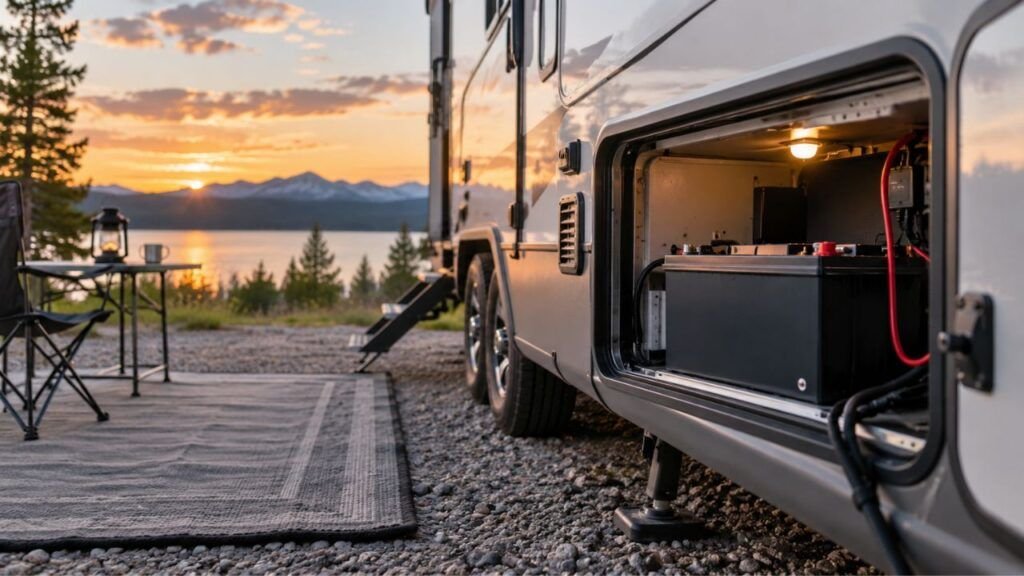
An RV lithium battery usually lasts longer while boondocking because more of its stored capacity remains usable, voltage stays stable during discharge, and less capacity is lost under heavy electrical loads. Lithium batteries also recharge efficiently, helping you recover more power from solar panels, generators, or alternator charging.
If you’re trying to stretch your RV’s battery power between hookups, I’ll walk you through exactly why lithium performs differently. We’ll also look at realistic runtime, heavy appliances, solar charging, cold weather, and ways to make your battery last even longer.
Key Takeaways
- Lithium batteries usually provide more usable energy from the same Ah rating.
- LiFePO4 batteries maintain relatively stable voltage while discharging.
- Lead-acid batteries lose more effective capacity under heavier electrical loads.
- Lithium handles inverter-powered appliances with less voltage sag.
- Faster, efficient charging helps during limited solar or generator charging periods.
- Lithium doesn’t create extra electricity, so daily energy use still matters.
- Cold temperatures and oversized loads can reduce expected lithium runtime.
Why Does an RV Lithium Battery Last Longer While Boondocking?
Lithium batteries generally give you access to more of the energy already stored inside them. That’s the biggest reason they often keep an RV running longer between charges.
A traditional lead-acid battery may have the same advertised amp-hour rating. However, repeatedly draining it deeply can shorten its useful life. Many RV owners therefore recharge lead-acid batteries well before reaching their full rated capacity.
LiFePO4 batteries tolerate deeper discharge much better. Depending on your battery manufacturer’s limits, you can normally use a much larger portion of the stored energy.
Lithium also maintains better voltage while the battery becomes discharged. Your RV equipment can continue receiving useful voltage instead of struggling as the battery approaches empty.
That combination becomes especially noticeable while boondocking because you don’t have unlimited shore power available.
What Does “Last Longer” Actually Mean While Boondocking?
Before comparing batteries, it helps to define what “lasting longer” actually means. People commonly use the term battery life for several different things.
First, there’s runtime per charge. This is how long your battery powers the RV before you need to recharge it.
There’s also total off-grid camping time. Solar panels, alternator charging, or generators can replace some electricity each day. This can keep you boondocking much longer than one battery discharge cycle.
Finally, there’s battery service life. This refers to how many charge cycles or years the battery may last before replacement.
For this article, we’re mainly talking about runtime between charges and your total available off-grid time.
Why Lithium Gives You More Usable Power From the Same Battery Rating
A lithium battery’s advantage isn’t caused by one feature alone. Several characteristics work together to make more stored energy practically available while you’re camping without hookups.
More of the Rated Capacity Is Usable
Suppose you have a 100Ah lithium battery and a 100Ah lead-acid battery.
Both labels say 100Ah, but that doesn’t automatically mean you’ll use them the same way.
Lead-acid batteries generally benefit from shallower discharges if you want to preserve their cycle life. That’s why RV owners commonly avoid repeatedly draining them extremely low.
Lithium iron phosphate batteries tolerate deeper cycling much better. Many allow you to use most of their rated capacity before recharging.
The easiest way to understand this difference is through watt-hours.
Usable battery energy = Battery voltage × Amp-hours × Usable capacity percentage
A 12.8V 100Ah lithium battery stores roughly:
12.8 × 100 = 1,280Wh
If your particular battery allows around 90% usable capacity:
1,280 × 0.90 = 1,152Wh usable
A similarly rated lead-acid battery may be operated much more conservatively.
That’s why two batteries displaying the same 100Ah number can deliver very different practical boondocking runtimes.
Lithium Holds Its Voltage Longer
Lithium batteries have a relatively flat discharge curve.
In simple terms, battery voltage stays fairly consistent through much of the discharge cycle. It then drops more sharply closer to empty.
Lead-acid voltage tends to decline more gradually throughout discharge.
That matters because your RV equipment doesn’t simply care about remaining amp-hours. It also needs adequate voltage.
Stable lithium voltage can help keep:
- LED lighting working normally
- Furnace electronics operating properly
- Water pumps running consistently
- 12V refrigerators operating correctly
- Inverters above their low-voltage shutdown point
This doesn’t mean lithium makes every appliance consume less electricity.
Instead, it means more stored electricity remains practically usable before low battery voltage becomes a problem.
Lithium Loses Less Capacity Under Heavy Loads
Battery capacity isn’t always as simple as the number printed on the label.
Lead-acid batteries can provide less effective capacity when electricity is pulled from them quickly. This behavior is commonly explained through something called the Peukert effect.
You don’t need to memorize the technical formula.
Think of it this way.
If you slowly draw power from a lead-acid battery, you may get closer to its expected capacity. Pull a large amount of current quickly, and the effective available capacity can become smaller.
Lithium batteries are affected much less by this behavior.
That’s especially useful inside modern RVs where inverters may power equipment drawing hundreds or even thousands of watts.
Lower Voltage Sag Helps High-Draw Appliances
Voltage sag happens when battery voltage temporarily drops under a heavy load.
Imagine switching on a 1,200-watt microwave through your inverter.
At around 12 volts, the battery may need to provide roughly 100 amps or more after accounting for inverter losses.
That’s a demanding load.
A lead-acid battery can experience considerable voltage sag under that current. Your inverter may interpret the low voltage as an empty battery and shut down.
That can happen even when some battery capacity technically remains.
LiFePO4 batteries generally hold voltage better under these loads. This can make more stored energy practically available for appliances.
Less Energy Is Lost During Charging
Every battery wastes some energy while being charged and discharged.
Lithium batteries are highly efficient.
A large percentage of the electricity entering the battery can later be used again. That matters when your available charging energy is limited.
Imagine your solar system produces only 1,000Wh during a cloudy day.
You want as much of that electricity as possible stored inside your battery.
Higher charging efficiency helps reduce wasted energy.
The difference may seem small during one charging session. Over several days of boondocking, however, those losses begin adding up.
Lithium Can Accept Charging Faster
Lithium batteries can generally accept substantial charging current through much of their charging cycle.
Lead-acid charging usually slows considerably as the battery approaches full charge.
This difference is important if you’re running a generator.
Suppose you only want to operate your generator for an hour or two.
A lithium-compatible charger may replace a significant amount of used capacity during that limited window.
Solar systems benefit too.
Strong midday sunlight may only last several hours. A battery capable of accepting charging power efficiently can make better use of that window.
Keep one distinction in mind.
Faster charging doesn’t make your battery hold more electricity.
It simply helps you replace the electricity you’ve already used more quickly.
100Ah Lithium vs. 100Ah Lead-Acid for Boondocking
Two batteries can share the same 100Ah rating yet behave very differently inside an off-grid RV. Here’s what usually creates the practical runtime difference.
| Comparison | 100Ah LiFePO4 | 100Ah Lead-Acid |
| Rated capacity | 100Ah | 100Ah |
| Approximate nominal energy | 1,280Wh at 12.8V | 1,200Wh at 12V |
| Practical usable capacity | Usually much higher | Commonly kept shallower |
| Voltage during discharge | Relatively stable | Gradually declines |
| High-current capacity loss | Relatively small | More noticeable |
| Voltage sag | Lower | Higher |
| Inverter performance | Generally stronger | More affected by voltage drop |
| Charging efficiency | High | Lower |
| Charge acceptance | Strong through much of charging | Slows approaching full charge |
| Typical boondocking result | More usable energy | Less practical usable energy |
I wouldn’t automatically assume every lithium battery gives exactly twice the runtime.
Battery construction, temperature, discharge rate, battery age, inverter size, and your manufacturer’s recommended discharge limit all affect real-world performance.
However, equal amp-hour ratings don’t tell the complete story.
Usable watt-hours tell you much more.
Does a 100Ah Lithium Battery Really Last Twice as Long?
A 100Ah lithium battery can approach roughly twice the practical runtime of a similarly rated lead-acid battery in some RV situations, but that’s not a universal rule.
You’ve probably seen claims saying lithium provides 100% usable capacity while lead-acid provides only 50%.
That comparison can be useful for explaining the concept. However, reality is more complicated.
Different lithium batteries have different recommended discharge limits. Lead-acid owners may also occasionally discharge their batteries below 50%.
Then you have additional variables including:
- Temperature
- Battery condition
- Discharge rate
- Inverter efficiency
- Voltage sag
- Appliance startup current
- Battery management system limits
Lithium’s advantage can become particularly noticeable under larger electrical loads.
For light loads, the difference may be less dramatic.
The safer way to plan your trip is by calculating usable watt-hours, rather than simply assuming lithium will always double your camping time.
A Realistic Boondocking Runtime Example
The easiest way to estimate your boondocking time is to compare usable battery energy with daily consumption. Here’s a simplified example showing how the calculation works.
Start With Daily RV Energy Use
Let’s imagine your RV uses the following electricity during one typical day.
| RV Load | Approximate Daily Energy |
| 12V refrigerator | 350Wh |
| LED lights | 80Wh |
| Water pump | 30Wh |
| Roof vent fan | 100Wh |
| Phones and tablets | 60Wh |
| Laptop | 120Wh |
| TV | 100Wh |
| Furnace blower | 120Wh |
| Small standby loads | 90Wh |
| Estimated Daily Total | 1,050Wh |
This isn’t a universal RV power budget.
Some campers may use only 500Wh daily. Others can easily exceed 2,000Wh.
The important part is measuring your own equipment.
Calculate Usable Battery Energy
Suppose your 100Ah LiFePO4 battery stores approximately 1,280Wh.
If you’re planning around 90% usable capacity:
1,280Wh × 0.90 = 1,152Wh
Now compare that with your daily usage.
Divide Usable Energy by Daily Consumption
Using the example above:
1,152Wh ÷ 1,050Wh per day = about 1.1 days
That means one 100Ah lithium battery would provide roughly one day of battery-only power in this example.
A 200Ah battery bank would roughly double that available stored energy.
However, solar charging could completely change the result.
If solar replaces 700Wh during the day, the battery only needs to supply the remaining deficit.
That’s why some RVers can boondock for many days using what appears to be a relatively modest battery bank.
Why High-Power RV Appliances Make Lithium’s Advantage More Noticeable
Lithium’s stable voltage and ability to handle higher current become particularly useful when your inverter powers larger appliances. These loads can expose weaknesses in smaller or older battery banks very quickly.
Microwave and Coffee Maker
A microwave may only run for five minutes.
However, it could demand 1,000 to 1,500 watts during those minutes.
Coffee makers can create similar short, high loads.
At 12 volts, this can require a very large amount of battery current.
Lithium batteries generally handle these temporary loads better than similarly sized lead-acid batteries.
Just remember that short usage doesn’t mean free electricity.
Several high-powered appliances used repeatedly can still drain lithium quickly.
Residential Refrigerator
Residential refrigerators can work well in an RV equipped with sufficient battery capacity and solar power.
However, they continuously cycle throughout the day.
A residential refrigerator usually requires an inverter, which adds its own energy losses and standby consumption.
Lithium batteries handle this combination well because of their consistent voltage.
Still, refrigerator energy consumption must be included in your daily energy budget.
Furnace Blower
Your propane furnace isn’t powered entirely by propane.
Propane creates the heat, but the furnace blower and electronic controls use 12V electricity.
During freezing nights, the blower may cycle frequently.
This can become one of your largest overnight battery loads.
Lithium’s usable capacity can help significantly during cold-weather boondocking.
Air Conditioner and Electric Heater
Here’s where expectations need to remain realistic.
Lithium batteries can supply high-current appliances better than lead-acid batteries.
That doesn’t mean high-powered appliances suddenly become efficient.
A rooftop air conditioner can consume well over 1,000 watts continuously while running.
A typical portable electric heater may draw around 1,500 watts.
Even a large lithium bank can drain quickly under those loads.
If maximum boondocking duration matters, electric resistance heating is usually one of the least battery-friendly choices.
Why Solar Can Make a Lithium Battery Seem to Last Much Longer
Solar panels don’t increase your battery’s actual capacity. Instead, they replace some or all of the electricity you’re consuming while camping.
Several lithium characteristics make this combination particularly effective:
- Lithium batteries can accept substantial charging current.
- Charging losses are relatively low.
- Strong charge acceptance makes good use of midday sunlight.
- Solar can power some RV loads while simultaneously charging.
- Daytime charging can replace electricity used overnight.
- Enough solar can greatly reduce daily battery depletion.
Imagine using 1,000Wh each day.
If your solar system reliably replaces 900Wh, your battery experiences only about a 100Wh daily deficit.
That battery could appear to last for many days.
Now imagine several cloudy days reduce solar production to 200Wh.
Suddenly your battery must supply 800Wh daily.
The same battery bank will drain much faster.
That’s why I recommend separating two ideas when planning.
Battery capacity tells you how much energy you can store.
Solar production tells you how much energy you can replace.
You need both numbers for realistic boondocking planning.
When an RV Lithium Battery May Not Last as Long as You Expected
Lithium is excellent for off-grid camping, but it can’t compensate for unlimited electricity consumption. If your battery seems to drain unusually fast, look for these common causes.
- Your battery bank may simply be undersized.
- Your inverter may stay powered all day.
- Inverter standby consumption may be higher than expected.
- A residential refrigerator may run more frequently.
- Cold weather may increase furnace blower runtime.
- Electric heaters may consume enormous amounts of battery power.
- Your solar panels may be shaded.
- Solar production may be lower during cloudy weather.
- Your converter may not fully charge lithium batteries.
- Your DC-to-DC charger may be incorrectly configured.
- Parasitic RV loads may remain active overnight.
- A damaged appliance may draw excessive current.
- Battery temperature protection may interrupt charging.
- The BMS may disconnect under an oversized load.
- Your battery monitor may be calibrated incorrectly.
- You may be estimating state of charge from voltage alone.
That final point is particularly important with lithium.
Lithium voltage remains relatively flat through much of its discharge cycle.
Because of that, measuring battery voltage alone isn’t always a reliable way to determine remaining capacity.
A shunt-based battery monitor gives you a much clearer picture.
Does Cold Weather Reduce Lithium Boondocking Runtime?
Cold weather can affect lithium battery performance, but charging temperature is usually the bigger concern.
LiFePO4 batteries can generally discharge in colder conditions than they can safely accept charging.
Many modern lithium batteries include low-temperature charging protection. The BMS may stop charging when the battery becomes too cold.
Some batteries include internal heaters that warm the cells before charging begins.
If you’re boondocking in freezing weather, this matters because your solar panels could be producing electricity while your battery refuses to accept it.
Cold temperatures can also reduce available battery performance.
Then there’s an indirect problem.
Cold nights cause your furnace blower to run longer.
Your battery may therefore drain faster even if the battery chemistry itself isn’t the main cause.
If you regularly camp below freezing, choose a battery designed for your expected temperature range.
Does the BMS Make an RV Lithium Battery Last Longer?
A battery management system helps protect your lithium battery, but it doesn’t create additional amp-hours.
Think of the BMS as your battery’s built-in safety supervisor.
Depending on the battery design, it may protect against:
- Overcharging
- Excessive discharge
- High current
- Short circuits
- High temperatures
- Low temperatures
- Unsafe charging conditions
If battery voltage drops too far, the BMS may disconnect the battery.
That’s much better than allowing the cells to reach damaging conditions.
However, you shouldn’t plan every camping trip around repeatedly reaching BMS shutdown.
Leave yourself some battery reserve.
That gives you flexibility if the night becomes colder, solar production drops, or you unexpectedly need more electricity.
How to Make an RV Lithium Battery Last Even Longer While Boondocking
Lithium gives you an efficient starting point, but your daily habits determine how far that energy actually takes you. Small improvements can noticeably extend off-grid runtime.
- Install a shunt-based battery monitor.
- Track daily watt-hour consumption.
- Turn the inverter off when AC power isn’t needed.
- Reduce unnecessary standby loads.
- Use LED lighting throughout the RV.
- Charge phones and electronics while driving.
- Pre-cool your refrigerator before leaving shore power.
- Use propane for heating when practical.
- Avoid battery-powered electric resistance heating.
- Run heavy appliances during peak solar production.
- Keep solar panels clean and unshaded.
- Use a lithium-compatible solar controller.
- Use appropriate DC-to-DC charging while driving.
- Check converter compatibility with LiFePO4 batteries.
- Size your battery bank around actual daily consumption.
- Keep some capacity available for unexpected conditions.
I particularly recommend monitoring your first few boondocking trips.
Write down your battery percentage in the morning and evening.
You’ll quickly discover which appliances are using more power than expected.
Once you know your real daily consumption, battery sizing becomes much easier.
How Much Lithium Battery Capacity Do You Need for Boondocking?
There’s no perfect lithium battery size for every RV because camping habits vary dramatically.
One person may run only lights, fans, and a water pump.
Another person may use:
- A residential refrigerator
- Microwave
- Television
- Laptops
- Coffee maker
- Starlink
- Large inverter
- CPAP machine
- Furnace blower
Start with your daily watt-hour consumption.
Then use:
Required battery energy = Daily Wh × Desired battery-only days
If you use 1,000Wh daily and want two days without charging:
1,000Wh × 2 = 2,000Wh
Then allow for your planned usable capacity.
A 200Ah 12.8V lithium bank stores approximately:
12.8V × 200Ah = 2,560Wh
That’s much more suitable for this example than a single 100Ah battery.
Solar can reduce how much battery capacity you need.
However, I wouldn’t size your entire system around perfect sunny weather.
A little reserve capacity makes cloudy days much less stressful.
Final Verdict
An RV lithium battery lasts longer while boondocking mainly because more of its rated energy remains practically usable.
Its deeper usable capacity provides the biggest advantage.
Stable voltage, lower voltage sag, better high-current performance, efficient charging, and strong charge acceptance further improve real-world off-grid performance.
Still, lithium isn’t unlimited power.
A 100Ah lithium battery can disappear surprisingly quickly if you’re running electric heaters, air conditioners, large inverters, or several high-powered appliances.
The best boondocking setup combines enough lithium capacity with sensible power management, solar charging, and accurate battery monitoring.
Once you understand your daily watt-hour use, you stop guessing.
You’ll know approximately how long your battery should last and when you need to recharge.
Related FAQs
Lithium battery runtime varies between RVs, so these common questions can help you set realistic expectations before your next off-grid trip.
Does a 100Ah Lithium Battery Last Two Days While Boondocking?
A 100Ah lithium battery can last two days with light electrical use, but it may last less than one day with heavier loads. Calculate your daily watt-hour consumption and compare it with your battery’s usable energy for a better estimate.
Does an RV Lithium Battery Really Last Twice as Long as Lead-Acid?
It can provide close to twice the practical runtime in some situations because more capacity remains usable and voltage stays stronger. However, the exact difference depends on discharge depth, load size, temperature, battery condition, and charging habits.
How Long Will a 200Ah Lithium Battery Last While Boondocking?
A 200Ah 12.8V lithium battery stores roughly 2,560Wh of nominal energy. If your RV consumes around 1,000Wh daily, it could provide roughly two days of battery-only power after allowing for usable capacity and system losses.
Why Does Lithium Maintain Voltage Better Than Lead-Acid?
LiFePO4 chemistry naturally has a flatter discharge voltage curve. Voltage remains relatively steady through much of the battery’s usable capacity instead of gradually falling as quickly as lead-acid voltage.
Does an RV Lithium Battery Recharge Faster With Solar?
Lithium batteries can usually accept higher charging current efficiently through much of their charging cycle. Actual charging speed still depends on solar panel output, sunlight, controller capacity, battery size, and the manufacturer’s charging limits.
Can I Run a Microwave From an RV Lithium Battery While Boondocking?
Yes, if your lithium battery bank, BMS, inverter, cables, and fuses can support the required current. Microwaves create large short-duration loads, so smaller battery systems may reach their current or inverter limits.
Can an RV Lithium Battery Run an Air Conditioner While Boondocking?
Yes, a properly sized lithium battery bank and inverter can power some RV air conditioners. However, air conditioners consume considerable energy and can drain even large battery banks quickly without strong solar or another charging source.
Do Lithium RV Batteries Lose Capacity in Cold Weather?
Yes, very cold temperatures can reduce available battery performance. Cold conditions also increase furnace usage, which can raise electrical consumption and make your battery appear to drain considerably faster overnight.
Can I Charge an RV Lithium Battery Below Freezing?
Many LiFePO4 batteries should not accept normal charging below freezing unless they have suitable low-temperature protection or an internal heating system. Always follow the temperature limits provided by your battery manufacturer.
Do I Need a Lithium-Compatible RV Converter for Boondocking?
A lithium-compatible converter is strongly recommended because it can provide the charging voltage and profile your LiFePO4 battery requires. An older converter may still provide some charging, but it may charge slowly or fail to reach full capacity.

Ryan Carter writes practical battery guides focused on troubleshooting, everyday use, and smarter buying decisions. His experience with lithium batteries, RV and automotive power, and home backup systems helps readers choose reliable solutions with confidence.