
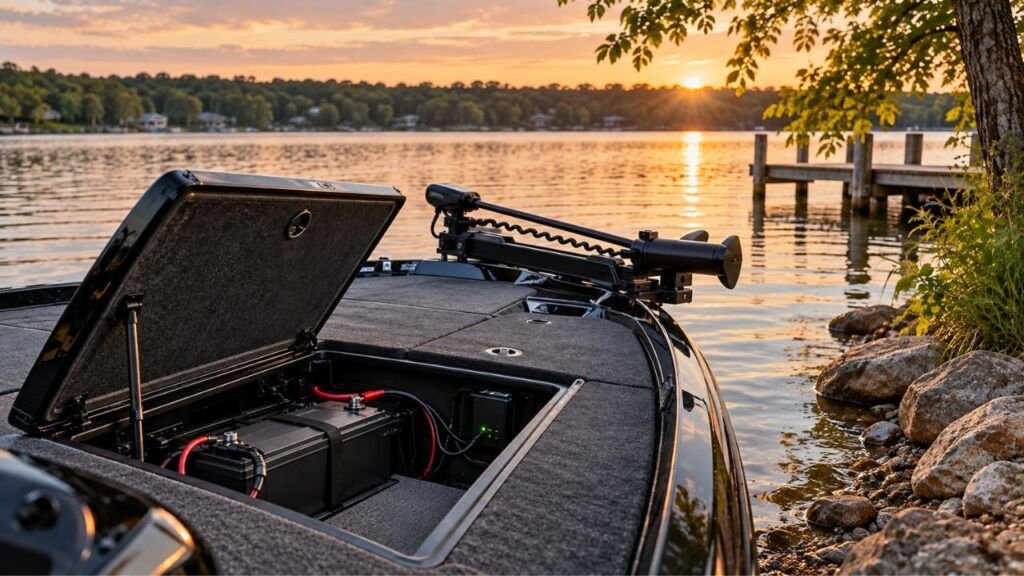
Yes, you can normally charge a trolling motor lithium battery while it remains installed in the boat. You do not need to remove the battery after every fishing trip. However, you should use a compatible charger and generally disconnect the trolling motor itself before shore-power charging.
The important part is knowing what can remain connected safely. I’ll explain onboard charging, 12V to 36V systems, battery cables, cold-weather charging, and the situations where removing the battery actually makes sense.
Key Takeaways
- A lithium trolling motor battery can normally stay installed while charging.
- You usually do not need to remove the battery cables completely.
- Disconnect or unplug the trolling motor before normal shore-power charging.
- Use a charger compatible with your battery’s LiFePO4 charging requirements.
- An onboard marine charger is usually the easiest everyday solution.
- Series-connected 24V and 36V banks need the correct charging arrangement.
- A single 24V or 36V battery requires the appropriate voltage charger.
- Alternator charging usually needs a suitable DC-DC charging system.
- Solar charging requires a lithium-compatible solar charge controller.
- Never force-charge a lithium battery below its approved temperature.
Yes, You Can Charge a Lithium Trolling Motor Battery Without Removing It
For most properly installed systems, the lithium battery can stay exactly where it is. Removing a heavy marine battery after every outing would defeat much of an onboard charger’s convenience.
The battery should remain securely mounted inside its battery tray or compartment. Its terminals should also stay protected from water and accidental contact.
You can then connect your charging source according to the system design. With a permanently mounted onboard charger, charging might involve little more than plugging the charger into AC power.
The main thing I want you to remember is this:
Leaving the battery in the boat is different from leaving the trolling motor electrically connected.
You may be able to leave charger wiring and battery-bank connections attached. However, the trolling motor should normally be disconnected during conventional shore-power charging.
What Does “Still in the Boat” Mean When Charging?
There are several connections around a trolling motor battery. They do not all need to be treated the same way during charging.
| Situation | Usually Okay? | What to Do |
| Battery remains secured in its tray | Yes | Leave it installed and secured |
| Onboard charger leads remain attached | Yes | Confirm charger compatibility first |
| Series jumper cables remain installed | Often | Follow the charger’s wiring instructions |
| Trolling motor remains plugged in | Generally avoid | Unplug it or open its breaker |
| Trolling motor runs during AC charging | Generally avoid | Charge with the motor disconnected |
| Solar controller remains attached | Possible | Use proper lithium settings |
| Outboard alternator charges trolling battery | Possible | Use an approved DC-DC arrangement |
The battery’s physical location is rarely the main concern. Charger compatibility, wiring, temperature, and electrical isolation matter much more.
Should You Disconnect the Trolling Motor Before Charging the Battery?
Yes, disconnecting the trolling motor during normal charging is the safer routine.
Many trolling motors connect through a removable plug near the bow. In that case, unplugging the motor before charging is simple.
Other boats have a dedicated trolling-motor circuit breaker or battery disconnect. Opening that circuit can electrically separate the motor from its battery bank.
Simply turning the trolling motor speed control to zero may not provide the same electrical isolation.
Disconnecting the motor also prevents accidental operation while charging. It reduces the possibility of charging-system voltage reaching equipment that should not be energized during the charging process.
This does not mean you have to dismantle the entire battery system.
You normally do not need to remove:
- Permanently installed onboard charger leads.
- Properly installed battery-bank jumper cables.
- Battery monitoring cables.
- The lithium battery itself.
The goal is mainly to isolate the trolling motor while allowing the charging system to work normally.
How to Charge the Lithium Battery While It Stays in the Boat
Charging an installed battery is straightforward once your system is properly configured. I recommend checking everything in the following order.
1. Confirm the Battery’s Charging Requirements
Start with the lithium battery itself.
Most modern trolling motor lithium batteries use LiFePO4 chemistry. However, charging specifications can still vary between manufacturers and battery models.
Check the battery documentation for:
- Recommended charging voltage.
- Maximum charging voltage.
- Recommended charging current.
- Maximum charging current.
- Minimum charging temperature.
- Maximum charging temperature.
- Low-temperature charging protection.
- Internal heater operation, if equipped.
The battery’s BMS adds protection, but you should not deliberately rely on it to correct an unsuitable charger.
2. Check That Your Charger Is Compatible
Make sure your charger supports your battery’s required charging profile.
A charger labeled “smart” is not automatically suitable for every lithium battery. What matters is whether its output matches the battery manufacturer’s specifications.
Check:
- Battery chemistry compatibility.
- Charger output voltage.
- Charging amperage.
- Number of charging banks.
- Marine installation rating.
- Temperature limitations.
A quality onboard charger with a proper lithium setting makes this process much easier.
3. Turn Off and Disconnect the Trolling Motor
Switch the trolling motor off before charging.
Then unplug its power connector or open the dedicated trolling-motor breaker, depending on your boat’s design.
This keeps the trolling motor isolated while charging takes place.
If your boat has unusual wiring, follow the instructions provided with your motor and charger rather than guessing.
4. Inspect the Battery Compartment
Take a quick look before plugging anything into shore power.
Check for:
- Loose battery terminals.
- Damaged insulation.
- Corrosion.
- Water around electrical connections.
- Frayed charging cables.
- Loose battery hold-downs.
- Exposed positive terminals.
The battery should remain firmly secured while the boat moves.
You should also fix wet or damaged connections before charging.
5. Connect the Charging Source
With an onboard charger, the battery-side wiring usually remains permanently installed.
You then connect the charger’s AC input to an appropriate power source.
If you are using a portable charger, connect it according to its instructions. Keep the charger protected from water, spray, and accidental movement.
Do not leave temporary charging connections lying loosely around the deck.
6. Let the Charger Complete Its Cycle
Allow the charger to work without repeatedly switching loads on and off.
Many lithium chargers provide status lights showing charging progress. Some lithium batteries also let you check state of charge through Bluetooth.
Once charging is complete, disconnect AC power as required.
Then reconnect or switch the trolling motor circuit back on before your next trip.
Best Ways to Charge a Lithium Trolling Motor Battery in the Boat
Several charging methods can work without removing the battery. The best choice depends on where and how you use your boat.
Lithium-Compatible Onboard Marine Charger
For most regular boat owners, this is the most convenient option.
An onboard charger is permanently mounted inside the boat. Its DC charging leads stay connected to the batteries.
After returning to the dock or driveway, you connect AC power. The charger then handles the charging process automatically.
Benefits include:
- No lifting batteries.
- Cleaner permanent wiring.
- Multiple charging banks.
- Easy charging after every trip.
- Less chance of reversing portable charger connections.
A multi-bank charger is especially useful with 24V and 36V trolling systems made from multiple 12V batteries.
Portable Lithium Battery Charger
A portable charger makes sense for smaller boats or occasional use.
You connect it to the battery when charging is needed. Afterward, you remove and store the charger.
This approach can work well for:
- Small fishing boats.
- Jon boats.
- Kayak trolling setups.
- Boats without permanent charger installations.
Just remember that a portable charger still needs appropriate AC power.
Keep it dry and secure while using it around the boat.
Boat Alternator With a DC-DC Charger
You can also recharge some trolling motor battery systems while the main outboard engine runs.
A typical arrangement looks like this:
Engine alternator → starting battery → DC-DC charger → trolling motor battery
The DC-DC charger performs an important job. It controls the charging current and voltage reaching your lithium bank.
That can protect both the lithium battery and the boat’s charging system.
Lithium batteries can accept substantial charging current. Connecting them into an alternator system without proper control may place unnecessary stress on the alternator.
The DC-DC charger must also match your trolling bank’s voltage arrangement.
Solar Panel With a Lithium-Compatible Charge Controller
Solar charging can help while fishing, camping, or leaving the boat at a slip.
The basic setup includes:
Solar panel → charge controller → lithium battery
Do not connect a solar panel directly to the lithium battery unless the system was specifically designed for that arrangement.
The charge controller regulates the power coming from the panel.
An MPPT controller can be useful when you want better performance from limited panel space.
Solar works particularly well for maintaining charge or replacing part of your daily usage.
However, a small panel will not magically recharge a heavily depleted 100Ah battery within an hour or two.
Available sunlight, panel wattage, shading, and battery capacity all affect charging time.
Charging 12V, 24V, and 36V Trolling Motor Lithium Systems
The correct charging method depends on how your trolling motor gets its required voltage. This becomes especially important with larger 24V and 36V motors.
| Trolling System | Typical Battery Setup | Common Charging Method |
| 12V | One 12V lithium battery | One compatible 12V charger |
| 24V | Two 12V batteries in series | Two isolated 12V charger banks |
| 24V | One 24V lithium battery | Compatible 24V lithium charger |
| 36V | Three 12V batteries in series | Three isolated 12V charger banks |
| 36V | One 36V lithium battery | Compatible 36V lithium charger |
A 24V or 36V trolling motor does not automatically mean you own one large 24V or 36V battery.
Many boats create those voltages by connecting separate 12V batteries in series.
That difference matters when choosing your charger.
Two 12V Batteries Making a 24V Bank
Suppose you have two 12V batteries connected in series.
You may use an appropriately designed two-bank onboard charger with isolated 12V outputs. Each charger bank connects to one battery.
The series jumper can often remain installed when the charger manufacturer specifically supports that configuration.
Three 12V Batteries Making a 36V Bank
The same idea applies to three 12V batteries creating a 36V system.
A suitable three-bank charger can charge each 12V battery individually.
Again, the charger must have properly isolated banks designed for this setup.
One 24V or 36V Lithium Battery
This is different.
If you have one physical 24V battery, you need a charging system designed for that battery voltage.
Likewise, a single 36V lithium battery needs an appropriate 36V charger.
You cannot treat a single 36V battery like three separate 12V batteries.
Always identify your actual battery configuration before buying a charger.
Do You Have to Remove the Battery Cables Before Charging?
Usually, no.
One advantage of an onboard charging system is avoiding repeated battery disconnection.
The charger’s permanent ring-terminal leads normally stay attached.
Properly configured series jumpers may also remain connected when your multi-bank charger supports charging the batteries that way.
What you should isolate is the trolling motor itself.
That might mean:
- Unplugging the trolling motor.
- Opening its circuit breaker.
- Using a dedicated battery disconnect switch.
Do not automatically remove every cable from every terminal.
Repeatedly removing cables can also create problems. Connections may become loose, hardware can get misplaced, and accidental polarity mistakes become more likely.
Your goal is a safe permanent installation that requires minimal disturbance.
Can You Leave an Onboard Charger Connected to a Lithium Battery?
Yes, the charger’s battery-side cables can normally remain connected permanently when the system is designed that way.
That is exactly how most onboard chargers are installed.
However, there is an important difference between leaving the charger wired to the battery and leaving the charger continuously powered from AC.
Those are not the same thing.
Whether continuous AC connection is acceptable depends on:
- Charger design.
- Lithium charging profile.
- Battery specifications.
- Storage conditions.
- Temperature.
Lithium batteries do not necessarily use the same long-term float-charging behavior associated with traditional lead-acid batteries.
A properly designed lithium-compatible charger should manage charging according to its programmed profile.
If you plan to leave the boat connected for weeks or months, check both the battery and charger instructions.
Can You Charge the Battery While the Boat Is in the Water?
Yes, an installed lithium trolling motor battery can be charged while the boat remains in the water. However, the charging method and electrical installation need to match the situation.
While Tied to a Dock
An onboard marine charger can be used at the dock when connected through an appropriate AC power arrangement.
Keep all electrical connections protected from water.
Never allow plugs, extension connections, or portable charging equipment to sit where they can become wet.
The trolling motor should generally remain disconnected during conventional AC charging.
While Running the Outboard
Charging while the main engine operates is also possible.
However, you need an appropriate alternator-charging arrangement.
For lithium trolling systems, that commonly means using a DC-DC charger or another purpose-designed charging system.
The starting battery and trolling motor bank should not simply be joined together without considering charging requirements.
While Fishing With Solar
Solar charging can operate while you remain on the water.
That makes it useful during long fishing days.
Your solar system might replace some energy while the trolling motor is being used intermittently.
However, do not assume the panel can completely offset motor consumption.
A trolling motor running hard can consume far more power than a small solar panel produces.
Can You Run the Trolling Motor While the Lithium Battery Is Charging?
For normal shore-power charging, I would not recommend operating the trolling motor at the same time.
The safer routine is:
- Stop the trolling motor.
- Electrically disconnect it.
- Charge the battery.
- Finish the charging cycle.
- Reconnect the motor afterward.
That keeps the two systems separated during charging.
However, this is different from purpose-designed charging while underway.
Solar and alternator-based systems may charge batteries while other loads are active. A properly designed DC charging system can also be built specifically for this purpose.
The important word is designed.
Do not assume that because current is entering the battery, every connected device should remain powered.
Follow the operating instructions for your specific motor, charger, and battery.
How Cold Is Too Cold to Charge a Trolling Motor Lithium Battery?
Cold-weather charging requires more attention with LiFePO4 batteries.
Many standard LiFePO4 batteries should not accept charging when their internal temperature falls around or below freezing.
Some batteries solve this problem with low-temperature charging protection.
Their BMS detects excessive cold and prevents charging until the cells warm sufficiently.
Other batteries include internal heaters.
A heated lithium battery may use incoming charging power to warm its cells before normal charging begins.
Do not bypass low-temperature protection just because you need the battery charged quickly.
Also remember that outside air temperature and battery temperature can differ.
A battery inside an enclosed compartment may remain warmer or colder than expected.
Always follow the temperature range specified for your particular battery.
Marine Safety Checklist Before Charging in the Boat
Charging inside the boat is convenient, but the installation still deserves regular attention.
- Turn the trolling motor off before charging.
- Disconnect the trolling motor when instructed.
- Verify charger voltage before connecting it.
- Confirm the charger supports your lithium battery.
- Check battery terminals for looseness.
- Inspect cables for damaged insulation.
- Keep electrical connections dry.
- Keep positive terminals properly protected.
- Make sure the battery cannot move inside its tray.
- Use properly sized marine-grade wiring.
- Keep required circuit protection installed.
- Do not bypass breakers or fuses.
- Avoid makeshift charging adapters.
- Never charge a physically damaged lithium battery.
- Stop charging if unusual heat, smell, or swelling develops.
- Do not charge outside the approved temperature range.
- Follow the battery’s maximum charging-current limit.
Most safe charging comes down to good equipment and good installation.
You should not need complicated procedures every time you return from fishing.
Common Mistakes When Charging a Lithium Trolling Motor Battery in a Boat
Most charging problems come from mismatched equipment or incorrect assumptions.
- Leaving the trolling motor electrically connected during shore charging.
- Assuming every smart charger supports LiFePO4 batteries.
- Using a charger with the wrong battery voltage.
- Charging a single 24V battery with a 12V charger.
- Charging a single 36V battery with a 12V charger.
- Using non-isolated charger outputs incorrectly on series batteries.
- Ignoring the battery’s maximum charging current.
- Connecting lithium batteries directly to an alternator without proper control.
- Forcing a battery to charge after low-temperature protection activates.
- Leaving temporary charger connections exposed to rain or spray.
- Allowing loose battery terminals to remain unattended.
- Using damaged extension cords around wet areas.
- Assuming the BMS can correct every charging mistake.
- Mixing batteries improperly within a series bank.
If something about your wiring arrangement seems unclear, identify each battery and connection before plugging in the charger.
That few minutes of checking can prevent expensive mistakes.
How Long Does It Take to Charge the Battery Without Removing It?
Leaving the lithium battery inside the boat does not meaningfully change its charging time. Battery capacity, remaining charge, and charger output are the main factors.
For example, suppose a 100Ah battery needs about 80Ah replaced.
| Charger Output | Rough Ideal Charging Time |
| 5A | About 16+ hours |
| 10A | About 8+ hours |
| 20A | About 4+ hours |
| 30A | Around 3 hours |
| 50A | Around 2 hours |
A simple estimate is:
Amp-hours needing replacement ÷ charger amps = approximate charging hours
So, if you need to replace 80Ah using a 20A charger:
80Ah ÷ 20A = about 4 hours
Real charging time may be somewhat longer.
The battery’s BMS, charging profile, temperature, charger behavior, and electrical losses all affect the final result.
You also need to stay within the battery’s maximum approved charging current.
A bigger charger is not automatically better.
When Should You Remove the Lithium Battery From the Boat?
You normally do not need battery removal for routine charging.
There are still situations where taking it out makes sense.
- The battery has visible physical damage.
- Water entered the battery compartment.
- Terminal repairs are needed.
- The battery tray needs maintenance.
- Major wiring work is required.
- You cannot safely access the charging connections.
- The battery must warm before charging in freezing conditions.
- Winter storage conditions exceed the battery’s approved limits.
- The boat will remain unused for an extended period.
- The battery manufacturer specifically recommends removal.
If none of those conditions apply, leaving the battery installed is usually easier.
A secure onboard battery and properly installed charger make routine maintenance much simpler.
Final Verdict
You can charge a trolling motor lithium battery while it is still in the boat, and removing it after every trip is normally unnecessary. A properly installed lithium-compatible onboard charger makes this one of the easiest ways to maintain your trolling battery.
The important distinction is what stays connected. The battery, charger leads, and properly configured battery-bank wiring can often remain installed. The trolling motor itself should normally be electrically disconnected during conventional shore-power charging.
Also make sure your charger matches the battery’s voltage, lithium charging requirements, amperage limits, and temperature range.
Pay extra attention with 24V and 36V systems. Two or three 12V batteries wired in series require a different charging arrangement than one large 24V or 36V battery.
Set the system up correctly once, and charging can become simple. You can return from the lake, connect shore power, let the charger work, and have your trolling motor ready for the next trip.
Related FAQs
Do I Need to Disconnect My Trolling Motor Before Charging the Battery?
Yes, disconnecting the trolling motor during conventional shore-power charging is generally recommended. Unplug the motor or open its dedicated breaker, depending on your boat’s electrical setup.
Can I Leave My Lithium Trolling Motor Battery Connected to an Onboard Charger?
Yes, the onboard charger’s DC leads are normally designed to remain permanently connected. Whether you should leave its AC supply powered continuously depends on the charger and battery manufacturer’s storage recommendations.
Can I Use My Old Onboard Charger With a Lithium Trolling Motor Battery?
Possibly, but only when its output matches your lithium battery’s approved voltage, current, and charging profile. Do not assume an older charger is compatible simply because it successfully charged lead-acid batteries.
Can I Charge a 24V Trolling Motor Battery With a 12V Charger?
You cannot normally charge one physical 24V battery with a standard 12V charger. However, two separate 12V batteries forming a 24V series bank may be charged using a compatible isolated two-bank 12V charger.
Can I Charge Three 12V Lithium Batteries While They Are Wired for 36V?
Yes, this can be possible with a compatible three-bank charger having isolated outputs. Each charging bank connects to one 12V battery, while the series wiring may remain installed when the charger’s instructions allow it.
Can I Charge a Lithium Trolling Motor Battery From My Boat Alternator?
Yes, but a suitable DC-DC charger or purpose-designed alternator charging system is generally the better approach. It regulates charging current and voltage before sending power into the lithium trolling bank.
Can I Charge My Trolling Motor Battery With Solar While It Is in the Boat?
Yes. Connect the solar panel through a charge controller configured for your lithium battery. Solar can maintain or replenish battery energy, although charging speed depends heavily on panel wattage and available sunlight.
Can I Charge a Lithium Trolling Motor Battery Below 32°F?
That depends on the battery. Many LiFePO4 batteries restrict charging around or below freezing, while heated models can warm themselves first. Follow your battery’s actual minimum charging-temperature specification.
Can I Charge the Battery While the Trolling Motor Is Running?
Do not assume you can run the trolling motor during conventional AC charging. Shore-power charging should normally occur with the trolling motor disconnected, while properly designed solar or DC charging systems may support charging with other loads present.
Do I Need to Remove a Lithium Boat Battery for Winter Charging?
Usually not, provided the battery remains within its approved temperature range and the installed charger is suitable. Removal may be helpful when the storage location becomes too cold for safe charging.

Ryan Carter writes practical battery guides focused on troubleshooting, everyday use, and smarter buying decisions. His experience with lithium batteries, RV and automotive power, and home backup systems helps readers choose reliable solutions with confidence.















