
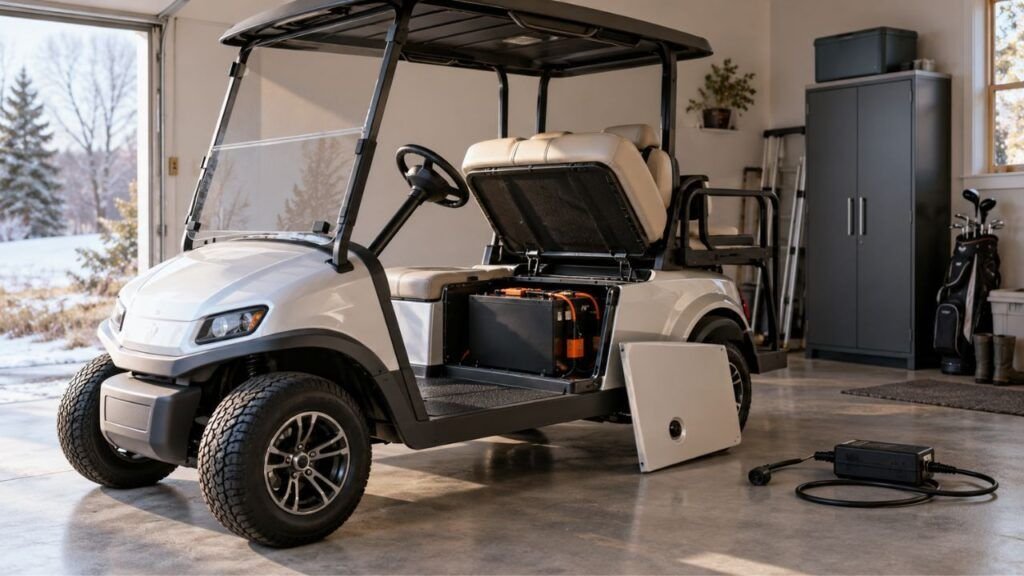
Yes, you can usually leave a lithium golf cart battery installed during storage. The key is shutting it down properly, preventing unwanted power draw, and following your battery manufacturer’s storage instructions.
Below, I’ll explain when leaving it installed is safe. I’ll also cover charge level, TOW mode, winter storage, temperatures, and long-term storage.
Key Takeaways
- Most lithium golf cart batteries can stay installed during storage.
- Installed does not necessarily mean electrically connected and active.
- Use storage, sleep, or master-off mode when your battery supports it.
- TOW mode may reduce power draw but may not isolate everything.
- Storage charge recommendations vary between lithium battery manufacturers.
- Accessories can continue draining power even when the cart is off.
- Extreme heat, cold, or long storage may justify battery removal.
- Always follow your battery manufacturer’s storage instructions first.
Can You Leave a Lithium Golf Cart Battery Installed During Storage?
Yes, leaving a lithium battery physically installed is usually acceptable.
The bigger concern is whether the battery remains electrically active.
Your golf cart may look completely off while small systems still draw power. A voltage reducer, USB port, stereo, GPS tracker, or controller can slowly discharge the battery.
For short or moderate storage, you often do not need removal. Instead, shut down or isolate the battery properly.
Many lithium batteries include a master switch, sleep mode, or storage mode. These features help reduce unwanted discharge while the cart sits.
However, every battery and golf cart setup is slightly different. That is why I would never recommend one storage method for everyone.
Your battery manual should always be your first reference.
Should You Leave the Battery Installed or Remove It?
The right choice depends on storage time, temperature, and electrical draw. Use this quick guide before deciding what makes sense.
| Storage Situation | Leave It Installed? | What I Recommend |
| A few weeks in a dry garage | Usually yes | Turn the battery and cart off properly |
| One to three months | Usually yes | Use storage mode and monitor charge |
| Winter in a suitable garage | Often yes | Follow temperature and SOC instructions |
| Three to six months or longer | Depends | Consider disconnecting the battery |
| Cart has several accessories | Use caution | Isolate possible parasitic loads |
| Battery has no master shutoff | Use caution | Consider cable disconnection |
| Very hot storage shed | Possibly not | Move to a cooler location |
| Severe winter conditions | Battery-dependent | Check rated storage temperature |
| Damp or flood-prone location | No | Move the battery or entire cart |
| Battery looks damaged | No | Stop using it and seek service |
The important point is simple.
You do not need to remove a healthy lithium battery automatically. Removal becomes useful when storage conditions create unnecessary risk.
Why Can the Battery Drain When the Golf Cart Is Off?
Turning the key off does not always stop every electrical load. Several small loads can continue drawing energy during storage.
Battery Management System Standby Draw
Your lithium battery contains a Battery Management System, commonly called a BMS.
The BMS protects the battery against unsafe operating conditions. Depending on the design, it may still consume small amounts of energy.
That standby draw may seem insignificant each day. However, months of inactivity can make it more noticeable.
This is another reason long-term storage deserves some planning.
Parasitic Loads From the Golf Cart
Several accessories may continue pulling power after shutdown.
Common examples include:
- USB charging ports
- GPS trackers
- Bluetooth modules
- Stereo memory circuits
- Alarm systems
- Keyless entry systems
- Digital displays
- Voltage reducers
- Aftermarket lighting controllers
- Other permanently wired accessories
These loads are especially important on modified golf carts.
You may have added accessories that bypass the normal ignition system. Those accessories can remain connected even after turning the key off.
Why the Key Switch Alone May Not Be Enough
The ignition switch mainly controls normal golf cart operation.
It does not guarantee complete battery isolation.
That is why I recommend checking for a battery power switch. You should also look for storage or sleep mode.
If your cart has aftermarket equipment, inspect those circuits as well.
Does TOW Mode Completely Disconnect a Lithium Golf Cart Battery?
Not necessarily.
TOW mode can reduce electrical activity in certain golf cart systems. However, it should not automatically be treated as a complete battery disconnect.
Some carts use a RUN/TOW switch to protect electronic components. Moving that switch to TOW may isolate parts of the drive system.
However, separately wired accessories could remain powered.
Your stereo, GPS tracker, USB outlets, or voltage converter may bypass that switch. Their wiring depends on how the cart was configured.
So, use TOW mode when your golf cart manual recommends it.
Just do not assume TOW mode eliminates every possible load.
The safest approach is checking both manuals. Look at the golf cart instructions and the lithium battery instructions.
How to Store a Lithium Golf Cart Battery While Leaving It Installed
You can safely leave many lithium batteries installed for seasonal storage. The steps below reduce unnecessary battery drain and storage-related problems.
1. Read Your Battery Storage Instructions
Start with the battery manufacturer’s recommendations.
Pay attention to:
- Recommended storage charge
- Allowed storage temperature
- Storage or sleep mode instructions
- Recommended inspection intervals
- Charger instructions
- Battery disconnect recommendations
This step matters because lithium battery manufacturers give different advice.
One brand may recommend partial charge during storage. Another may recommend storing its battery fully charged.
Neither recommendation should automatically be applied to every battery.
2. Set the Correct Storage Charge Level
Avoid guessing the ideal storage percentage.
Many lithium iron phosphate batteries are stored at a moderate charge level. Recommendations around 40% to 70% are common.
However, some golf cart battery manufacturers recommend 100% before storage.
That difference is important.
The battery manufacturer understands its own BMS, cells, and standby draw. Therefore, its recommendation should come before general lithium advice.
If your manual gives a specific percentage, follow it.
If it does not, contact the manufacturer before extended storage.
3. Turn Off the Battery or Activate Storage Mode
Look for a physical battery switch or storage function.
Depending on your battery, it may be called:
- Master power
- Sleep mode
- Storage mode
- Hibernate mode
- Battery disconnect
These features are designed to reduce electrical consumption while unused.
Do not assume every lithium battery has the same shutdown process.
Some batteries require holding a button for several seconds. Others use an external disconnect switch.
Follow your model’s instructions carefully.
4. Put the Golf Cart in TOW Mode When Required
Some golf cart manufacturers recommend switching the cart into TOW mode.
Doing so can reduce unnecessary electrical activity during storage.
However, TOW mode varies between golf cart designs.
Do not blindly copy instructions from another cart owner online.
Check whether your Club Car, E-Z-GO, Yamaha, or other model requires it.
5. Disconnect Unnecessary Accessories
Aftermarket accessories deserve special attention during long storage.
Consider isolating equipment such as:
- GPS trackers
- USB outlets
- Stereos
- Decorative lighting
- Dash accessories
- Phone chargers
- Voltage reducers
- Auxiliary electronics
If you are unsure how something is wired, avoid experimenting.
A golf cart technician can identify circuits that remain energized.
6. Disconnect the Charger Unless Instructions Say Otherwise
Lithium batteries usually do not need traditional lead-acid float charging.
That means leaving the charger attached for months is unnecessary for many systems.
Once the battery reaches its recommended storage charge, disconnect the charger unless the manufacturer specifically allows continuous connection.
This is especially important if you use an aftermarket charger.
Use only a charger approved for your battery type.
7. Clean and Inspect the Battery Compartment
Before storage, spend a few minutes inspecting the battery area.
Look for:
- Loose cables
- Damaged insulation
- Dirt buildup
- Moisture
- Rodent activity
- Loose mounting hardware
- Cracks or physical damage
Make sure the battery cannot move inside its compartment.
Lithium batteries need less maintenance than flooded lead-acid batteries. Still, a visual inspection can catch problems early.
8. Store the Cart Somewhere Dry and Temperature-Appropriate
A garage is often better than an exposed outdoor location.
Try to avoid:
- Direct sunlight
- Standing water
- Flood-prone areas
- Extremely hot sheds
- Excessive humidity
- Temperatures outside battery specifications
Temperature becomes especially important during long-term storage.
I will cover cold and hot conditions more closely below.
What Charge Percentage Is Best for Lithium Golf Cart Battery Storage?
There is no universal storage percentage for every lithium golf cart battery.
That is one of the most important things to understand.
Many lithium batteries prefer storage at a moderate state of charge. You may see recommendations around 40%, 50%, 60%, or 70%.
However, certain golf cart lithium batteries specify full charge before storage.
Why are the recommendations different?
Battery systems can vary in:
- Cell configuration
- BMS programming
- Standby consumption
- Sleep-mode behavior
- State-of-charge calibration
- Manufacturer warranty requirements
That is why I would not automatically store every battery at 50%.
Check the manual for your exact battery.
If the manufacturer says 100%, follow that recommendation.
If it says 50% or 60%, follow that instead.
Battery-specific instructions should always beat generic online advice.
How Long Can a Lithium Golf Cart Battery Stay Installed?
Storage duration matters, but there is no universal cutoff. Battery design and parasitic draw matter just as much.
As a general guide:
- Several days to a few weeks: Leaving it installed is normally fine.
- One to three months: Use storage mode or battery isolation.
- Three to six months: Check charge periodically and consider disconnection.
- Six months or longer: Follow manufacturer-specific long-term storage procedures.
A battery with an effective sleep mode can sit differently. A battery without proper isolation may discharge much faster.
Your cart configuration matters too.
A completely stock golf cart may have minimal standby consumption. A modified cart could have several active accessories.
Watch the battery percentage during the first storage period.
If it drops faster than expected, investigate possible parasitic draw.
Can You Leave a Lithium Golf Cart Battery Installed Over Winter?
Yes, many lithium golf cart batteries can remain installed over winter. However, cold storage and cold-weather charging require different precautions.
Cold Storage Is Different From Cold Charging
This distinction causes a lot of confusion.
A lithium battery may tolerate storage below freezing. That does not mean you should charge it below freezing.
Many LiFePO4 batteries restrict charging around 32°F.
Charging cells when they are too cold can cause permanent damage. Modern BMS protection may block charging until temperatures rise.
Storage temperature ratings can be much wider.
That means an unheated garage is not automatically unsafe.
You need to compare actual garage temperatures with the battery specifications.
When an Unheated Garage May Be Acceptable
An unheated garage may work if temperatures stay within battery limits.
A garage also protects the cart from snow, rain, and direct exposure.
Before winter, check:
- Minimum storage temperature
- Minimum charging temperature
- Battery heater availability
- Storage charge recommendation
- Manufacturer winter-storage instructions
If your battery has Bluetooth monitoring, check it occasionally.
That gives you an easy way to monitor charge without driving.
When Bringing the Battery Indoors Makes More Sense
Removal may be more sensible when:
- Temperatures exceed the battery’s storage rating
- The garage becomes extremely cold for months
- You cannot monitor battery charge
- The battery lacks storage mode
- Parasitic draw cannot be stopped
- The manufacturer specifically recommends removal
If you remove the battery, remember its weight.
Large 36V, 48V, and 72V lithium golf cart batteries can be heavy. Get help rather than risking injury or terminal damage.
What About Hot-Weather Storage?
Cold weather gets most of the attention, but heat matters too.
High temperatures can accelerate lithium battery aging.
This matters if your golf cart sits inside a metal shed. Interior temperatures can climb well above the outside temperature.
Owners in Arizona, Texas, Florida, Nevada, and similar climates should be careful.
Whenever possible, choose a shaded and ventilated storage location.
Avoid leaving the battery where direct sunlight heats the compartment.
You should also avoid completely sealed areas that trap excessive heat.
Again, check your battery’s maximum storage temperature.
If your storage location regularly exceeds that limit, move the battery.
When Should You Disconnect or Remove the Battery Completely?
Leaving the battery installed is convenient, but sometimes removal makes sense. Consider extra isolation when storage conditions are less than ideal.
You may want to disconnect or remove it when:
- The cart will sit unused for several months.
- The battery has no proper storage mode.
- The cart has unexplained parasitic drain.
- State of charge drops unusually fast.
- Accessories cannot be isolated.
- Storage temperatures exceed battery limits.
- The location is damp or flood-prone.
- The manufacturer specifically recommends removal.
- You cannot periodically inspect the cart.
- The battery shows signs of physical damage.
Do not casually disconnect high-current battery cables without guidance.
Large lithium golf cart batteries can deliver tremendous current.
A short circuit can create serious heat and electrical damage.
If the correct isolation procedure is unclear, use a qualified technician.
How Often Should You Check a Stored Lithium Golf Cart Battery?
Lithium batteries need less maintenance than lead-acid batteries. However, periodic checks are still useful during extended storage.
During storage, check:
- Current state of charge
- Unexpected battery percentage loss
- BMS warning messages
- Battery compartment moisture
- Loose or damaged wiring
- Rodent damage
- Active accessories
- Charger connection
- Unusual smells, heat, or physical changes
You do not necessarily need to inspect it every week.
Some manufacturers recommend monthly checks. Others allow longer intervals.
Use your battery manufacturer’s recommended schedule.
The important thing is preventing a deeply discharged battery from sitting unnoticed.
Should You Leave the Lithium Golf Cart Charger Plugged In During Storage?
Usually, you should not assume the charger needs continuous connection.
Lithium batteries behave differently from traditional flooded lead-acid batteries.
Many lithium systems do not require constant float charging during storage.
Charge the battery to its manufacturer-recommended storage level. Then disconnect the charger unless continuous connection is specifically permitted.
This also reduces unnecessary dependence on the charger during long storage.
Do not use a lead-acid charging strategy automatically with lithium.
The battery and charger should be designed to work together.
Common Mistakes When Storing a Lithium Golf Cart Battery
Many storage problems come from small assumptions. Avoid these common mistakes before leaving your golf cart unused.
- Assuming the ignition key stops every electrical load
- Leaving the golf cart in RUN unnecessarily
- Assuming TOW mode disconnects every accessory
- Storing the battery almost completely discharged
- Assuming every lithium battery should be stored at 50%
- Leaving an unsuitable charger connected for months
- Charging the battery below its approved temperature
- Forgetting aftermarket GPS and USB accessories
- Storing the cart inside an extremely hot shed
- Ignoring battery charge for an entire season
- Using lead-acid storage habits on lithium batteries
- Ignoring unusually fast state-of-charge loss
Most of these problems are easy to avoid.
Spend a few minutes preparing the cart before storage.
How to Put the Golf Cart Back Into Service After Storage
When storage ends, do not immediately press the accelerator. A quick inspection helps you catch problems before driving.
Follow these steps:
- Inspect the battery case and compartment.
- Check cables, terminals, and mounting hardware.
- Confirm the battery temperature is suitable.
- Check the current state of charge.
- Reconnect anything intentionally disconnected.
- Exit storage or sleep mode.
- Return the cart from TOW to RUN when required.
- Check your BMS app or display for warnings.
- Charge the battery with its approved charger if needed.
- Test the cart slowly before normal driving.
Pay attention to unusual warnings or reduced performance.
If anything seems abnormal, stop and inspect the system first.
Final Verdict
Yes, you can usually leave a lithium golf cart battery installed during storage.
You do not automatically need to carry the battery indoors every winter. The better approach is properly shutting down and isolating the system.
Start with the storage charge recommended for your exact battery. Then use its master switch, storage mode, or sleep function when available.
Also check for accessories that may create parasitic draw.
For very long storage, extreme temperatures, or unexplained battery drain, disconnecting or removing the battery may offer better protection.
Most importantly, do not treat every lithium battery identically.
Your battery manufacturer’s storage instructions should always come first.
Related FAQs
Here are quick answers to common questions about storing lithium golf cart batteries.
Can I Leave a Lithium Golf Cart Battery in the Cart All Winter?
Yes, many lithium golf cart batteries can remain installed all winter when stored within their rated temperature range. Shut down the battery correctly, prevent parasitic loads, and follow the manufacturer’s winter-storage instructions.
Should I Disconnect My Lithium Golf Cart Battery for Storage?
Not always. Short-term storage may only require switching the battery off or activating storage mode. Longer storage may justify electrical disconnection when your manufacturer recommends it or parasitic drain cannot be eliminated.
Should a Golf Cart Be in Run or Tow Mode During Storage?
Many golf cart manufacturers recommend TOW mode during extended storage. However, requirements differ between models. Check your cart manual because TOW mode may not disconnect separately wired accessories.
What Percentage Should a Lithium Golf Cart Battery Be Stored At?
There is no universal percentage for every lithium golf cart battery. Some manufacturers recommend moderate partial charge, while others recommend full charge. Follow the storage percentage specified for your exact battery.
Can a Lithium Golf Cart Battery Stay in an Unheated Garage?
Yes, provided garage temperatures remain within the battery’s approved storage range. Remember that safe storage temperatures may differ from safe charging temperatures, especially during freezing weather.
Will a Lithium Golf Cart Battery Drain While the Cart Is Off?
Yes, slow discharge can still occur. The battery BMS, voltage reducers, trackers, stereos, USB ports, and other accessories may continue drawing small amounts of power.
How Long Can a Lithium Golf Cart Battery Sit Without Charging?
That depends on its starting charge, standby draw, storage mode, and manufacturer specifications. Many batteries can sit for months, but you should periodically check their state of charge during extended storage.
Should I Leave My Lithium Golf Cart Charger Plugged In All Winter?
Do not assume continuous charging is necessary. Many lithium battery manufacturers recommend disconnecting the charger after reaching the proper storage charge. Follow the charger and battery instructions for your specific system.
Can a Lithium Golf Cart Battery Be Stored Below Freezing?
Some lithium batteries can safely be stored below freezing within their rated limits. However, charging below freezing may be restricted. Always check the battery’s storage and charging temperature specifications separately.
Do I Need to Remove a Lithium Golf Cart Battery for Long-Term Storage?
Not necessarily. Batteries with effective storage or sleep modes may remain installed. Removal becomes more useful when temperatures are unsuitable, parasitic drain persists, or the manufacturer specifically recommends it.

Ryan Carter writes practical battery guides focused on troubleshooting, everyday use, and smarter buying decisions. His experience with lithium batteries, RV and automotive power, and home backup systems helps readers choose reliable solutions with confidence.















