
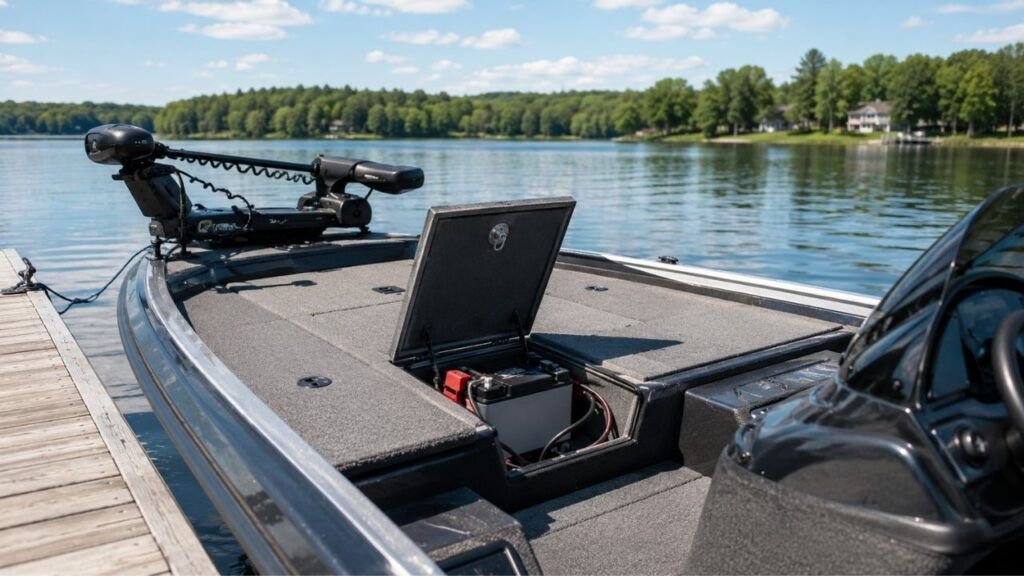
Yes, you can usually leave a lithium trolling motor battery in your boat between regular fishing trips. Keep the battery dry, securely mounted, properly charged, and disconnected from unnecessary electrical loads while the boat sits.
You normally do not need to remove the battery every weekend. However, charging, temperature, parasitic drain, and storage duration can change what you should do. I’ll walk you through each situation so you can leave your battery safely without shortening its useful life.
Key Takeaways
- Lithium trolling motor batteries can usually remain inside the boat between trips.
- Recharge the battery after fishing if you want full runtime next time.
- Turn off or disconnect unnecessary electrical loads during storage.
- Only use a charger suitable for your lithium battery chemistry.
- Leaving the battery installed does not mean everything should stay connected.
- Cold storage and charging in freezing temperatures are different concerns.
- Long-term storage requires different care than several days between trips.
- Follow your battery manufacturer’s storage charge recommendation for extended storage.
- Keep the battery compartment dry and protect connections from corrosion.
- Remove the battery when temperature, water, security, or storage conditions become unsuitable.
Can You Leave a Lithium Trolling Motor Battery in the Boat Between Trips?
For normal fishing schedules, leaving a lithium trolling motor battery installed is generally fine. You do not need to carry a heavy battery indoors after every outing.
If you fish on Saturday and plan another trip next weekend, the battery can usually stay exactly where it is.
The important part is how you leave it.
Make sure the trolling motor is switched off. Check that no unnecessary accessories remain powered. You should also inspect the battery compartment for water before leaving the boat.
Lithium iron phosphate, commonly called LiFePO4, batteries also have low self-discharge. That means the battery itself usually loses relatively little energy while sitting.
However, your boat can still drain it.
Fish finders, trolling motor electronics, battery monitors, USB ports, switches, and other connected devices may slowly consume power.
That is why there is an important difference between these two statements:
You can leave the battery installed in your boat.
You should leave every electrical device connected and powered.
The first is usually fine. The second can cause unnecessary battery drain.
When Can You Leave the Battery in the Boat, and When Should You Remove It?
The right decision depends mainly on storage duration and conditions. A battery sitting for five days needs different care than one sitting all winter.
| Situation | Leave Battery in Boat? | Leave Charger Connected? | Recommended Approach |
| 2–7 days between fishing trips | Usually yes | Optional if approved | Recharge and switch off unnecessary loads |
| 1–4 weeks without use | Usually yes | Usually unnecessary | Disconnect loads and check battery charge |
| Boat stored in mild weather | Usually yes | Battery-dependent | Keep battery dry and protected |
| Very hot outdoor storage | Depends | Avoid unnecessary charging | Reduce heat exposure when possible |
| Freezing weather | Battery-dependent | Charging may be restricted | Check low-temperature specifications |
| Several months of storage | Manufacturer-dependent | Usually disconnect | Follow long-term storage instructions |
| Wet or flooding battery compartment | No | No | Remove battery and correct water problem |
| Battery cannot remain secured | No | No | Securely mount or remove the battery |
For an ordinary weekend fishing schedule, leaving the battery installed is usually the easiest option.
Extended storage deserves more attention because temperature and state of charge become increasingly important.
What Should You Do With the Battery After Every Fishing Trip?
You do not need an elaborate maintenance routine after every outing. A few basic checks can prevent most between-trip battery problems.
- Turn the trolling motor completely off.
- Check the battery compartment for standing water.
- Inspect battery terminals and cable connections.
- Check the battery’s remaining state of charge.
- Recharge it with a compatible lithium charger.
- Switch off accessories connected to the battery.
- Use your battery disconnect switch when appropriate.
- Make sure the battery remains securely mounted.
- Keep terminals protected from accidental short circuits.
- Check battery status again before your next outing.
If everything looks normal, the battery can stay onboard until your next trip.
Should You Leave a Lithium Trolling Motor Battery on the Charger Between Trips?
Leaving the battery inside your boat and leaving it connected to a charger are separate decisions. A compatible charger may sometimes remain connected, but it is not automatically necessary.
Can You Leave a Smart Lithium Charger Connected for a Few Days?
Many modern lithium batteries can remain connected to a properly designed lithium-compatible smart charger for several days.
The charger should use charging voltages and behavior approved for your battery.
A smart charger typically reduces or stops charging when the battery reaches the appropriate level. The battery’s BMS adds another layer of protection.
This can be convenient for weekend anglers.
You can return from fishing, connect the charger, and have a ready battery before your next outing.
However, check instructions from both your battery and charger manufacturers.
Some charging systems are intended for long-term connection. Others are better disconnected after charging completes.
Why the BMS Does Not Make Any Charger Safe
One common mistake is assuming the Battery Management System protects against everything.
It does not make an unsuitable charger appropriate for your battery.
The BMS can protect against conditions such as excessive voltage, excessive current, very low voltage, and certain temperature problems.
But your charger should still provide the correct charging profile.
Avoid chargers that use aggressive lead-acid functions unless the battery manufacturer specifically approves them.
Problematic functions may include:
- Equalization
- Desulfation
- Excessively high charging voltage
- Charging profiles intended only for flooded lead-acid batteries
Think of the BMS as protection rather than your primary charging controller.
Should You Leave the Charger Connected for Weeks or Months?
Short-term charging and long-term storage should not be treated the same way.
Keeping the battery ready for next weekend is different from keeping it fully charged for an entire winter.
For several months of storage, many lithium battery manufacturers recommend disconnecting electrical loads and storing the battery at a specified state of charge.
The exact percentage varies between manufacturers.
Some recommend approximately half charge for long storage. Others provide different procedures for their specific batteries.
Therefore, follow the storage instructions supplied with your battery rather than assuming one percentage works for every lithium battery.
Should You Disconnect the Trolling Motor From the Battery Between Trips?
You usually do not need to physically remove the battery. However, disconnecting or isolating the trolling motor is often a sensible precaution.
Your trolling motor may appear completely off while still having electronics connected to the battery.
The same can happen with other onboard equipment.
A simple battery disconnect switch can make between-trip storage much easier. Turning it off isolates many electrical loads without removing battery cables.
If your trolling motor uses a removable plug, unplugging it is another straightforward option.
You may also disconnect the negative battery cable during longer storage.
Before doing that, check whether any important boat equipment depends on continuous battery power.
The main objective is preventing small electrical loads from slowly draining your trolling motor battery.
How Temperature Changes Whether You Should Leave the Battery in the Boat
Lithium batteries handle storage well, but temperature still matters. Pay attention to separate storage, discharge, and charging temperature limits.
Leaving a Lithium Battery in the Boat During Cold Weather
Cold weather does not automatically mean your lithium battery must come indoors.
Many LiFePO4 batteries can be stored at temperatures considerably colder than their safe charging temperature.
That distinction matters.
A battery might safely sit in cold weather while being unable to accept a charge at the same temperature.
Always check your specific battery’s storage temperature range.
If temperatures are expected to fall outside that range, removing the battery is the safer choice.
You should also consider how quickly temperatures change inside the boat.
A battery compartment can remain colder than daytime outside temperatures suggest.
Charging a Lithium Trolling Motor Battery Below Freezing
Charging is where cold temperatures become particularly important.
Standard LiFePO4 cells generally should not be charged below freezing unless the battery system specifically supports cold-weather charging.
Charging cells when they are too cold can cause permanent internal damage.
Many modern trolling motor batteries include low-temperature charging protection.
When the battery becomes too cold, the BMS may prevent charging.
Some batteries also include internal heaters. These warm the cells before charging begins.
Do not assume your battery includes either feature.
Check its specifications before plugging in your charger during freezing weather.
A battery that can power your trolling motor in cold conditions may still be too cold to recharge safely.
What About Hot Summer Weather?
Cold weather gets plenty of attention, but excessive heat also matters.
Boat battery compartments can become much hotter than outside temperatures.
This is especially possible when the boat sits under direct sunlight or a dark cover.
High temperatures can accelerate battery aging over time.
Avoid leaving the battery where it experiences unnecessary extreme heat.
Check the manufacturer’s maximum storage temperature if your boat remains outside through very hot summers.
The battery compartment should also remain reasonably ventilated and protected from direct water exposure.
How Much Charge Should You Leave in the Battery Between Fishing Trips?
The ideal charge level depends largely on how soon you plan to use the boat again. Short-term readiness and long-term battery storage have different priorities.
For a Few Days Between Trips
For normal weekend fishing, charging the battery after your trip makes sense.
You want maximum available capacity the next time you launch.
For example, suppose you return home Sunday evening and fish again Saturday.
Charging the battery after returning means you are not rushing before your next trip.
Once properly charged, the battery can remain installed in the boat.
There is generally no benefit in intentionally leaving it nearly discharged for the week.
For Several Weeks Without Fishing
If your fishing plans change and the boat sits longer, lithium batteries tolerate partial charge better than traditional lead-acid batteries.
You do not necessarily need to continuously top them off.
Instead, isolate unnecessary electrical loads and periodically check the battery.
Bluetooth-enabled batteries can make this particularly convenient.
You can check battery status without repeatedly disconnecting cables or using a separate meter.
For Seasonal or Multi-Month Storage
Long-term storage is where you should stop following generic advice.
There is no single storage percentage appropriate for every lithium trolling motor battery.
Some manufacturers recommend storing batteries around 50% charge.
Others recommend different procedures for their particular batteries and BMS designs.
Check your battery manual before winter storage.
You should also completely disconnect unnecessary loads during extended storage.
Lithium batteries have low self-discharge, but connected electronics can still slowly drain them.
What About 24V and 36V Lithium Trolling Motor Battery Banks?
Higher-voltage trolling motor systems follow the same basic storage principles. However, multiple-battery banks require extra attention to charging and battery balance.
- A 24V system may use two 12V batteries in series.
- A 36V system may use three 12V batteries in series.
- Some systems use one dedicated 24V or 36V lithium battery.
- Every battery should remain within its recommended charge range.
- Use charging equipment approved for your bank configuration.
- Multi-bank chargers can charge individual 12V batteries separately.
- Every charger bank should use the correct lithium setting.
- Avoid mixing batteries with significantly different capacities or conditions.
If you use multiple batteries in series, follow their manufacturer’s instructions regarding charging and balancing.
Do not assume advice for one 12V battery automatically applies to every multi-battery system.
Does Leaving the Battery Installed Cause Parasitic Drain?
Simply leaving the battery physically installed does not create significant additional drain. The bigger concern is equipment that remains electrically connected.
Possible sources of parasitic draw include:
- Trolling motor electronics
- GPS-equipped trolling motors
- Fish finders
- Battery monitors
- Bluetooth electronics
- USB charging ports
- Lighting circuits
- Bilge pumps
- Chargers with standby consumption
- Other accessories connected directly to the battery
Even a small continuous load can become noticeable after several weeks.
Imagine an accessory drawing only a small amount of current.
During one afternoon, it may seem meaningless.
Allow that same load to continue day and night for several weeks, and the total consumption becomes much larger.
This is why disconnecting unused loads is more important than worrying about the battery’s natural self-discharge.
A battery disconnect switch can simplify the process.
Just remember that some equipment may be wired directly to the battery and bypass the switch.
Does the Battery Need to Come Out If the Boat Stays Outside?
Not necessarily.
A lithium trolling motor battery can often remain in an outdoor-stored boat if environmental conditions remain within its specifications.
The battery should be securely mounted and protected from standing water.
Water resistance also does not mean you should allow a battery to sit submerged.
Check drainage around the battery compartment after heavy rain.
Also inspect terminal covers and cable connections.
Outdoor storage becomes more concerning when the boat faces:
- Severe heat
- Extreme winter temperatures
- Frequent flooding
- Heavy condensation
- Poor compartment drainage
- Unprotected electrical connections
- Significant theft risk
A boat parked outdoors under a proper cover in moderate weather may present few problems.
An uncovered jon boat collecting rainwater around its battery is a different situation.
Use the condition of the storage environment rather than simply whether the boat sits indoors or outside.
When Should You Actually Remove the Lithium Battery From the Boat?
Most anglers do not need to remove their lithium battery after every outing. Certain conditions, however, make removal the better choice.
- The battery will remain unused for several months.
- Storage temperatures may exceed manufacturer limits.
- The battery lacks suitable protection for expected cold conditions.
- Water regularly collects inside the battery compartment.
- Flooding or battery submersion is possible.
- The battery cannot remain securely mounted.
- Wiring or terminal corrosion needs repair.
- The boat is stored somewhere with significant theft risk.
- The battery manufacturer specifically recommends indoor storage.
- You cannot prevent unwanted electrical loads during long storage.
Removing the battery should solve a specific storage problem.
You do not need to make battery removal part of every normal fishing trip.
Common Between-Trip Lithium Battery Mistakes
Lithium batteries require less routine maintenance than many older marine batteries. Still, a few simple mistakes can cause unnecessary problems.
- Leaving the trolling motor accidentally switched on.
- Forgetting accessories connected directly to the battery.
- Assuming the disconnect switch isolates every electrical load.
- Using an incompatible lead-acid charger.
- Assuming the BMS makes any charger safe.
- Charging a battery when its cells are below safe temperature.
- Assuming every lithium battery has low-temperature charging protection.
- Leaving standing water around the battery or terminals.
- Storing the battery nearly empty for several months.
- Keeping it at maximum charge indefinitely without checking storage guidance.
- Ignoring individual batteries in a 24V or 36V bank.
- Mixing batteries with different specifications in the same bank.
Most of these problems are easy to avoid once you know what to check.
A Simple Between-Trip Routine for Weekend Anglers
You do not need to complicate your battery routine. Follow the same simple process after every fishing trip.
- Turn off your trolling motor.
- Unplug or isolate it if appropriate.
- Check the battery compartment for water.
- Inspect cables and terminals.
- Check the remaining battery charge.
- Connect your lithium-compatible charger.
- Allow the battery to recharge properly.
- Disconnect the charger if your setup requires it.
- Turn off unnecessary battery loads.
- Check battery status before your next trip.
This entire routine quickly becomes automatic.
More importantly, it keeps your boat ready without requiring battery removal every weekend.
Final Verdict: Can You Leave a Lithium Trolling Motor Battery in the Boat?
Yes, you can normally leave a LiFePO4 trolling motor battery installed in your boat between ordinary fishing trips. For anglers fishing every few days or every weekend, removing the battery after every outing is generally unnecessary.
Instead, recharge it correctly, keep the compartment dry, and isolate unnecessary loads. Pay particular attention to temperature before charging during cold weather.
Once your boat will sit for several weeks or months, change your approach. Follow the battery manufacturer’s long-term storage instructions, including its recommended state of charge and temperature limits.
That simple distinction makes battery care much easier: short breaks between fishing trips are normal use, while seasonal storage needs its own routine.
Related FAQs
Do I Need to Charge My Lithium Trolling Motor Battery After Every Trip?
You do not absolutely have to recharge after every short outing, but doing so keeps maximum capacity available for your next fishing trip. Use a charger designed or approved for your lithium battery.
Can I Leave My Lithium Trolling Motor Battery Plugged Into the Charger All Week?
You often can when using a compatible smart lithium charger and your battery manufacturer permits continuous connection. However, you should check both battery and charger instructions instead of assuming every lithium charger can remain connected indefinitely.
Should I Disconnect My Trolling Motor Battery When the Boat Is Not Being Used?
Disconnecting or isolating the trolling motor is a good practice because some electronics can create small parasitic loads. A battery disconnect switch or trolling motor plug often makes this easy.
Can a Lithium Trolling Motor Battery Sit for a Month?
Yes, a properly stored lithium trolling motor battery can normally sit unused for a month. Disconnect unnecessary loads, keep it within its recommended storage temperature, and check its state of charge before your next trip.
Can I Leave a Lithium Trolling Motor Battery in the Boat Over Winter?
Sometimes, but winter storage depends on your battery’s temperature specifications and local climate. If temperatures may exceed the approved storage range, removing the battery and storing it somewhere suitable is the safer choice.
Should a Lithium Trolling Motor Battery Be Stored Fully Charged?
Not necessarily during long-term storage. Different lithium battery manufacturers recommend different storage charge levels, so follow the instructions for your specific battery rather than applying one universal percentage.
Can I Charge a Lithium Trolling Motor Battery Below 32°F?
Standard LiFePO4 batteries generally should not be charged below freezing unless the system includes approved low-temperature charging protection or heating. Always follow your battery’s specified charging temperature range.
Does a Lithium Battery Lose Charge While Sitting in the Boat?
Yes, but its natural self-discharge is generally low. Connected trolling motor electronics and other accessories can drain the battery much faster than the battery loses charge by itself.
Will the BMS Stop My Lithium Trolling Motor Battery From Overcharging?
A BMS normally provides overvoltage protection, but it should not replace a correct charger. You still need a charging system that uses voltage and charging behavior suitable for your specific lithium battery.
Can I Leave a 24V or 36V Lithium Battery Bank Connected Between Trips?
Yes, provided the bank is properly installed and unnecessary loads are switched off. If multiple 12V batteries create the bank, follow their manufacturer’s charging and balancing instructions during storage.

Ryan Carter writes practical battery guides focused on troubleshooting, everyday use, and smarter buying decisions. His experience with lithium batteries, RV and automotive power, and home backup systems helps readers choose reliable solutions with confidence.















