
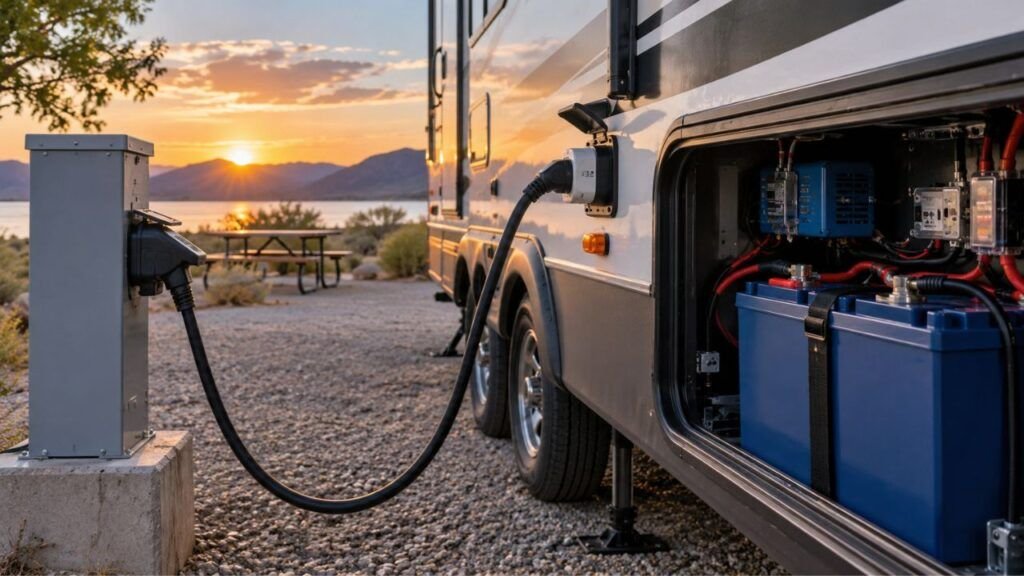
Yes, an RV lithium battery normally charges while connected to shore power. However, shore power does not charge the battery directly. Your RV’s converter or inverter/charger converts 120V AC electricity into DC charging power. The charging system must also be connected, working properly, and compatible with your lithium battery.
If your battery does not gain charge while plugged in, don’t assume the battery has failed. I’ll show you how shore power charging works, what equipment matters, how long charging takes, and what to check when something is not working.
Key Takeaways
- Shore power normally charges an RV lithium house battery automatically.
- Your converter or inverter/charger performs the actual battery charging.
- Having working RV outlets does not prove your battery is charging.
- A lithium-compatible charging profile provides the best charging performance.
- The battery disconnect usually needs to remain connected for charging.
- Cold temperatures may cause the lithium battery’s BMS to block charging.
- Battery current, voltage, or a monitor can confirm actual charging.
- A 30-amp or 50-amp hookup does not determine battery charging speed.
Does an RV Lithium Battery Charge While Plugged Into Shore Power?
An RV lithium battery should begin charging automatically after you connect your RV to shore power, assuming the charging system is working correctly.
The campground pedestal or household outlet provides 120V AC electricity. Your lithium house battery needs DC electricity instead. The RV’s converter handles that conversion and sends suitable DC power toward the battery.
Some larger RV electrical systems use an inverter/charger instead. It can manage battery charging whenever shore power becomes available.
However, plugging your RV into electricity does not guarantee charging.
Several things must happen correctly.
The converter needs AC power. Its charging circuit must remain connected to the battery. Fuses and breakers must also be intact. Finally, the lithium battery’s BMS must allow charging.
That distinction becomes important when troubleshooting.
Your microwave, air conditioner, and wall outlets may work perfectly. Meanwhile, your lithium battery could still receive no charging current.
How Shore Power Gets From the Pedestal to Your Lithium Battery
Several electrical components sit between the campground pedestal and your battery. Understanding that path makes troubleshooting much easier.
Shore Power Brings 120V AC Into the RV
A campground pedestal usually provides 30-amp or 50-amp RV service. Some owners also plug their RV into a household outlet.
Electricity enters through your shore cord and RV power inlet.
It then reaches the RV’s AC breaker panel. From there, electricity can power your 120V appliances and the battery-charging equipment.
The Converter Changes AC Electricity Into DC Power
Your house battery cannot directly use campground AC electricity for charging.
The converter changes incoming 120V AC electricity into lower-voltage DC electricity. That DC electricity operates many RV systems and charges the battery.
The basic charging path looks like this:
Shore pedestal → shore cord → AC breaker panel → converter/charger → lithium battery
While plugged in, the converter can also power:
- Interior lights
- Water pump
- Vent fans
- Furnace controls
- Refrigerator controls
- Other 12V equipment
The converter may therefore support DC appliances and charge simultaneously.
The Battery Management System Allows or Blocks Charging
Most RV LiFePO4 batteries include an internal Battery Management System, commonly called a BMS.
Think of the BMS as the battery’s protection system.
It can interrupt charging when conditions move outside safe limits.
Possible reasons include:
- Battery temperature is too low.
- Battery temperature becomes too high.
- Charging voltage becomes excessive.
- Charging current exceeds allowed limits.
- Individual cells reach unsafe voltage levels.
- Another internal protection condition occurs.
That means your converter could be working while charging remains blocked.
Converter vs. Inverter/Charger: Which One Charges the Battery?
These terms often cause unnecessary confusion for RV owners. They perform different jobs, although some equipment combines several functions.
What an RV Converter/Charger Does
A converter takes incoming AC electricity and produces DC electricity.
When shore power is available, it can power 12V equipment while charging the house battery.
Many travel trailers and older RVs use separate converters.
What an Inverter Does
An inverter works in the opposite direction.
It takes DC battery power and changes it into 120V AC electricity.
That allows certain household-style appliances to operate while you’re camping without shore power.
A basic inverter does not automatically charge your battery.
What an Inverter/Charger Does
An inverter/charger combines both functions.
When shore power is available, it can charge the battery. It may also pass incoming AC electricity to selected RV circuits.
When shore power disappears, it can switch directions. The unit then uses battery power to create AC electricity.
These systems are common in larger lithium battery installations.
Does Your RV Converter Need to Be Lithium-Compatible?
LiFePO4 batteries charge differently from traditional lead-acid batteries. The converter’s charging profile therefore matters for performance and battery health.
What a Lithium Charging Profile Changes
Lithium-compatible chargers use charging behavior designed for LiFePO4 batteries.
Depending on the manufacturer, this can affect:
- Maximum charging voltage
- Charging current
- Charging duration
- Charge termination
- Maintenance voltage
- Charging restart behavior
Many 12V LiFePO4 systems use charging voltages around 14.2V to 14.6V during higher-voltage charging.
However, don’t treat one number as universal.
Your battery manufacturer’s recommended voltage should always take priority.
Lithium batteries also generally do not need lead-acid equalization or desulfation cycles. Those features can apply inappropriate voltages to lithium batteries.
Can an Older Lead-Acid Converter Still Charge a Lithium Battery?
Sometimes it can.
An older converter may put useful energy into a lithium battery. That doesn’t automatically mean it provides an ideal charging profile.
You might notice:
- Slower charging
- Charging stopping before full capacity
- Battery percentage remaining below 100%
- Incorrect maintenance voltage
- Unwanted equalization cycles
- BMS protection activating unexpectedly
Some older fixed-voltage converters may charge LiFePO4 batteries reasonably well for certain situations. Others may perform poorly.
So don’t replace equipment based only on its age.
Find its specifications first.
How to Find Out What Converter Your RV Has
Start at your RV’s power distribution center.
Look for a manufacturer’s label and model number.
Then check whether the converter mentions:
- Lithium
- LiFePO4
- LFP
- Li mode
- Battery-type selection
Compare its output voltage with your battery manufacturer’s charging requirements.
If you’re unsure, checking model specifications is much better than guessing.
Lithium vs. Lead-Acid Charging on Shore Power
Lithium and lead-acid batteries can both charge from shore power. However, their preferred charging behavior differs considerably.
| Charging Characteristic | LiFePO4 RV Battery | Lead-Acid RV Battery |
| Charge acceptance | Usually remains high | Decreases significantly near full charge |
| Battery-specific charging profile | Recommended | Lead-acid profile required |
| Equalization | Usually avoided | Sometimes used with flooded batteries |
| Long absorption stage | Usually unnecessary | Common |
| Float charging | Depends on system design | Commonly used |
| Cold charging | Often restricted near freezing | Different cold-weather limits |
| Internal BMS | Usually included | Usually not included |
| Voltage as charge indicator | Less accurate through mid-range | More useful after resting |
These are general differences, not universal specifications. Always follow your particular battery manufacturer’s charging instructions.
Should the RV Battery Disconnect Be On When Connected to Shore Power?
Usually, yes.
If you want shore power to charge your house battery, the battery disconnect normally needs to remain in the ON, USE, or CONNECTED position.
Turning the disconnect off may separate the battery from the converter.
Your 12V lights might still work because the converter is supplying them directly. Meanwhile, the battery itself may receive no charging current.
However, RV disconnect systems are not wired identically.
Some manufacturers allow certain charging circuits to bypass the disconnect switch.
If your battery doesn’t charge, check these areas:
- Battery disconnect position
- Converter output fuse
- Battery fuse or breaker
- Loose battery terminals
- Ground connections
- Converter operation
- BMS protection status
Don’t assume the disconnect switch works exactly like another RV’s switch.
Does Shore Power Charge the Battery While You Are Using RV Appliances?
Yes, it normally can.
Your converter can support the RV’s 12V equipment while sending remaining available charging current into the battery.
Suppose you have a 55-amp converter.
That doesn’t necessarily mean your battery constantly receives 55 amps.
If lights, fans, furnace controls, and other DC equipment currently consume 15 amps, less converter capacity remains available for charging.
Battery condition also affects charging current.
A partly discharged lithium battery may accept substantial current. A nearly full battery may accept much less.
So charging speed can change even though shore power stays connected.
Does a 30-Amp or 50-Amp Shore Connection Charge Lithium Faster?
Not automatically.
This is one of the easiest RV charging numbers to misunderstand.
A 30-amp shore connection describes how much 120V AC power your RV can draw from the pedestal.
It does not mean 30 amps flow directly into your lithium battery.
Likewise, a 50-amp RV hookup doesn’t automatically provide faster battery charging.
Battery charging speed depends mainly on things like:
- Converter or inverter/charger output
- Battery maximum charging current
- Battery state of charge
- Number of batteries
- Active 12V loads
- Wiring resistance
- Battery temperature
- BMS limits
Imagine two RVs using the same 30-amp campsite connection.
One RV has a 30A converter. Another has a 60A lithium-compatible converter.
Their batteries could charge at very different speeds despite using identical shore service.
How Long Does an RV Lithium Battery Take to Charge on Shore Power?
Battery capacity and actual charging current provide a useful starting point. Real charging time can still vary with the RV’s electrical load.
A simple estimate is:
Charging time ≈ amp-hours needing replacement ÷ actual charging amps
Suppose your 100Ah lithium battery needs about 80Ah replaced.
If the battery receives approximately 40A of charging current:
80Ah ÷ 40A = about 2 hours
That is only a rough estimate.
Real charging time can change because of:
- Appliances using converter capacity
- Converter current limitations
- Battery BMS limits
- Cable voltage drop
- Battery temperature
- Multiple batteries
- Charging behavior near full capacity
If you’re running several 12V loads, the battery may charge slower.
How Can You Tell If Your RV Lithium Battery Is Actually Charging?
You don’t need to guess whether shore power is charging your battery. A few simple checks can provide a much clearer answer.
Check the Battery Monitor or Bluetooth App
This is usually the easiest method.
Many modern lithium batteries provide Bluetooth monitoring. RV owners may also have a shunt-based battery monitor.
Look for:
- Positive charging current
- Increasing state of charge
- Rising battery voltage
- Charger status
- BMS warnings
Positive current flowing into the battery is strong evidence that charging is occurring.
Check Battery Voltage
Measure battery voltage before connecting shore power.
Then connect the RV and check again after charging begins.
You would normally expect battery voltage to rise while the charger operates.
Exact voltage depends on your battery and charging stage.
Don’t rely on one universal voltage number.
Check the Converter or Inverter/Charger Display
Some chargers provide status lights or digital displays.
Look for information such as:
- Charging
- Bulk
- Lithium mode
- Charge current
- Battery voltage
- Error codes
An inverter/charger may also show incoming AC power.
Don’t Use Working AC Appliances as Proof
This mistake causes plenty of unnecessary battery troubleshooting.
Your microwave working does not prove your battery is charging.
Neither does your air conditioner, television, or wall outlet.
Those devices can receive 120V electricity directly from shore power.
Your battery depends on the separate DC charging path.
Why Isn’t My RV Lithium Battery Charging on Shore Power?
When the battery isn’t charging, start with simple checks first. Most problems come from the charging path, settings, or battery protection system.
The Battery Disconnect Is Off
Check this before removing panels or testing anything complicated.
Place the disconnect in the position your RV uses for normal battery operation.
If charging starts afterward, you’ve found the problem.
The Converter Breaker or Fuse Has Tripped
Your converter normally receives AC power through a breaker.
It may also have DC output fuses.
A tripped breaker or blown fuse can stop battery charging completely.
Reset breakers once if appropriate.
If they immediately trip again, don’t keep resetting them. There may be an electrical fault that requires professional diagnosis.
The Converter Is Set Incorrectly
Some modern converters have selectable battery profiles.
If yours is set for lead-acid instead of lithium, charging performance may suffer.
Check its battery-type setting.
The Converter Has Failed
Converters do eventually fail.
A failed converter may produce little or no DC charging output.
Before replacing it, verify its breaker, fuses, connections, and battery settings.
Power Isn’t Reaching the Battery
Sometimes the converter works perfectly, but electricity cannot reach the battery.
Possible causes include:
- Blown inline fuse
- Tripped DC breaker
- Loose battery cable
- Poor ground connection
- Corroded terminal
- Damaged wiring
A voltage test at different points can help locate the interruption.
The Battery Is Already Nearly Full
Very low charging current isn’t always a problem.
A lithium battery at or near full charge may need little additional energy.
Check its state of charge before assuming something failed.
The BMS Has Stopped Charging
Your lithium battery can intentionally stop accepting charge.
Common reasons include:
- Low cell temperature
- High temperature
- Excessive charging voltage
- Excessive current
- Internal protection event
A Bluetooth battery app can make this much easier to identify.
The Battery Is Too Cold
Cold charging protection is especially important during winter RV use.
Many LiFePO4 batteries restrict charging around or below freezing.
The converter may appear completely normal while the BMS refuses charging.
That isn’t necessarily a converter problem.
Will an RV Lithium Battery Charge From Shore Power Below Freezing?
It depends on the battery.
Many conventional LiFePO4 batteries stop accepting normal charging around 32°F because charging very cold lithium cells can cause permanent damage.
However, battery designs differ.
Some lithium RV batteries include internal heaters.
When charging power becomes available, the battery may first use that energy to warm its cells. Normal charging begins once internal temperature reaches an acceptable level.
Other batteries simply disable charging until temperatures improve.
Before charging in winter:
- Check the battery’s charging temperature range.
- Look at cell temperature through its app.
- Check for low-temperature BMS protection.
- Confirm whether the battery is self-heating.
- Follow the manufacturer’s temperature limits.
Remember that outside air temperature isn’t always battery temperature.
A battery installed inside a heated compartment could remain considerably warmer.
Can You Leave an RV Lithium Battery Connected to Shore Power All the Time?
In many modern RV systems, yes.
A correctly configured lithium-compatible charger can manage charging automatically while shore power remains connected.
However, there is a difference between camping while plugged in and storing your RV for several months.
Lithium batteries generally don’t need to sit at maximum state of charge throughout long storage periods.
Storage recommendations vary between manufacturers.
If your RV will remain parked for months, check the battery manufacturer’s preferred storage percentage and maintenance instructions.
Also verify that your charger doesn’t use inappropriate equalization or desulfation modes.
Don’t rely only on the BMS to correct an unsuitable charging setup.
What Happens When Shore Power Is Disconnected?
Once shore power disappears, the converter stops receiving its AC input.
Your connected lithium house battery then supplies the RV’s 12V systems.
Lights, water pumps, control boards, and other DC equipment can continue operating from battery power.
If your RV has an inverter, selected 120V appliances may also continue working.
The inverter takes DC battery energy and converts it into AC electricity.
This transition explains why your battery matters even when the converter powers many systems while you’re plugged in.
Final Verdict
Yes, your RV lithium battery should normally charge while connected to shore power. The campground pedestal doesn’t charge it directly, though. Your converter or inverter/charger must convert AC electricity into the DC charging power your battery needs.
If the battery percentage isn’t rising, don’t immediately replace the battery. Check charging current, converter settings, the disconnect switch, fuses, wiring, and BMS status first. In many cases, the battery itself is working exactly as designed.
Related FAQs
Does My RV Battery Automatically Charge When Plugged Into Shore Power?
Yes, most RV house batteries automatically charge when shore power is connected and a functioning converter or inverter/charger is connected to the battery. A disconnected battery, failed converter, blown fuse, or BMS protection can prevent charging.
Should My Battery Disconnect Be On When Plugged Into Shore Power?
Usually, yes. The disconnect generally needs to remain ON or CONNECTED so the converter can charge your lithium house battery. However, disconnect wiring differs between RV manufacturers, so check your RV’s electrical documentation if you’re unsure.
Does a 30-Amp RV Hookup Charge the Battery Faster?
Not necessarily. A 30-amp hookup describes available AC shore power, while battery charging speed depends mainly on your converter output, battery charging limit, current 12V loads, and battery state of charge.
Does a 50-Amp RV Hookup Charge Faster Than 30-Amp Service?
Not automatically. A 50-amp connection provides more AC capacity for the RV, but your converter or inverter/charger still determines how much charging current can reach the battery.
Can an Old RV Converter Charge a Lithium Battery?
Some older converters can put charge into a LiFePO4 battery, but they may not provide the ideal voltage profile or full charging performance. Check the converter’s specifications against your lithium battery manufacturer’s charging requirements.
What Voltage Should I See When My RV Lithium Battery Is Charging?
Many 12V LiFePO4 systems reach somewhere around 14.2V to 14.6V during higher-voltage charging, but exact requirements vary. Always use your battery manufacturer’s recommended charging range rather than treating one voltage as universal.
Why Is My RV Battery Not Charging Even Though the Outlets Work?
Your AC outlets can receive electricity directly from shore power while the battery uses a separate DC charging path. A converter problem, blown fuse, open disconnect, damaged cable, or BMS protection could stop battery charging while the outlets continue working.
Can I Use My RV While the Lithium Battery Is Charging?
Yes. You can normally use your RV while shore power charges the lithium battery. The converter supplies DC loads and sends available remaining current toward the battery.
Will Shore Power Charge a Completely Dead Lithium RV Battery?
It may, but a deeply discharged lithium battery can enter BMS protection mode. Some chargers can wake the battery automatically, while others may not recognize it until the BMS is reset or an approved recovery procedure is used.
Can Shore Power and Solar Charge My RV Lithium Battery Together?
Yes, properly configured shore and solar chargers can work with the same battery bank. Both charging systems should use settings compatible with your lithium battery’s required voltage and charging limits.
Does Shore Power Bypass the RV Battery?
Shore power directly operates many AC appliances while the converter powers 12V systems and charges the battery. Whether specific DC equipment continues operating without the battery depends on your RV’s electrical design.
Why Does My Lithium Battery Stop Charging at 80% or 90% on Shore Power?
Possible causes include an incompatible converter profile, incorrect monitor calibration, wiring voltage drop, charger settings, BMS limits, or converter output limitations. Check actual charging current and charger settings before assuming the battery has lost capacity.

Ryan Carter writes practical battery guides focused on troubleshooting, everyday use, and smarter buying decisions. His experience with lithium batteries, RV and automotive power, and home backup systems helps readers choose reliable solutions with confidence.















