
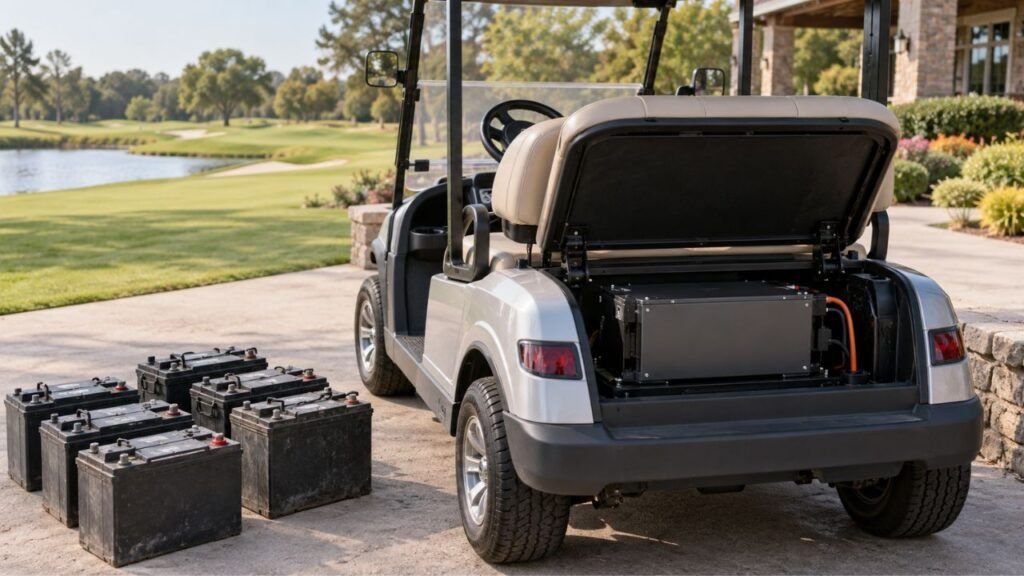
Yes, one lithium golf cart battery can replace multiple lead-acid batteries when properly sized. A single lithium pack can provide the same system voltage while reducing weight, wiring, maintenance, and charging time. However, voltage, capacity, BMS output, charger compatibility, and cart requirements must all match.
If you are considering this upgrade, battery count is only the beginning. I’ll explain how one lithium pack replaces several batteries, what performance changes to expect, and what you should check before spending your money.
Key Takeaways
- One lithium pack can replace four, six, or eight lead-acid batteries.
- The lithium battery must match your golf cart’s required system voltage.
- A single lithium pack still contains many individual cells internally.
- Lithium normally removes hundreds of pounds from the battery compartment.
- Fewer external batteries mean fewer cables and corrosion points.
- Lithium usually provides steadier voltage as the battery discharges.
- A proper BMS rating is especially important for hills and heavy loads.
- Your existing lead-acid charger may not work correctly with lithium.
- Lead-acid remains attractive when keeping upfront costs low matters most.
One Lithium Battery vs Multiple Lead-Acid Batteries: Quick Comparison
At first glance, replacing six batteries with one seems unusual. However, both systems can supply the same required golf cart voltage.
| Comparison | One Lithium Golf Cart Battery | Multiple Lead-Acid Batteries |
| Typical 48V setup | One integrated 48V-class pack | 6×8V, 8×6V, or 4×12V |
| External battery cases | Usually one | Usually four to eight |
| Overall weight | Much lighter | Much heavier |
| External connections | Fewer | More |
| Voltage during discharge | More consistent | Drops more noticeably |
| Routine watering | None | Required for flooded batteries |
| Terminal corrosion | Less likely | More connection points |
| Charging time | Usually faster | Usually slower |
| Battery management | Internal BMS | Managed through charger and battery care |
| Maintenance | Low | Regular attention required |
| Upfront cost | Higher | Lower |
| Typical lifespan | Longer | Shorter |
| Battery gauge | Often SOC display or app | Often voltage-based |
| Best for | Convenience and long-term ownership | Lower initial purchase price |
The big difference is therefore not simply battery quantity. It is how each system stores and delivers energy.
How Can One Lithium Battery Replace Six or Eight Lead-Acid Batteries?
A golf cart does not care how many battery cases you have. It needs the correct voltage and enough usable electrical capacity.
Multiple Lead-Acid Batteries Combine Their Voltage
Traditional golf carts use several lower-voltage batteries connected in series.
For example:
- Six 6V batteries create a 36V system.
- Six 8V batteries create a 48V system.
- Eight 6V batteries also create a 48V system.
- Four 12V batteries can create a 48V system.
When batteries are connected in series, their voltages add together.
Their amp-hour ratings do not add in the same way.
Suppose six 8V, 170Ah batteries are connected in series. The resulting bank remains around 170Ah, but its voltage becomes 48V.
That distinction matters when comparing replacement batteries.
One Lithium Battery Is Really an Integrated Battery Pack
A single lithium golf cart battery looks like one large battery. Internally, though, it contains many smaller lithium cells.
Those cells are arranged to create the necessary voltage and capacity.
The pack normally includes:
- LiFePO4 battery cells
- Internal cell connections
- A Battery Management System
- Temperature sensors
- Cell balancing
- Overcurrent protection
- Overvoltage protection
- Undervoltage protection
- Charging and discharging safeguards
So you are not replacing several lead-acid batteries with one cell.
You are replacing several external battery cases with one integrated system.
That design is one reason lithium conversions look much cleaner.
Why You Should Not Compare Amp-Hours Alone
This is where many golf cart owners understandably become confused.
You might see a 100Ah lithium battery beside 150Ah lead-acid batteries. That can make the lithium battery appear much smaller.
The comparison is not that simple.
A useful starting calculation is:
Watt-hours = Voltage × Amp-hours
Watt-hours tell you how much energy the battery theoretically stores.
However, usable energy also depends on battery chemistry and discharge behavior.
Flooded lead-acid batteries generally perform best when you avoid repeatedly draining them extremely deeply. Deep discharges can shorten their service life.
LiFePO4 batteries can normally use a greater portion of their rated capacity.
Lithium also maintains voltage more consistently during discharge.
Therefore, two batteries with different Ah ratings can sometimes provide surprisingly similar usable driving performance.
When shopping, compare usable energy rather than only the Ah sticker.
How Much Weight Do You Save With One Lithium Pack?
Weight reduction is one of the most noticeable lithium conversion benefits.
A traditional lead-acid bank can easily weigh several hundred pounds.
For example, imagine six 8V batteries weighing around 60–65 pounds each.
That gives you roughly:
6 × 63 pounds = 378 pounds
A single 48V lithium golf cart pack may weigh around 100–130 pounds, depending on capacity and construction.
That could remove roughly 200–280 pounds from the cart.
Some configurations save even more weight.
I would avoid assuming every conversion removes 300–500 pounds, though. Actual savings depend on your original batteries and replacement capacity.
Reducing battery weight can improve how responsive the cart feels.
You may notice easier acceleration and lighter steering behavior.
The motor also has less mass to move during every trip.
However, lighter does not automatically mean a faster top speed.
Motor programming, gearing, tires, and controller settings still matter.
You should also secure the lighter battery properly.
The old battery tray was designed around several heavy batteries. Your lithium pack should have proper brackets and hold-down hardware.
Major weight changes can also alter weight distribution slightly.
That matters more on modified, lifted, or heavily loaded carts.
Does One Lithium Battery Improve Golf Cart Performance?
Lithium often changes how a golf cart feels while driving. The biggest difference usually comes from steadier voltage under load.
Lithium Holds Voltage More Consistently
Lead-acid battery voltage gradually declines as charge disappears.
You may have noticed this yourself.
Your cart feels strong after charging but becomes sluggish later.
Hills become harder.
Acceleration becomes weaker.
That behavior becomes more noticeable as lead-acid batteries age.
Lithium batteries generally maintain a flatter discharge voltage.
The cart can therefore feel more consistent throughout the charge.
You still lose range as energy runs out.
The difference is that performance usually does not fade as gradually.
BMS Current Rating Matters
This is one specification I would never ignore.
A lithium battery’s amp-hour rating mainly helps describe its capacity.
The BMS current rating tells you how much current the battery can safely deliver.
Look for two important specifications:
- Continuous discharge current
- Peak discharge current
Continuous current covers normal ongoing operation.
Peak current handles brief power demands during acceleration or climbing.
This becomes especially important if your cart has:
- Large tires
- A lift kit
- A high-performance controller
- Heavy passenger loads
- Steep hills
- Utility equipment
- Motor modifications
A battery can have plenty of Ah capacity yet still have an undersized BMS.
In that situation, the BMS may shut down during heavy acceleration.
Do not size a golf cart lithium battery using Ah alone.
Lithium Does Not Automatically Increase Top Speed
You may feel better acceleration after removing several hundred pounds.
Steadier voltage can also keep performance more consistent.
However, the battery does not independently determine maximum speed.
Top speed also depends on:
- Motor design
- Controller limits
- Gear ratio
- Tire diameter
- Vehicle programming
- Mechanical condition
Think of lithium as improving the power supply.
It does not automatically rewrite the cart’s speed limits.
Regenerative Braking Needs Compatibility
Some golf carts use regenerative braking.
During regenerative braking, the motor sends electrical energy back toward the battery.
That charging current must remain within the lithium battery’s acceptable limits.
The BMS must also tolerate the cart’s regenerative voltage.
If charging voltage becomes excessive, the BMS may disconnect the battery.
That can cause unexpected behavior.
For this reason, regenerative braking compatibility should be checked before conversion.
Do not assume every 48V lithium pack works with every 48V cart.
Is One Lithium Battery Electrically Simpler?
In many ways, yes. One integrated pack removes several external connections, but there are still important tradeoffs.
- Fewer battery cables: You eliminate most inter-battery jumper cables.
- Fewer terminals: There are fewer connections that can loosen.
- Less corrosion: Fewer exposed terminals reduce corrosion points.
- No battery-to-battery mismatch: Separate batteries cannot age differently.
- Built-in monitoring: Many packs provide displays or Bluetooth monitoring.
- Integrated protection: The BMS monitors cells and electrical limits.
- Cleaner battery compartment: Wiring usually becomes much simpler.
- Simpler troubleshooting: Fault information may be available electronically.
- One main failure point: A complete pack failure disables the whole system.
- BMS shutdowns matter: Protection events can temporarily stop battery output.
That final point deserves attention.
A traditional lead-acid bank contains several separate batteries. One weak battery can hurt the entire bank, but individual batteries can be tested separately.
A single lithium pack places everything inside one enclosure.
That is simpler, but it also makes pack quality extremely important.
Charging One Lithium Battery vs a Lead-Acid Bank
Lithium generally provides faster and more convenient charging. However, your charger must use the correct charging profile.
Lithium Usually Charges Faster
A lithium golf cart battery can often recharge much faster.
Actual charging time depends on several factors:
- Battery capacity
- Charger output
- Starting charge level
- Battery temperature
- BMS charging limits
For example, a larger charger can recharge faster than a smaller one.
That does not mean you should use any high-output charger available.
The battery manufacturer sets acceptable charging current limits.
Follow those limits.
Lead-acid batteries commonly require longer charging periods, especially after deeper discharge.
They may also need additional charging stages before reaching full capacity.
Lithium’s charging behavior is generally more efficient and straightforward.
Your Old Lead-Acid Charger May Not Work
This is one of the most important conversion checks.
Do not assume your old charger is safe because the voltage matches.
Lithium batteries require a suitable lithium charging profile.
Lead-acid chargers may use charging stages that lithium batteries do not need.
Some chargers can be reprogrammed.
Others must be replaced.
Before buying your new battery, check whether:
- Your existing charger supports LiFePO4.
- A lithium profile can be programmed.
- The charger voltage matches the battery.
- Charging current stays within BMS limits.
- The battery manufacturer approves the charger.
The physical battery replacement may look simple.
The charging system still needs to match.
Cold-Weather Charging Works Differently
Cold temperatures deserve extra attention with lithium batteries.
LiFePO4 batteries can normally discharge in colder conditions than they can safely charge.
Many BMS systems block charging when cells become too cold.
Some batteries include internal heaters.
Others rely entirely on low-temperature charging protection.
If you use your golf cart during cold winters, check this before buying.
Follow the temperature limits specified for your exact battery.
Maintenance: One Pack Is Easier, but Not Completely Hands-Off
One lithium pack eliminates most traditional battery maintenance. You should still inspect the battery system periodically.
Lead-Acid Battery Bank Maintenance
Flooded lead-acid batteries need regular attention.
Typical maintenance includes:
- Checking electrolyte levels
- Adding distilled water when necessary
- Cleaning terminal corrosion
- Inspecting cables
- Keeping battery tops clean
- Checking charging performance
- Following equalization recommendations
- Inspecting all inter-battery connections
You have several batteries, so you have several possible trouble points.
One loose jumper cable can cause performance problems.
One poorly maintained battery can also weaken the entire series bank.
Lithium Removes Most Routine Battery Maintenance
A sealed LiFePO4 pack eliminates electrolyte watering.
You also eliminate most battery-to-battery jumper connections.
There is no flooded acid electrolyte to refill.
Routine equalization charging is also unnecessary.
For many owners, this convenience alone makes lithium appealing.
You charge the pack and drive the cart.
That is much easier than maintaining six separate flooded batteries.
Maintenance-Free Does Not Mean Never Inspect It
I would still inspect a lithium system periodically.
Check:
- Battery mounting
- Main cable condition
- Terminal tightness
- Fuse or breaker condition
- Charger operation
- BMS warnings
- Battery display
- Physical damage
- Water intrusion
- Storage charge requirements
A lithium battery saves maintenance time.
It does not eliminate basic electrical inspection.
Lifespan and Cost: One Lithium Pack vs Complete Lead-Acid Sets
Lithium costs more initially, while lead-acid remains cheaper to purchase. Long-term cost depends heavily on how long you keep your cart.
Lead-Acid Usually Costs Less Upfront
A complete flooded lead-acid battery set generally has a lower purchase price.
That makes lead-acid attractive if money is tight today.
However, compare complete systems fairly.
Do not compare one lithium pack with one lead-acid battery.
Your golf cart may require four, six, or eight lead-acid batteries.
The correct comparison is:
One complete lithium pack versus one complete lead-acid bank.
You should also include charger costs when necessary.
Lithium Usually Lasts Longer
LiFePO4 batteries generally support far more charge cycles than flooded lead-acid batteries.
Actual lifespan depends on:
- Battery quality
- Depth of discharge
- Charging habits
- Temperature
- Storage conditions
- Current demand
- Usage frequency
Lithium may last many years under proper conditions.
Lead-acid lifespan is more sensitive to maintenance and deep discharge.
Letting flooded batteries sit partially discharged can shorten their life.
Repeated deep discharges also accelerate wear.
That difference matters if you use your golf cart frequently.
Calculate Long-Term Ownership Cost
I recommend calculating the full ownership cost before choosing.
For lead-acid, include:
Initial battery bank cost
+ future replacement banks
+ maintenance
+ installation
+ charging costs
For lithium, include:
Lithium battery
+ compatible charger
+ mounting kit
+ possible battery meter
+ possible DC-DC converter
+ installation
The higher lithium purchase price can make sense over several years.
But it is not automatically cheaper for every owner.
When Lead-Acid May Still Save Money
Lead-acid can make practical financial sense when:
- You use your cart occasionally.
- You may sell the cart soon.
- Your cart is already very old.
- Upfront cost is your main concern.
- Your current charger works perfectly.
- You are comfortable doing maintenance.
There is nothing wrong with choosing lead-acid for those reasons.
The best battery is the one that fits your ownership situation.
What Should You Check Before Replacing Lead-Acid With One Lithium Battery?
A lithium conversion involves more than matching the voltage label. I recommend working through this checklist before ordering anything.
- System voltage: Confirm whether your cart is 36V, 48V, or 72V.
- Operating voltage range: Confirm the battery matches the controller’s limits.
- Battery capacity: Choose enough Ah or Wh for your normal driving range.
- Continuous BMS current: It must support normal motor demand.
- Peak BMS current: It must handle acceleration and hills.
- Motor controller: Make sure it accepts the lithium voltage range.
- Regenerative braking: Confirm the battery accepts regenerative charging.
- Battery charger: Use a compatible lithium charging profile.
- Onboard charging system: Older carts may need changes.
- 12V accessories: Lights and radios may need regulated power.
- DC-DC converter: Check whether accessories require one.
- Battery gauge: Old voltage-based gauges may become inaccurate.
- Battery tray: Confirm the new pack physically fits.
- Mounting hardware: The lighter battery must remain firmly secured.
- Main cables: Check cable size and terminal positions.
- Fuse or breaker: Follow battery manufacturer requirements.
- Weight distribution: Consider large changes on modified carts.
- Warranty: Check both battery and vehicle warranty requirements.
- Vehicle model: Never assume every 48V cart uses identical electronics.
Taking ten minutes to check these details can prevent expensive mistakes.
One Lithium Battery vs Six Lead-Acid Batteries: A Simple 48V Example
Imagine your golf cart currently uses six 8V flooded batteries.
Those six batteries are connected in series.
Together, they create a 48V electrical system.
Now suppose you install one correctly sized 48V-class LiFePO4 golf cart pack.
The cart still receives the voltage range it needs.
What changes is the battery architecture.
Instead of six separate battery cases, you have one enclosure.
Instead of five inter-battery jumper cables, those cell connections live inside the pack.
You no longer check water levels across six batteries.
You no longer clean corrosion between several battery terminals.
The new pack’s BMS handles cell balancing and protection internally.
You may also gain an accurate battery percentage display.
However, you might need a lithium-compatible charger.
Your 12V accessories may also require a DC-DC converter.
This is why I prefer calling lithium conversions system upgrades.
They are not always simple battery swaps.
Does Fewer Batteries Mean Fewer Problems?
Usually, fewer external batteries mean fewer routine trouble points.
You have fewer terminals to clean.
You have fewer cables that can loosen.
Also, you eliminate differences between individual lead-acid batteries.
You also eliminate the possibility of one weak lead-acid battery dragging down several healthy batteries.
That simplicity is valuable.
However, one lithium pack is still not failure-proof.
The BMS may shut the battery down when it detects:
- Excessive current
- Excessive charging voltage
- Very low battery voltage
- Excessive temperature
- Low charging temperature
- Internal cell imbalance
- Other unsafe conditions
A protection shutdown is actually doing its job.
But when the BMS disconnects, the entire pack stops providing power.
That is why battery quality and correct sizing matter so much.
Simpler does not mean impossible to fail.
It means you have fewer external components to maintain.
Which Setup Is Better for Your Golf Cart?
There is no perfect battery choice for every owner. Your driving habits, budget, and ownership plans should guide the decision.
Choose One Lithium Golf Cart Battery If You:
- Drive your golf cart frequently.
- Want less routine battery maintenance.
- Regularly drive steep hills.
- Carry several passengers.
- Want faster charging.
- Want to reduce vehicle weight.
- Plan to keep the cart for years.
- Want fewer battery cables.
- Prefer digital battery monitoring.
- Can afford the higher initial cost.
Lithium becomes especially attractive for heavily used personal and utility carts.
You pay more initially for convenience and long-term performance.
Keep Multiple Lead-Acid Batteries If You:
- Want the lowest immediate purchase price.
- Use your golf cart occasionally.
- Expect to sell the cart soon.
- Already own a good lead-acid charger.
- Prefer locally available replacement batteries.
- Do not mind checking water levels.
- Want to keep the cart close to factory configuration.
A properly maintained lead-acid bank can still serve many owners well.
It simply requires more routine attention.
Do Not Choose Based on Battery Count Alone
One battery is not automatically better because there is only one.
Likewise, six batteries are not automatically stronger because there are more.
Look at the complete system.
Voltage, usable energy, BMS output, charging compatibility, and vehicle requirements matter much more than the number of battery cases.
Common Mistakes When Switching From Multiple Batteries to One Lithium Pack
A lithium conversion can work extremely well when planned correctly. Most problems come from overlooking compatibility details.
- Buying a battery only because the label says 48V
- Comparing batteries using Ah alone
- Choosing a BMS with insufficient current output
- Reusing an incompatible lead-acid charger
- Ignoring regenerative braking
- Forgetting 12V lights and accessories
- Trusting an old lead-acid battery gauge
- Leaving the lithium pack loosely mounted
- Choosing insufficient range capacity
- Ignoring cable and fuse requirements
- Assuming every Club Car uses identical electronics
- Assuming every E-Z-GO uses identical electronics
- Assuming every Yamaha conversion is identical
- Mixing lithium and lead-acid batteries
- Mixing old and new lead-acid batteries
- Assuming lighter always means higher top speed
Avoiding these mistakes makes the conversion much more predictable.
Final Verdict
For most owners who regularly use their golf cart, one properly matched lithium battery is usually more convenient than multiple flooded lead-acid batteries. You get less weight, fewer external connections, no battery watering, steadier power, faster charging, and generally longer service life.
Lead-acid still has one major advantage: lower upfront cost. If you rarely use your cart or expect to replace it soon, buying another conventional battery bank may make better financial sense.
If you decide to switch, focus on the entire electrical system rather than battery count. Match the voltage, usable capacity, BMS current, charger, regenerative braking system, accessories, mounting, and controller requirements.
A lithium conversion works best when every component is compatible.
That is much more important than simply finding a battery marked “48V.”
Related FAQs
Can One 48V Lithium Battery Replace Six 8V Lead-Acid Batteries?
Yes. One properly sized 48V-class lithium golf cart battery can replace six 8V lead-acid batteries connected in series. You still need to confirm capacity, BMS current, charger compatibility, controller limits, mounting, and regenerative braking requirements.
How Many Lithium Batteries Do I Need for a 48V Golf Cart?
Many modern 48V golf cart conversions use one integrated lithium pack. Modular setups using several lithium batteries also exist. The correct number depends on the battery design, voltage, capacity, and manufacturer recommendations rather than a fixed battery count.
Is a 100Ah Lithium Battery Equal to a 100Ah Lead-Acid Battery?
Not exactly. Both may carry a 100Ah rating, but usable capacity, discharge behavior, voltage sag, and recommended depth of discharge differ. Compare watt-hours, usable energy, current capability, and expected driving range instead of relying on Ah alone.
Does One Lithium Battery Make a Golf Cart Faster?
A lithium conversion can improve acceleration and maintain stronger performance as charge drops because the battery weighs less and holds voltage better. However, your motor, controller, gearing, tire size, and programming still determine maximum speed.
Do I Need a New Charger When Switching to Lithium?
Possibly. Your existing charger must provide a charging profile approved for the lithium battery. Some chargers can be reprogrammed, while older lead-acid-only chargers may require replacement. Always verify compatibility before connecting the battery.
Can I Use My Existing Lights and 12V Accessories After Converting?
Usually, but they still need the correct supply voltage. Many 48V carts use a DC-DC converter to provide 12V power for lights, radios, USB ports, horns, and other accessories. Check how your accessories currently receive power.
What Happens If the Lithium Battery BMS Shuts Down While Driving?
The battery may temporarily stop supplying power when the BMS detects unsafe current, voltage, temperature, or another protected condition. Correct battery sizing reduces unexpected shutdowns, particularly during steep climbs or heavy acceleration.
Can I Replace Only One Bad Lead-Acid Golf Cart Battery?
You can physically replace one battery, but mixing one new battery with several heavily aged batteries often causes imbalance and poor performance. If the bank is already old, replacing the complete matched set is usually the better approach.
Is One Lithium Battery Safer Than Six Lead-Acid Batteries?
A quality LiFePO4 golf cart pack includes a BMS that protects against several electrical problems and eliminates flooded acid maintenance. However, safe operation still depends on proper installation, charging, fusing, mounting, wiring, and compatibility with the golf cart.
Will One Lithium Battery Fit Any Club Car, E-Z-GO, or Yamaha Golf Cart?
No. Two carts can both be labeled 48V while using different controllers, chargers, regenerative braking systems, wiring, trays, and accessories. Always check the exact model, year, voltage range, charger requirements, and lithium battery compatibility before converting.

Ryan Carter writes practical battery guides focused on troubleshooting, everyday use, and smarter buying decisions. His experience with lithium batteries, RV and automotive power, and home backup systems helps readers choose reliable solutions with confidence.















