
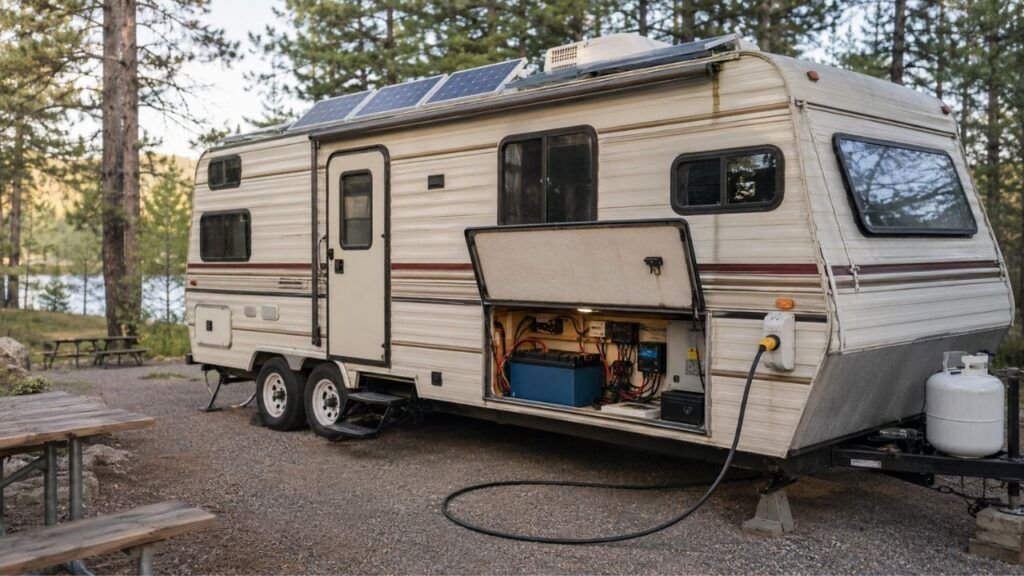
Yes, an older RV can often charge a lithium battery, but it may not charge it properly or efficiently. The real issue is usually the converter or charger, not the RV’s age. Older lead-acid converters may charge LiFePO4 batteries slowly, stop below the intended full-charge level, or use charging stages that are not ideal for lithium.
If you are upgrading an older motorhome, travel trailer, or camper, you do not necessarily need to replace everything. I’ll show you how to check your converter, understand its charging voltage, test your system, and decide which upgrades actually make sense.
Key Takeaways
- An older RV does not automatically need a new converter.
- Many older converters can still put energy into lithium batteries.
- Charging properly depends on voltage, current, and charger behavior.
- A lithium-specific converter usually provides faster, more predictable charging.
- Shore power, alternator, and solar charging should be checked separately.
- Your battery manufacturer determines the correct charging voltage.
- A DC-to-DC charger may help control alternator charging.
- Never install a larger converter without checking wiring and fuses.
Can an Older RV Actually Charge a Lithium Battery?
In many cases, yes. An older RV converter can still send charging current into a LiFePO4 battery. However, being able to charge the battery is different from charging it properly.
Some older converters produce enough voltage to charge lithium reasonably well. Others remain at a lower maintenance voltage intended for lead-acid batteries.
That lower voltage can still charge a discharged lithium battery. The problem usually appears as the battery approaches the upper part of its capacity.
Charging may slow considerably before the battery reaches its intended charging target.
There are generally three possible situations.
Your old converter may charge the lithium battery satisfactorily. It may charge the battery partially but slowly. Or its charging behavior may make replacement worthwhile.
This is why I would not judge compatibility by RV age alone.
A 2004 RV might already have a newer replacement converter. Meanwhile, a much newer used RV could still contain older charging equipment.
Check the equipment itself before ordering replacement parts.
Why Older RV Converters Can Struggle With LiFePO4 Batteries
Older RV charging systems were generally designed around lead-acid batteries. Lithium batteries behave differently, particularly during charging.
Older Converters Were Designed Around Lead-Acid Batteries
Traditional RV house batteries were commonly flooded lead-acid or AGM batteries.
Converters designed for those batteries may use several charging stages. These can include bulk, absorption, float, and maintenance stages.
Some chargers also include equalization or desulfation functions.
Those stages make sense for lead-acid chemistry. Lithium iron phosphate batteries do not require exactly the same charging routine.
That does not mean every old converter becomes dangerous with lithium.
It simply means you need to compare its behavior with your battery specifications.
Lithium Batteries Use Different Charging Targets
LiFePO4 batteries generally charge at higher voltages than many older maintenance converters provide.
You may see lithium chargers operating somewhere around the low-to-mid 14-volt range.
However, there is no single charging voltage that applies to every lithium battery.
Some batteries are designed around approximately 14.2 volts. Others may specify 14.4 or 14.6 volts.
Always follow the battery manufacturer’s recommended charging range.
I would avoid replacing equipment simply because somebody says lithium always requires exactly 14.6 volts.
Your battery manual should make that decision.
A Lower Voltage May Still Charge the Battery
This is where many RV owners get confused.
Suppose your older converter produces approximately 13.6 volts. That does not automatically mean your lithium battery receives no charge.
A sufficiently discharged LiFePO4 battery can still accept current at that voltage.
However, charging current may gradually fall as battery voltage rises.
The result can be slow charging near the top.
Your battery may also fail to reach the charging voltage needed for its normal full-charge behavior.
Whether that matters depends on your camping habits.
Someone connected to shore power for several days has different needs than someone running a generator for two hours.
Lead-Acid Float and Equalization Are Different Issues
Older lead-acid systems often maintain batteries at a lower float voltage.
Lithium batteries generally do not need the same continuous float behavior.
A lower float voltage is not automatically harmful. It may simply provide little additional charging once battery voltage rises.
Equalization is more concerning.
Lead-acid equalization can involve voltages above normal charging levels. Those voltages may exceed what your lithium battery permits.
If your converter uses an equalization or desulfation mode, check its maximum voltage carefully.
Do not assume the battery’s BMS makes every charging mode acceptable.
What Your RV Converter Voltage Means for a Lithium Battery
Converter voltage gives you useful clues, but it should not be interpreted alone. Always compare the measured voltage with your battery manufacturer’s charging specifications.
| Converter Behavior | What It May Mean With LiFePO4 | What You Should Do |
| Around 13.2V maintenance output | Charging may become very limited once battery voltage rises | Check whether the converter can leave maintenance mode |
| Around 13.6V fixed output | It may charge lithium, although charging can become slow near the top | Compare output with your battery specifications |
| Around 14.2–14.4V charging | Common charging range for many LiFePO4 systems | Confirm your battery permits this voltage |
| Around 14.6V charging | Suitable for some LiFePO4 batteries | Do not assume every battery requires 14.6V |
| High-voltage equalization mode | May exceed the lithium battery’s recommended voltage | Disable it unless specifically approved |
| Lower voltage at battery than converter | Wiring or connection voltage loss may exist | Check cables, terminals, grounds, and fuses |
You should also avoid estimating lithium state of charge from voltage alone.
LiFePO4 batteries maintain fairly steady voltage through much of their usable capacity.
That makes voltage-based percentage estimates much less useful than with lead-acid batteries.
How to Find Out Whether Your Old RV Converter Is Lithium-Compatible
You do not need to guess whether your charging system works with lithium. A few basic checks can usually give you a much clearer answer.
- Locate the RV’s converter or power center.
- Find the manufacturer and exact model number.
- Look for a lithium, LiFePO4, or battery-type setting.
- Check the converter’s published charging voltages.
- Compare those voltages with your battery manual.
- Check the converter’s maximum charging current.
- Inspect the battery cables and main fuse.
- Measure voltage directly across the battery terminals.
- Compare battery voltage with converter output voltage.
- Watch for unusual heat during charging.
Common RV converter brands include WFCO, Progressive Dynamics, IOTA, and PowerMax.
Some RVs use an inverter/charger instead of a basic converter.
Those systems may allow custom battery settings through a control panel.
Do not assume a converter is incompatible simply because it lacks a large “lithium” label.
Check the actual charging specifications first.
Shore Power Is Only One Way an Older RV Charges the Battery
Your lithium battery may receive power from several different charging sources. Each charging path should be checked independently.
Charging From Shore Power
When your RV connects to campground or household power, it receives 120-volt AC electricity.
The converter changes that AC electricity into lower-voltage DC power.
That DC power runs many RV systems and charges the house battery.
If the converter uses an unsuitable charging profile, leaving the RV plugged in longer does not change that profile.
The battery may still charge, but perhaps not as efficiently as intended.
Charging From a Generator
An RV generator usually feeds the same AC electrical system used by shore power.
The generator itself normally does not determine the battery charging profile.
Your converter still handles AC-to-DC charging.
That means an incompatible converter remains the limiting factor.
Running the generator longer may add more energy, but it does not magically turn an older lead-acid converter into a lithium charger.
This matters especially when boondocking.
Generator runtime becomes expensive and annoying when charging slows unnecessarily.
A lithium-compatible converter can often make generator charging more practical.
Charging While Driving
Motorhomes frequently use the engine alternator to help charge house batteries.
Lithium batteries can accept relatively high charging current when deeply discharged.
That can place more demand on some alternator charging systems.
A DC-to-DC charger sits between the vehicle charging system and house battery.
It controls both charging current and charging voltage.
This can help protect the alternator while providing the lithium battery with controlled charging.
Whether you need one depends on your vehicle and charging arrangement.
Do not assume every older motorhome uses the same alternator wiring.
Charging Through a Travel Trailer’s 7-Way Connector
Travel trailers are slightly different.
The tow vehicle’s 7-way connector may provide charging current through a dedicated charge wire.
However, that wire can be long and relatively small.
Voltage loss through wiring and connectors can reduce charging performance considerably.
You may see the lithium battery receive only modest charging while driving.
In this situation, the problem may be weak charging rather than excessive charging current.
A DC-to-DC charger can help provide more controlled charging at the trailer battery.
However, its size must match the vehicle wiring and electrical system.
Charging From RV Solar Panels
Your solar panels normally do not care whether the battery is lithium or lead-acid.
The solar charge controller does.
Check whether your controller provides:
- A lithium battery profile
- Adjustable absorption voltage
- Adjustable float voltage
- Disabled equalization
- Appropriate charging current
- Low-temperature charging protection
Many existing solar systems need only a controller setting change.
You should not replace perfectly good solar panels simply because you changed battery chemistry.
Do You Need to Replace the Converter When Switching to Lithium?
Not always. Some older RV converters can remain usable with lithium, while others are worth replacing for faster and more predictable charging.
You may be able to keep your existing converter if:
- Its charging voltage fits your battery specifications.
- It includes an adjustable battery profile.
- It has a selectable lithium charging mode.
- Charging speed is acceptable for your camping style.
- Your solar system regularly completes battery charging.
- Another compatible charger handles full charging when needed.
Consider upgrading the converter if:
- It stays at a low maintenance voltage.
- Charging becomes extremely slow before the battery fills.
- Generator charging takes much longer than expected.
- The battery never reaches its recommended charging range.
- You frequently boondock and need faster recovery.
- The converter uses unsuitable lead-acid charging modes.
Stop using that charging method until checked if:
- Charging voltage exceeds the battery’s maximum rating.
- Battery cables or terminals become unusually hot.
- The converter behaves erratically.
- The BMS repeatedly disconnects during charging.
- Your equipment manufacturer specifically warns against that setup.
I would make the decision from measurements, not assumptions.
What Should You Upgrade in an Older RV?
You may only need one upgrade, or several components may need attention. Work through each charging path separately before replacing equipment.
Lithium-Compatible Converter/Charger
The converter is usually the first thing to check.
A lithium-compatible unit provides charging behavior designed for LiFePO4 batteries.
Some replacement converters use a dedicated lithium profile.
Others automatically detect battery chemistry or allow manual settings.
Choose a model that matches both your battery and RV electrical system.
DC-to-DC Charger
A DC-to-DC charger is mainly useful for alternator-based charging.
It regulates current coming from the vehicle charging system.
It also provides a controlled output voltage for the house battery.
This can be particularly valuable in motorhomes and camper vans.
Travel trailers may also benefit when meaningful charging through the tow vehicle is desired.
Solar Charge Controller
You probably do not need a new solar controller if yours already supports lithium settings.
Check the available battery profiles before replacing anything.
A configurable controller may only require new voltage settings.
Also confirm that equalization is disabled for lithium unless specifically permitted.
Battery Monitor
Older RV battery displays often estimate battery level using voltage.
That works reasonably well with lead-acid batteries because voltage changes noticeably during discharge.
Lithium voltage behaves differently.
It stays relatively flat through much of the discharge cycle.
A shunt-based monitor measures current entering and leaving the battery.
That usually provides a more useful state-of-charge estimate.
Wiring and Circuit Protection
Do not overlook the wiring simply because the battery fits.
Check:
- Battery cable size
- Cable condition
- Main fuse rating
- Terminal tightness
- Ground connections
- Battery disconnect switches
- Existing circuit breakers
A lithium upgrade can expose weaknesses that were less noticeable previously.
Loose connections also create voltage loss and unnecessary heat.
Don’t Automatically Install a Higher-Amp Converter
A larger converter can charge your lithium battery faster, but bigger is not automatically better.
Suppose your RV originally used a 45-amp converter.
Replacing it with a much larger charger may increase current through wiring designed for the original system.
The battery cables, fuses, breakers, terminals, and connections must safely handle the added current.
Lithium batteries can often accept much higher charge rates than lead-acid batteries.
That does not mean the rest of your RV can.
If you want to increase converter amperage, verify the wiring first.
This is especially important in older RVs with long cable runs.
Age, corrosion, loose connections, and previous owner modifications can also affect safe current capacity.
When unsure, match the original converter rating or have the wiring inspected professionally.
Does the Lithium Battery’s BMS Make an Old Converter Compatible?
No. A Battery Management System protects the battery, but it does not convert an incompatible charger into a lithium charger.
The BMS can monitor conditions such as voltage, current, and temperature.
It may disconnect charging if those conditions become unsafe.
However, the BMS cannot increase converter output voltage.
For example, a converter producing 13.2 volts will still produce approximately 13.2 volts.
The BMS cannot turn that into a 14.4-volt charging source.
Think of the BMS as a safety system.
Think of the converter as the charging system.
Both have different jobs.
What About Charging Lithium Below Freezing?
Cold-weather charging requires more attention with LiFePO4 batteries.
Using a lithium battery in cold weather is different from charging one while its cells are too cold.
Many LiFePO4 batteries restrict charging around 32°F, or 0°C.
Charging cells below their permitted temperature can cause permanent internal damage.
Modern RV lithium batteries may include low-temperature charging protection.
Some also include internal heating systems.
A heated battery can warm its cells before allowing normal charging.
However, temperature limits differ between manufacturers.
Always check your battery’s charging-temperature specifications.
Do not assume that every “heated lithium battery” behaves exactly the same way.
If you regularly camp during winter, low-temperature protection should be part of your upgrade planning.
How to Test Whether Your Older RV Is Charging Lithium Properly
You can learn a lot from a few simple measurements. The goal is to see what voltage and current actually reach the battery.
- Start with the battery partially discharged.
- Turn off unnecessary 12-volt loads.
- Connect the RV to shore power.
- Measure voltage directly at the battery terminals.
- Check charging current using your battery app or monitor.
- Compare measured voltage with the battery specifications.
- Check voltage near the converter if safely accessible.
- Compare converter voltage with battery-terminal voltage.
- Watch the charging current as battery level increases.
- Check cables and terminals for unusual heat.
A noticeable voltage difference can point toward wiring resistance.
Loose terminals, undersized cables, poor grounds, and corroded connections can all reduce charging performance.
This means the converter itself may not always be the problem.
One important safety note applies here.
Do not open the 120-volt side of your RV power center unless you are qualified to work around AC electrical equipment.
An RV technician can perform converter testing if you are uncomfortable doing it yourself.
Signs Your Old RV Is Not Charging the Lithium Battery Properly
Some charging problems are easy to miss until you start watching battery behavior closely.
Common warning signs include:
- Charging becomes extremely slow well before the battery is full.
- Battery capacity stays lower than expected after long charging periods.
- Converter voltage never reaches the expected charging range.
- Generator charging takes much longer than expected.
- Solar charging works normally while shore-power charging struggles.
- Battery voltage differs significantly from converter output voltage.
- Charging cables or terminals become unusually hot.
- The battery BMS repeatedly disconnects charging.
- A dedicated lithium charger performs much better than the RV converter.
- Your old RV battery meter gives confusing percentage readings.
That comparison between charging sources can be very useful.
If solar fully charges your battery but shore power does not, investigate the converter first.
If every charging source performs poorly, look at wiring and battery settings too.
Can You Keep Using the Old Converter Temporarily?
Possibly.
Some owners install lithium batteries before upgrading their older converters.
If the converter stays within the battery’s permitted voltage range, it may provide usable charging in the meantime.
Charging could simply take longer or stop below the desired full-charge target.
That may be acceptable for temporary use.
For example, your solar controller might complete charging during daytime camping.
A portable lithium charger could also occasionally complete the charge when necessary.
However, confirm that the converter does not use charging modes that exceed battery specifications.
Also make sure the battery has appropriate temperature protection.
I would not leave an unknown converter connected indefinitely without first checking its behavior.
A few measurements can prevent a lot of uncertainty.
When an Upgrade Is Worth the Money
Not every RV owner needs the fastest possible charging system.
A lithium charging upgrade becomes more valuable when you:
- Boondock regularly
- Depend heavily on generator charging
- Drive frequently between campsites
- Want meaningful alternator charging
- Have a large lithium battery bank
- Run substantial inverter loads
- Need quick charging between overnight stops
- Use the RV for extended off-grid travel
Suppose you mainly stay in campgrounds with full hookups.
Charging speed may be much less important to you.
Your existing converter might provide acceptable performance even if it is not ideal.
On the other hand, slow charging becomes frustrating when generator time is limited.
That is why I recommend upgrading around your actual camping style.
Final Verdict
An older RV can often charge a lithium battery, but charging and charging properly are not always the same thing. Some older converters can provide useful charging, while others remain at voltages that make lithium charging slow or incomplete.
The best approach is not replacing everything immediately.
Find your converter model first. Measure its actual output. Compare that output with your battery specifications.
Then check shore power, solar, generator, and alternator charging separately.
You may discover that only one component needs upgrading.
That gives you a safer lithium setup without spending money where you do not need to.
Related FAQs
Will a 13.6V RV Converter Charge a Lithium Battery?
Yes, a 13.6V converter can often put charge into a LiFePO4 battery, especially when the battery is discharged. However, charging may become slow near the upper end, and the battery may not reach the charging voltage recommended by its manufacturer.
Does a LiFePO4 Battery Need 14.6 Volts to Charge Fully?
Not every LiFePO4 battery requires exactly 14.6 volts. Some manufacturers specify lower charging voltages, such as 14.2 or 14.4 volts. Always use the charging range provided for your specific battery instead of following one universal number.
Can I Use My Old Lead-Acid Converter With a Lithium Battery?
Possibly. Some older lead-acid converters operate within voltage ranges that can charge lithium batteries reasonably well. Others provide slow or incomplete charging. Check your converter specifications and compare them with your lithium battery’s charging requirements before continuing long-term use.
Will an Old Converter Damage a Lithium Battery?
An older converter does not automatically damage lithium batteries. Many simply charge them inefficiently. Problems become more serious if the converter uses voltages or charging modes outside the battery’s permitted limits, particularly high-voltage equalization or poorly regulated output.
Do I Need a New RV Converter If My Solar Controller Charges Lithium Properly?
Not necessarily. A properly configured solar controller may complete battery charging even when your older converter does not. However, upgrading the converter can still improve shore-power and generator charging, especially when you need faster charging without sunlight.
Does an RV Generator Need a Special Lithium Charger?
Usually, the generator itself does not determine the lithium charging profile. It supplies AC electricity to the RV, while the converter charges the battery. If your converter is unsuitable for lithium, generator charging will normally have the same limitation.
Does a Lithium Battery’s BMS Replace a Lithium-Compatible Charger?
No. The BMS protects the battery from unsafe operating conditions, but it does not create the proper charging voltage. Your converter, solar controller, or DC-to-DC charger still needs to operate within the battery manufacturer’s charging requirements.
Do I Need a DC-to-DC Charger for an Older Motorhome?
You may need one if your alternator directly charges a lithium house battery. A DC-to-DC charger controls charging current and voltage, which can help protect the alternator while giving the lithium battery a more appropriate charging profile.
Do I Need a DC-to-DC Charger for a Travel Trailer?
Not every travel trailer requires one. The 7-way charge line often provides limited current because of long wiring and voltage loss. A DC-to-DC charger can improve controlled charging while driving when your electrical system supports it.
Can an Older RV Battery Monitor Read Lithium State of Charge?
Older voltage-based battery monitors may provide inaccurate lithium percentage readings because LiFePO4 voltage remains relatively flat during discharge. A shunt-based battery monitor usually provides better information by tracking current entering and leaving the battery.
Can I Charge an RV Lithium Battery Below 32°F?
Many LiFePO4 batteries should not be charged when their cells are below about 32°F unless they have an approved heating system or manufacturer-specific protection. Check your battery’s temperature limits and make sure low-temperature charging protection is enabled.

Ryan Carter writes practical battery guides focused on troubleshooting, everyday use, and smarter buying decisions. His experience with lithium batteries, RV and automotive power, and home backup systems helps readers choose reliable solutions with confidence.















