
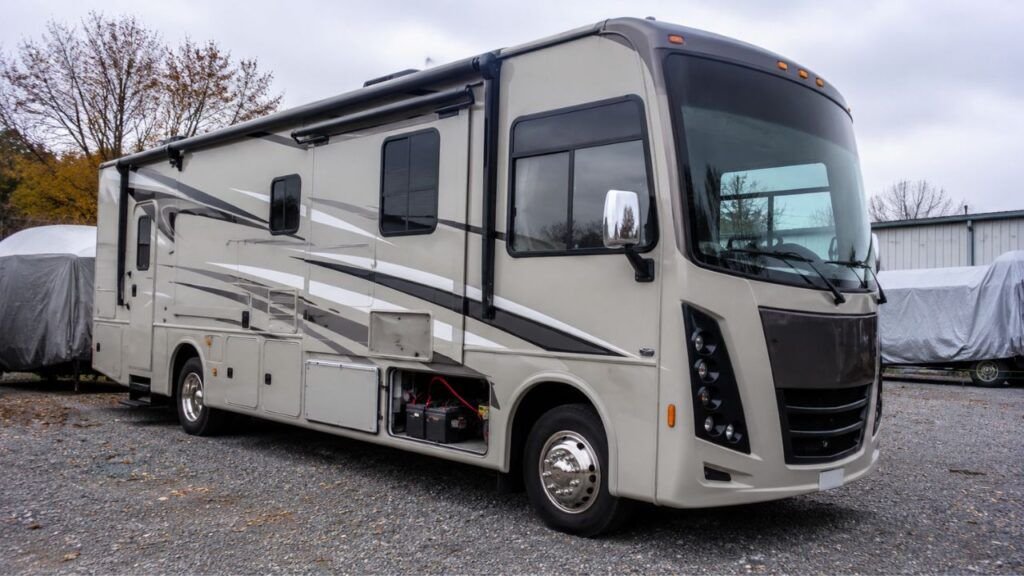
An RV lithium battery can drain during storage because small electrical loads may stay connected even when the RV looks completely turned off. Parasitic loads, inverter standby power, equipment wired around the disconnect switch, battery electronics, and normal LiFePO4 self-discharge can all reduce the battery’s charge over time.
The important part is figuring out whether the power is leaving through the RV or disappearing inside the battery itself. I’ll show you how to tell the difference, find hidden loads, and prevent your battery from being unexpectedly low after storage.
Key Takeaways
- Small parasitic loads can drain an RV lithium battery over several weeks.
- The RV battery disconnect may not shut down every electrical circuit.
- An inverter can consume power even when no appliances are running.
- LiFePO4 batteries naturally self-discharge, but usually quite slowly.
- A battery’s BMS and Bluetooth electronics may use some standby power.
- Cold temperatures can stop charging while RV loads continue consuming energy.
- Self-heating battery behavior varies between battery models.
- Storage charge recommendations also vary between lithium battery manufacturers.
- A battery that holds charge while disconnected usually has an RV-side drain.
- Rapid discharge while completely isolated may indicate a battery-related problem.
Is It Normal for an RV Lithium Battery to Drain During Storage?
A small amount of charge loss during storage is normal. A large or rapid drop usually is not.
LiFePO4 batteries have relatively low natural self-discharge compared with many traditional battery types. If you completely disconnect a healthy lithium battery, it should normally retain most of its charge for quite some time.
Things change when the battery remains connected to the RV.
Your RV may have several small electrical loads operating around the clock. Individually, they may not look important. Together, they can gradually remove dozens of amp-hours from the battery.
The speed of the drain gives you an important clue.
Losing a small percentage after sitting for several weeks may simply reflect normal standby consumption and self-discharge. Losing a large percentage within several days deserves further investigation.
If your battery drops dramatically overnight while the RV is stored, something larger is probably drawing power.
Why Does an RV Lithium Battery Drain While the RV Is in Storage?
Your battery can lose energy from two general places. The RV can consume power through connected equipment, while the battery itself can lose a smaller amount internally.
Here are the most common causes I would check.
Parasitic 12-Volt Loads Stay Powered
An RV can look completely off without actually being electrically inactive.
Several devices may remain connected to the 12-volt battery. Depending on your RV, these can include:
- LP gas detectors
- carbon monoxide detectors
- stereo memory circuits
- refrigerator control boards
- thermostats
- USB outlets
- tank-monitor systems
- antenna boosters
- Wi-Fi equipment
- security devices
- leveling-system electronics
- aftermarket accessories
- storage-compartment lights
One small device normally will not drain a large lithium battery quickly.
The problem develops when several small loads operate continuously.
A 50-milliamp load sounds insignificant. But that same load running every hour for an entire month consumes about 36Ah.
That is why a battery can seem fine when you park the RV, then appear surprisingly low several weeks later.
The RV Battery Disconnect May Not Disconnect Everything
This catches many RV owners by surprise.
You turn the battery disconnect switch to OFF and assume the entire RV is electrically isolated. Depending on the RV’s wiring, that may not actually happen.
Some equipment can be connected directly to the battery or wired around the main disconnect.
Possible examples include:
- inverter cables
- solar-charge equipment
- trailer breakaway systems
- battery monitors
- security systems
- GPS trackers
- hydraulic equipment
- leveling systems
- auxiliary fuse panels
- aftermarket electronics
Previous owners can make this even more complicated.
Someone may have installed an accessory directly onto the battery terminals years ago. Your main disconnect switch cannot shut that circuit off if it sits on the battery side of the switch.
That means battery disconnect OFF does not always mean zero battery draw.
An Inverter Can Draw Power While Nothing Is Plugged In
Your inverter deserves special attention during storage.
An inverter converts battery DC power into household-style AC power. Many inverters continue consuming some electricity while waiting for an appliance to turn on.
The microwave can be off.
The television can be off.
Every AC outlet can be unused.
The inverter may still be using battery power.
This is called inverter standby or idle consumption.
The amount depends heavily on the inverter. Larger systems can consume considerably more standby energy than small detectors or memory circuits.
Before storing your RV, turn the inverter off from its actual control panel. If your inverter has both a physical switch and remote panel, confirm its shutdown procedure.
Do not assume turning off the connected appliances also turns off the inverter.
Solar Equipment Can Remain Connected
Solar makes storage a little more complicated.
When everything works properly, solar can replace the energy lost through normal standby loads. That can keep your lithium battery in good condition during storage.
However, solar does not automatically guarantee this.
Charging can become limited because of:
- covered panels
- indoor storage
- heavy shade
- snow
- dirty panels
- disconnected solar wiring
- blown fuses
- controller faults
- low winter sunlight
- incorrect controller settings
The solar controller itself may also remain connected to the battery.
So you can end up with a system that is technically connected to solar but still experiences a gradual net battery loss.
If you rely on solar during storage, confirm that charging is actually reaching the battery.
The Lithium Battery Naturally Self-Discharges
Even a completely disconnected LiFePO4 battery slowly loses some stored energy.
That process is called self-discharge.
LiFePO4 chemistry generally has a relatively low self-discharge rate, which makes it well suited for RV storage. However, the exact rate varies by battery design, temperature, and manufacturer.
This is important because natural self-discharge usually happens much more slowly than RV parasitic drain.
If a disconnected battery loses only a small amount over an extended period, that may be normal.
If it loses a substantial amount within several days, natural self-discharge alone probably does not explain it.
The BMS and Smart-Battery Electronics May Use Energy
A modern RV lithium battery contains more than lithium cells.
Most include a Battery Management System, commonly called the BMS. Smart batteries may also include Bluetooth modules, temperature sensors, state-of-charge monitoring, balancing circuits, and other electronics.
These components can consume a small amount of power.
Some batteries enter a low-power sleep mode during storage. Others continue running certain monitoring functions.
A battery’s power button can also behave differently between models.
Turning discharge off through an app does not necessarily mean every internal electronic component stops consuming power.
Check your battery manual for terms such as:
- standby current
- sleep current
- storage mode
- power-off mode
- Bluetooth sleep
- BMS shutdown
These specifications help you understand what the battery itself consumes while stored.
Cold Weather May Stop Charging While Loads Continue
Cold temperatures can create another confusing situation.
Many LiFePO4 batteries include low-temperature charge protection. The BMS may temporarily stop charging when the cells become too cold.
That protects the battery.
However, some connected RV loads may continue drawing electricity.
Imagine your RV is stored with solar connected.
During warmer daylight hours, the battery may normally receive solar charging. Once temperatures fall below the battery’s charging limit, the BMS can stop accepting that charge.
The RV loads may still operate.
Now the battery has power leaving but little or no power entering.
The result is gradual net discharge.
This can make it appear that cold weather itself drained the battery. The real problem may be that charging stopped while parasitic loads remained active.
A Self-Heating Lithium Battery Can Behave Differently
Heated lithium batteries need extra attention during winter storage.
Not every self-heating battery operates the same way.
Some heating systems activate only when charging power is available. Others may use different control strategies.
Because of this, you should not automatically assume the internal heater is draining your stored battery.
Check your battery documentation for:
- heater activation temperature
- heater shutdown temperature
- minimum charging current
- heater power source
- heater-disable option
- winter-storage instructions
Understanding your specific system matters more than following one universal rule.
How Fast Can a Small Parasitic Load Drain an RV Lithium Battery?
Tiny electrical loads become surprisingly significant when they operate continuously. The table below shows how quickly seemingly harmless standby current can add up.
| Constant Hidden Draw | Battery Use Per Day | Approximate Use in 30 Days |
| 20 mA | 0.48Ah | 14.4Ah |
| 50 mA | 1.2Ah | 36Ah |
| 100 mA | 2.4Ah | 72Ah |
| 250 mA | 6Ah | 180Ah |
| 500 mA | 12Ah | 360Ah |
The calculation is simple:
Current × operating hours = amp-hours consumed
For example:
0.05A × 24 hours × 30 days = 36Ah
A continuous 50mA load would therefore consume around 36Ah during one month.
That is more than one-third of a 100Ah battery’s rated capacity.
Now imagine several small accessories operating together.
A battery monitor, security system, stereo memory circuit, USB charger, and another aftermarket device can create considerably more total draw.
This is why I would not dismiss a parasitic load just because the measured current looks small.
Time makes small loads important.
How to Tell Whether the RV or the Lithium Battery Is Causing the Drain
The easiest way to troubleshoot storage drain is to separate the battery from the RV. You want to determine whether energy disappears only while the RV remains connected.
Follow these steps in order.
Step 1: Start With a Known State of Charge
Begin with a properly charged battery.
Record whatever information your battery monitor or Bluetooth application provides, including:
- state of charge
- battery voltage
- current
- temperature
Using state of charge is usually more useful than relying only on voltage.
LiFePO4 voltage remains fairly flat through much of its usable capacity. Two noticeably different charge levels can therefore produce similar resting voltage readings.
A battery monitor or BMS reading gives you better information.
Step 2: Turn Off Every Obvious Load
Walk through the RV and shut everything down.
Check:
- inverter
- refrigerator
- furnace
- water pump
- lighting
- ventilation fans
- entertainment systems
- Wi-Fi router
- antenna booster
- USB chargers
- portable electronics
- aftermarket accessories
Also check storage compartments.
A compartment light accidentally left on can consume much more electricity than several small monitoring devices.
Step 3: Turn the RV Battery Disconnect Off
Now use the RV’s main battery disconnect switch.
Check your battery monitor again.
If your system provides real-time current, see whether current is still leaving the battery.
Then record the state of charge.
Check it again after 24 to 48 hours.
A continued noticeable loss suggests that something may remain connected around the disconnect switch.
Step 4: Physically Isolate the Battery
This is the most useful diagnostic step.
Follow the battery and RV manufacturer’s proper shutdown procedure and electrically isolate the battery from RV loads.
Systems containing solar equipment, inverter/chargers, multiple batteries, and specialized monitoring equipment may have a specific shutdown order.
Once isolated, record the state of charge again.
Leave the battery disconnected for an appropriate comparison period.
If the battery now holds its charge normally, the RV almost certainly contains a parasitic load.
If the battery continues losing an unusual amount while completely isolated, investigate the battery itself.
Step 5: Measure the Remaining Parasitic Draw
If the RV is responsible, measuring current can help locate the problem.
A properly installed battery shunt makes this especially easy.
A suitable DC clamp meter can also measure current without disconnecting battery cables.
Look at the current after all normal loads are switched off.
Do not immediately assume the battery has failed because its percentage decreased.
Finding measurable current leaving the battery proves that something is still consuming energy.
Step 6: Pull 12-Volt Fuses One Circuit at a Time
Your fuse panel can help narrow the problem.
Watch the current reading while removing one 12-volt fuse at a time.
Use this basic process:
- Record the current draw.
- Remove one fuse.
- Watch for a noticeable current decrease.
- Replace that fuse.
- Move to the next circuit.
When the draw suddenly falls, you have probably found the circuit causing the problem.
Check every device connected to that circuit.
You may discover a forgotten light, control board, stereo circuit, accessory, or aftermarket device.
Step 7: Check Direct-to-Battery Wiring
Fuse testing does not find everything.
Some equipment bypasses the RV’s regular 12-volt fuse panel.
Look directly around the battery for additional cables.
Common examples include:
- inverter
- solar controller
- battery shunt
- GPS tracker
- auxiliary fuse block
- power jack
- leveling system
- security equipment
- aftermarket accessories
A small wire attached directly to the positive battery terminal deserves investigation.
Tracing these connections often solves mysterious storage drain.
Step 8: Test the Battery While Completely Disconnected
Finally, monitor the battery after complete isolation.
If it retains most of its charge, the RV was probably causing the drain.
If charge continues falling substantially faster than the battery manufacturer considers normal, investigate:
- BMS operation
- internal electronics
- incorrect SOC reporting
- temperature
- cell imbalance
- battery damage
- abnormal standby consumption
At that stage, contacting the battery manufacturer may be more productive than continuing to search the RV.
Why Does the Battery Still Drain With the RV Disconnect Switch Off?
Your RV’s disconnect switch may shut down the main distribution panel without isolating every battery connection. That is why storage drain can continue even after the switch says OFF.
Common circuits that may bypass the disconnect include:
- inverter cables
- solar-charge controller
- trailer breakaway system
- battery monitor or shunt
- GPS tracker
- alarm equipment
- leveling equipment
- hydraulic systems
- safety circuits
- auxiliary fuse blocks
- aftermarket accessories
Your exact RV may be wired differently.
Do not assume every device listed above bypasses your disconnect.
Instead, use your battery monitor or current meter to verify what happens when the switch changes position.
Here is the most useful test.
If your battery continues draining with the disconnect OFF but stops draining after complete physical isolation, the battery itself probably is not the main problem.
Something in the RV still has access to it.
Does a Lithium Battery’s BMS Drain Power During Storage?
Yes, a lithium battery’s internal electronics can consume some power while the battery is stored.
The BMS constantly protects the cells against conditions such as excessive voltage, low voltage, overcurrent, and extreme temperatures.
Smart batteries may also operate:
- Bluetooth communication
- state-of-charge monitoring
- temperature sensors
- data logging
- balancing electronics
However, the amount of standby consumption varies substantially between batteries.
Some models enter a very low-power sleep state. Others maintain more active electronics.
That is why you should check your battery’s actual specifications rather than assume the BMS consumes a particular amount.
Look for the manufacturer’s recommended storage procedure.
Your battery may have a dedicated sleep mode, power button, Bluetooth shutdown option, or other storage setting.
Can a Heated RV Lithium Battery Drain Itself in Winter Storage?
A heated lithium battery can use energy for heating, but the answer depends entirely on how that battery’s heating system works.
Some batteries activate internal heating only when charging power is available and cell temperatures fall below a certain point.
That means they are not necessarily pulling stored battery energy all night just to keep themselves warm.
Other designs may behave differently.
Before winter storage, check your specific battery’s heating instructions.
You need to know:
- when heating starts
- when heating stops
- where heater power comes from
- whether external charging must be present
- whether heating can be disabled
Do not treat every heated LiFePO4 battery the same.
The correct winter-storage setup depends on your battery’s actual design.
What State of Charge Should an RV Lithium Battery Be Stored At?
There is no single storage percentage that applies perfectly to every RV lithium battery.
You will commonly see recommendations such as 50%, 80%, or even a full charge before storage.
That does not necessarily mean one recommendation is wrong.
Battery manufacturers design their BMS, cells, storage procedures, and warranty requirements differently.
Some manufacturers prefer partial charge for longer storage. Others instruct owners to fully charge the battery before completely disconnecting it.
The safest approach is simple.
Follow the storage state-of-charge recommendation provided for your exact battery.
Do not choose a random percentage simply because another lithium battery owner uses it.
Also avoid storing the battery nearly empty.
Even a small amount of self-discharge or standby consumption can eventually push an already-low battery toward BMS low-voltage shutdown.
How to Prevent an RV Lithium Battery From Draining in Storage
Storage preparation depends partly on how long the RV will remain parked. A weekend away requires less preparation than several months of winter storage.
Here is how I would approach each situation.
For a Few Days to a Couple of Weeks
For shorter storage periods:
- Turn the inverter completely off.
- Switch off unnecessary 12-volt equipment.
- Remove USB chargers and portable accessories.
- Check storage-bay and exterior lights.
- Use the RV battery disconnect.
- Confirm solar charging works if you rely on it.
- Check the battery monitor before leaving.
A healthy lithium battery should normally handle short storage periods easily when unnecessary loads are removed.
For Long-Term or Seasonal Storage
Longer storage deserves more preparation.
Before parking the RV:
- Follow your battery manufacturer’s recommended storage SOC.
- Use the manufacturer’s storage or sleep mode when available.
- Shut down the inverter.
- Eliminate unnecessary parasitic loads.
- Verify what your battery disconnect actually controls.
- Account for direct-to-battery accessories.
- Follow the correct solar shutdown procedure.
- Physically isolate the battery when appropriate.
- Check battery condition periodically.
The main goal is avoiding weeks or months of unnoticed continuous current.
Even a small load eventually becomes meaningful.
For Winter Storage
Cold-weather storage requires another layer of planning.
Check:
- battery storage-temperature limits
- low-temperature charging limits
- heater operation
- solar production
- battery location
- expected minimum temperature
- manufacturer’s winter-storage instructions
Remember that charging temperature and storage temperature are different specifications.
A battery may safely sit at a temperature where the BMS would not allow charging.
Do not assume freezing outdoor temperatures automatically mean the lithium battery must be removed.
Likewise, do not assume every battery can remain installed throughout extreme winter conditions.
Follow the limits published for your battery.
Should You Disconnect the Negative Cable During RV Storage?
Disconnecting the negative battery cable can be an effective way to stop RV parasitic loads during long storage periods.
However, I would not make that the first universal recommendation for every RV.
Modern RV electrical systems can include:
- solar controllers
- inverter/chargers
- multiple lithium batteries
- battery monitors
- alarm systems
- trailer electronics
These systems may require a particular shutdown sequence.
For example, some solar installations should have the solar input isolated before disconnecting the battery from the charge controller.
Follow your RV, charger, and battery manufacturer’s procedure.
Once everything is shut down correctly, physically isolating the battery can make long-term storage much easier.
It also gives you an excellent diagnostic tool.
If the battery stops draining once isolated, you know the RV was consuming the power.
What to Do If Your RV Lithium Battery Is Dead After Storage
Finding an apparently dead lithium battery does not automatically mean the battery is ruined. The BMS may simply have shut down its output after detecting an excessively low state of charge.
Here is what to check.
Check Whether the BMS Entered Low-Voltage Protection
A deeply discharged lithium battery may appear completely dead.
You might see:
- no usable output
- extremely low terminal voltage
- no response from connected RV equipment
- Bluetooth connection unavailable
The BMS may have disconnected the battery to protect the cells.
Do not immediately assume the internal cells have failed.
Follow the Manufacturer’s Wake-Up Procedure
Lithium batteries use different recovery procedures.
Depending on the design, waking the BMS may require:
- a compatible lithium charger
- a charger with activation mode
- manufacturer-specific reset procedure
- charging-source reconnection
- physical battery power button
Follow the battery manual.
Avoid improvising with charging methods that the manufacturer does not approve.
Recharge and Verify That It Still Holds Capacity
Once the battery wakes up, recharge it using the correct charging profile.
Then monitor it.
Check whether:
- SOC reaches the expected level
- the battery accepts normal charging current
- voltage behaves normally
- the battery holds charge while disconnected
- capacity seems normal during use
If everything looks stable afterward, the original problem was probably storage drain rather than permanent battery failure.
Know When the Battery Needs Further Evaluation
Stop troubleshooting the RV and evaluate the battery itself if you notice:
- rapid discharge while completely isolated
- repeated unexplained BMS shutdowns
- unusual heat
- swelling
- physical damage
- inability to accept charge
- dramatically reduced usable capacity
- serious cell imbalance reported by the BMS
Those symptoms deserve manufacturer or qualified technician attention.
Final Verdict
An RV lithium battery usually drains during storage because something remains connected and quietly consumes power. Parasitic 12-volt loads, inverter standby consumption, direct-to-battery accessories, and circuits bypassing the disconnect switch are often bigger contributors than the lithium cells’ natural self-discharge.
The simplest diagnosis is also the most useful. Monitor the battery while connected, then compare its behavior while completely isolated. If the battery holds charge when disconnected, look for an RV-side load. If it continues losing charge rapidly while isolated, investigate the battery, BMS, or internal electronics.
Related FAQs
Why Does My RV Lithium Battery Drain With the Disconnect Off?
The battery disconnect may control only the main RV distribution circuits. Inverters, solar equipment, monitors, trackers, safety systems, and aftermarket accessories may remain connected directly to the battery and continue drawing power.
How Much Charge Should a LiFePO4 Battery Lose During Storage?
A healthy LiFePO4 battery normally self-discharges slowly when completely disconnected. The exact rate varies between manufacturers, temperatures, and battery designs, so compare your battery’s observed loss with its published storage specifications.
Should I Turn My Lithium Battery Off During RV Storage?
Turning the battery off can help reduce standby consumption if your battery includes a true storage or shutdown mode. Follow the battery manufacturer’s instructions because different power buttons and app controls may shut down different internal functions.
Should I Disconnect My RV Lithium Battery for Winter?
Disconnecting the battery can prevent parasitic drain during winter storage, but follow your RV and battery manufacturer’s shutdown procedure first. Solar systems, inverter/chargers, and multiple-battery installations can require a specific disconnection sequence.
Can Solar Keep an RV Lithium Battery Charged During Storage?
Yes, properly functioning solar can replace small standby losses during storage. However, shade, snow, indoor storage, low winter sunlight, wiring faults, and controller problems can prevent enough charging from reaching the battery.
Does Cold Weather Drain an RV Lithium Battery Faster?
Cold weather does not necessarily cause rapid self-discharge. However, low-temperature charge protection may prevent charging while connected RV loads continue consuming energy, creating a gradual net loss during cold storage.
Can a Self-Heating Lithium Battery Drain Itself?
It depends on the battery design. Some internal heaters operate only when external charging power is available, while other designs can behave differently. Check the heater power source and winter-storage instructions for your exact battery.
Does the BMS Use Power While the Battery Is Stored?
Yes, the BMS and other smart-battery electronics can consume a small amount of standby power. The amount varies by battery, and some models enter low-power sleep modes during long periods of inactivity.
Why Does My Lithium Battery Show 0 Volts After Storage?
The BMS may have entered low-voltage protection after the battery became deeply discharged. Follow the manufacturer’s approved wake-up or charging procedure before assuming the battery has permanently failed.
How Often Should I Check an RV Lithium Battery in Storage?
For long-term storage, periodic checks are a good precaution. The exact interval depends on the battery manufacturer’s recommendations, storage temperature, remaining standby loads, and whether a reliable maintenance charging system is connected.

Ryan Carter writes practical battery guides focused on troubleshooting, everyday use, and smarter buying decisions. His experience with lithium batteries, RV and automotive power, and home backup systems helps readers choose reliable solutions with confidence.















