
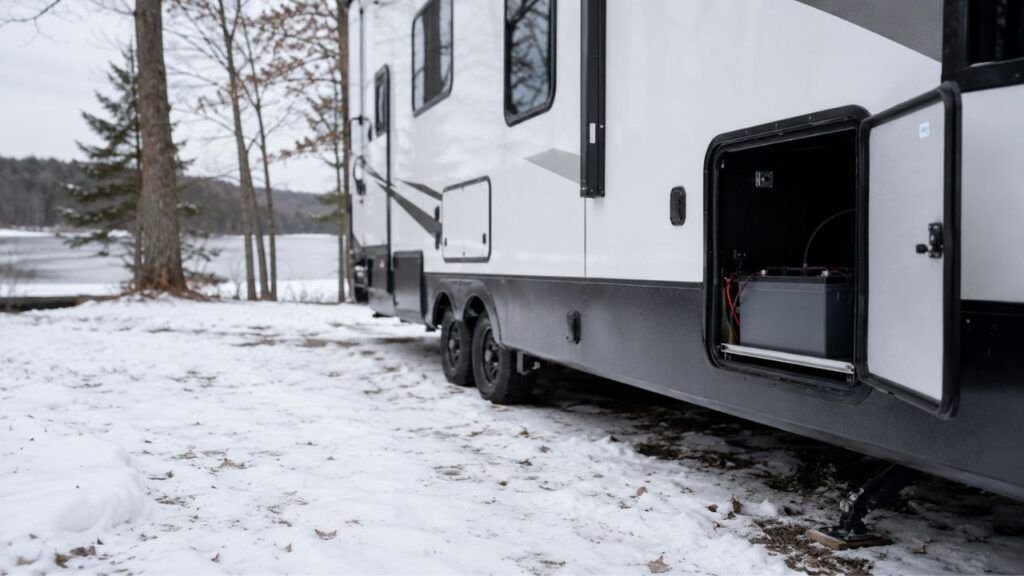
Yes, an RV lithium battery can usually stay installed all winter if it remains within its rated storage temperature, is properly disconnected from unwanted loads, and cannot be charged when it is too cold. You do not automatically need to remove a LiFePO4 battery just because freezing weather arrives.
The important part is knowing the difference between storing, charging, and using the battery in cold weather. I’ll walk you through when you can safely leave it installed, when removal makes more sense, and how to prepare it correctly.
Key Takeaways
- An RV lithium battery can often remain installed through winter.
- Leaving it installed does not mean leaving it electrically connected.
- Storage and charging temperature limits are different.
- Do not assume every LiFePO4 battery has the same temperature limits.
- Parasitic loads can slowly drain an apparently disconnected battery.
- Solar panels may still attempt to charge a battery during winter storage.
- Heated lithium batteries have different winter-storage requirements.
- Always follow your battery manufacturer’s storage instructions first.
Can You Leave a Lithium Battery in Your RV Over Winter?
In most cases, yes. A LiFePO4 house battery can stay inside your RV through winter as long as the battery’s storage rating covers the temperatures it will experience.
The first thing I would check is the battery manual rather than the weather forecast alone.
Some lithium batteries can safely sit well below freezing while they are not being charged. Others have more conservative long-term storage limits.
You also need to consider where the battery is mounted.
A battery installed underneath a dinette inside an RV may stay considerably warmer than one mounted on the trailer tongue or inside an exterior storage compartment.
The other issue is electrical isolation.
Your battery may tolerate the temperature perfectly but still end up discharged because a detector, inverter, controller, monitor, or other small device remained powered.
That is why I like to separate two questions:
Can the battery remain physically installed? Usually, yes.
Should it remain connected to the entire RV all winter? Usually, not without careful planning.
When Can the Battery Stay Installed, and When Should You Remove It?
The right decision depends more on your battery specifications and storage environment than winter itself.
| Winter Storage Situation | Leave Installed? | What I Recommend |
| Heated indoor RV storage | Usually yes | Set the proper storage charge and isolate unnecessary loads |
| Mild winter within battery temperature limits | Usually yes | Disconnect loads and prevent unwanted charging |
| Outdoor storage with occasional freezing | Usually yes | Verify storage and cold-charge limits |
| Exterior unheated battery compartment | Depends | Compare expected temperatures with battery specifications |
| Temperatures below the rated storage range | No | Remove the battery and store it somewhere warmer |
| Solar charging remains active | Depends | Confirm reliable low-temperature charge protection |
| Battery cannot be fully isolated | Risky | Disconnect it according to manufacturer instructions |
| Compartment has water or condensation problems | Better to remove | Store the battery somewhere dry and protected |
If you are unsure, look at the lowest temperature expected where the battery actually sits, not just the daytime outdoor temperature.
Cold Storage and Cold Charging Are Not the Same Thing
This is one of the most important things to understand about an RV lithium battery in winter. A battery may safely sit or even discharge below freezing while still being too cold to accept a charge.
Storage Temperature
Storage temperature tells you how cold or hot the battery can safely remain while it is sitting unused.
Many LiFePO4 batteries tolerate temperatures well below 32°F during storage.
However, there is no single temperature limit that applies to every RV lithium battery.
You may see -4°F mentioned frequently, but that number should not be treated as a universal rule.
Some batteries have wider storage ranges. Others may specify different limits depending on how long the battery will remain stored.
Use the storage-temperature specification printed in your manual.
Discharge Temperature
A lithium battery can often provide power at lower temperatures than it can accept charging power.
This means your battery may still run lights, pumps, or other 12-volt equipment below freezing.
Cold temperatures can temporarily reduce available performance, though.
For winter storage, this matters mainly because occasional battery use does not automatically mean the battery is safe to recharge immediately afterward.
Charging Temperature
Charging is where cold weather requires the most caution.
Charging LiFePO4 cells when they are too cold can cause lithium plating inside the cells. That damage can permanently reduce capacity and battery life.
Many lithium batteries stop accepting a charge somewhere around freezing. However, the exact cutoff differs between manufacturers and models.
Some batteries use an internal Battery Management System, or BMS, that automatically blocks charging when the cells become too cold.
Others rely on the charger, temperature sensor, or external controller.
A heated lithium battery may warm its cells before allowing charging.
The safest rule is simple:
Do not charge the battery below the minimum charging temperature specified by its manufacturer.
What Charge Level Should an RV Lithium Battery Have Before Winter Storage?
There is no universal state-of-charge percentage that every LiFePO4 battery should have before winter storage.
You may frequently see recommendations such as 50%, 60%, or 50% to 80%. Those ranges can be appropriate for many batteries stored for several months.
However, some manufacturers recommend charging their batteries fully before disconnecting them for storage.
Storage duration also matters.
A battery sitting for three weeks is different from one sitting unattended for five months.
My suggestion is to use the manufacturer’s storage SOC recommendation rather than choosing an arbitrary percentage from the internet.
If your manual recommends partial charge for long storage, follow it.
If it recommends starting fully charged and then shutting the battery down, follow that procedure instead.
The important thing is avoiding an extremely low battery that could continue draining during storage.
How to Leave an RV Lithium Battery Installed for the Winter
Leaving the battery in place can be perfectly reasonable. I would just prepare the electrical system carefully before walking away from the RV for several months.
Check Your Battery’s Storage Specifications
Start with the battery manual or specification sheet.
Look for:
- Recommended storage state of charge
- Minimum storage temperature
- Maximum storage temperature
- Minimum charging temperature
- Low-temperature BMS protection
- Recommended storage duration
- Battery OFF or storage mode
- Heater operation during storage
Pay particular attention to whether the temperature numbers refer to storage, charging, or discharging.
Those limits are often different.
Set the Battery to the Recommended State of Charge
Bring the battery to the charge level recommended for extended storage.
Do this before temperatures become too cold for normal charging.
If your battery is already below its minimum charging temperature, do not simply plug the RV into shore power and try charging it.
Allow the battery to warm into its safe charging range first.
Turn Off the Inverter and Major DC Loads
Turn off equipment that does not need to operate while the RV is stored.
An inverter can consume power even when you are not actively running a 120-volt appliance.
Its standby draw may seem small, but several months of continuous consumption can become significant.
The same applies to other electronic equipment left powered unnecessarily.
Stop Parasitic Battery Drain
One of the most common winter-storage problems is not actually the cold.
It is hidden electrical consumption.
Possible parasitic loads include:
- LP and carbon monoxide detectors
- Inverter standby circuits
- Stereo memory
- USB outlets
- Battery monitors
- Control boards
- Aftermarket electronics
- Wireless monitoring devices
Your particular RV may have only some of these.
A few small loads operating continuously can eventually pull substantial amp-hours from the battery.
Use the Battery Disconnect, but Verify What It Actually Disconnects
Do not automatically assume your RV battery disconnect switch shuts down everything.
Some RVs have safety equipment or other circuits connected directly to the battery.
That means flipping the disconnect switch may still leave a small load behind.
After using the disconnect, check your battery monitor if you have one.
You can also follow the battery manufacturer’s procedure for complete electrical isolation.
Some batteries have their own power button or storage mode.
Others may require physically disconnecting a cable.
Follow the instructions for your specific system.
Disable Unwanted Charging Sources
Charging sources are easy to overlook when an RV is parked.
Possible charging sources include:
- Solar charge controller
- Converter
- Inverter/charger
- DC-to-DC charger
- Alternator charging circuit
- External battery charger
Solar deserves particular attention.
A cold winter day can still be sunny.
Your panels may produce charging current even when the RV has not been touched for weeks.
If the cells are below their safe charging temperature and your system lacks reliable protection, that can create a problem.
Either disable the charging source according to the manufacturer’s instructions or confirm that your BMS and charging system correctly prevent cold charging.
Keep the Battery Compartment Dry
Cold temperatures are not the only concern during winter.
Snow, melting ice, condensation, and roof or compartment leaks can introduce moisture.
Check the area around your battery before storage.
Look for water entry points and make sure the battery remains protected according to its enclosure rating.
Also inspect the terminals and cable connections.
A dry battery compartment makes spring startup considerably easier.
Record the Battery’s SOC Before Walking Away
I like this simple step because it makes later checks much more useful.
Write down:
- Battery state of charge
- Date
- Battery temperature
- BMS status
- Whether the battery is switched off
- Whether solar is disabled
- Whether shore power is disconnected
If the battery has Bluetooth monitoring, save or screenshot the important values.
When you check the RV later, you will have a baseline for comparison.
Do You Need to Turn Off a Heated Lithium Battery During Winter Storage?
A heated lithium battery can make cold-weather RV use easier, but heating does not automatically mean you should leave everything active during storage.
Heated batteries work differently between manufacturers.
Some heaters draw energy from the battery itself.
Others primarily use incoming charging power.
Their activation temperatures and control logic can also vary.
If a heater remains active for months while the RV is stored, it could consume energy unnecessarily depending on the design.
Some batteries therefore have a heater switch or storage procedure that disables heating.
Check your battery instructions before winter storage.
A heated battery is extremely useful if you plan to camp and recharge during freezing weather.
It is not necessarily something that needs to remain warm continuously while your RV sits unused.
Should You Leave Shore Power Connected All Winter?
You do not automatically need to leave an RV lithium battery connected to shore power during winter storage.
LiFePO4 batteries have relatively low self-discharge compared with traditional lead-acid batteries.
A properly isolated lithium battery may sit for months without needing continuous maintenance charging.
Leaving shore power connected can work in some systems, but only when the setup is designed for it.
Your converter or inverter/charger should have an appropriate lithium charging profile.
The battery also needs proper low-temperature charging protection if freezing temperatures are possible.
If the battery manufacturer recommends disconnecting the battery during storage, continuous shore power can work against that recommendation.
I would not leave shore power connected simply because that was your routine with an older lead-acid battery.
Lithium storage practices can be different.
What About RV Solar Panels During Winter Storage?
Solar panels can keep generating power even during cold weather, so they should be part of your winter-storage plan.
The concern is not that solar itself damages the battery.
The concern is whether the charge controller tries to send current into cells that are below their safe charging temperature.
Some modern lithium batteries have a BMS that blocks the charge.
Some charge controllers also use temperature sensors and low-temperature cutoffs.
Heated batteries may use incoming solar power to warm themselves before charging.
If you know your system provides reliable low-temperature protection, leaving solar connected may be acceptable.
If you are not sure, follow your battery and solar-controller storage procedures instead of assuming the panels should stay connected all winter.
How Cold Is Too Cold to Leave the Lithium Battery in the RV?
The correct limit is the battery’s storage temperature rating, not its charging cutoff and not necessarily its discharge limit.
This is why saying every RV lithium battery must be removed below -4°F can be misleading.
Your specific battery may have a different storage range.
Removal becomes the safer choice when:
- Temperatures may fall below the rated storage range.
- The battery will stay extremely cold longer than permitted.
- You cannot stop unintended charging.
- You cannot eliminate parasitic loads.
- The battery compartment has moisture problems.
- The manufacturer specifically recommends indoor storage.
- You cannot monitor or properly isolate the system.
If you live somewhere with severe winters, such as Minnesota, North Dakota, Montana, or parts of the Mountain West, pay particular attention to overnight lows.
An exterior battery compartment can become nearly as cold as the surrounding air.
Is an Unheated Exterior Battery Compartment Safe for Winter Storage?
An unheated battery compartment is not automatically unsafe for lithium storage.
What matters is whether the temperature inside that compartment stays within the battery’s storage limits.
A battery mounted on the tongue of a travel trailer receives much more direct exposure than one installed beneath the floor or inside a protected basement compartment.
Wind, sun exposure, insulation, and nearby heated spaces can all influence battery temperature.
Also remember that outside air temperature and internal cell temperature are not always identical.
A large battery can warm and cool more slowly than the surrounding air.
However, I would never rely on that temperature lag as your primary protection.
Use the manufacturer’s rated limits and plan around the coldest reasonable conditions.
How Often Should You Check an Installed Lithium Battery During Winter?
You usually do not need to constantly maintain a properly stored LiFePO4 battery, but checking it occasionally is still a good idea.
During your checks, look for:
- Unexpected state-of-charge loss
- BMS warnings
- Moisture inside the compartment
- Loose or dirty connections
- Unusual battery temperature
- Active heater operation
- Charging when it should be disabled
- Devices drawing current unexpectedly
Follow the inspection interval recommended by your battery manufacturer.
I also suggest checking the system sooner during your first winter.
That lets you learn how much energy your particular setup loses while stored.
If the battery keeps losing noticeable charge while supposedly disconnected, look for the cause.
Repeatedly recharging it without finding the hidden load does not fix the actual problem.
Common Winter Storage Mistakes That Can Damage an RV Lithium Battery
Many winter battery problems come from small setup mistakes rather than the battery simply getting cold.
Common mistakes include:
- Assuming the RV disconnect switch removes every load
- Leaving an inverter in standby mode
- Forgetting that solar panels can still charge
- Charging below the battery’s safe temperature
- Treating -4°F as a universal storage limit
- Leaving the battery nearly empty for months
- Assuming every battery should be stored at 100%
- Assuming every heated battery works the same way
- Leaving heating enabled without checking its power source
- Using a charger that is not suitable for lithium
- Ignoring leaks or condensation around the battery
- Applying lead-acid winter-storage habits to LiFePO4
Most of these are easy to prevent once you know what to check.
How to Bring Your RV Lithium Battery Back Online in Spring
Spring startup should be simple if the battery was stored correctly. Take a few minutes to inspect everything before reconnecting all loads and charging sources.
Inspect the Battery and Connections
Look over the battery case, terminals, cables, mounting hardware, and surrounding compartment.
Check for moisture, corrosion, loose connections, or damaged wiring.
If something looks wrong, fix that before turning the electrical system back on.
Let a Very Cold Battery Warm Before Charging
Do not immediately start charging a battery that is still below its permitted charging temperature.
Allow it to warm naturally or use the approved heating system.
Your BMS may block charging automatically, but I would still verify the battery temperature before relying on the charger.
Turn the Battery or BMS Back On
If you used a battery power switch, sleep mode, or storage mode, restore it according to the manufacturer’s instructions.
Some batteries wake immediately.
Others may need charging voltage applied before the BMS becomes active again.
Reconnect Charging Sources and Loads
Reconnect the electrical system in the sequence recommended by the battery, RV, and charging-equipment manufacturers.
That may include solar, the converter, inverter/charger, and other equipment.
Watch the battery monitor during startup.
Make sure voltage and charging behavior look normal.
Charge Fully and Verify the Battery Monitor
After storage, give the battery a proper full charge when temperatures are safe.
A full charge may help certain battery-monitoring systems resynchronize their state-of-charge reading.
It can also allow the battery management system to perform any balancing that normally happens near the top of the charging cycle.
Final Verdict
Yes, an RV lithium battery can stay installed all winter in many situations.
You usually do not need to carry a large LiFePO4 battery into your garage simply because temperatures fall below freezing.
The bigger questions are whether the battery will remain inside its approved storage range, whether you can stop parasitic drain, and whether unsafe cold charging is prevented.
The most important distinction is this:
A lithium battery can often tolerate colder temperatures while sitting unused than it can while being charged.
So do not use one temperature number for every winter situation.
Check your battery’s storage limit, charging limit, recommended state of charge, BMS features, and heater instructions.
If those conditions are satisfied, leaving the battery installed can be both safe and convenient.
If your winter temperatures fall outside those limits, or you cannot reliably isolate the electrical system, removing the battery and storing it somewhere protected is the safer option.
Related FAQs
Can LiFePO4 Batteries Be Left in an RV Below Freezing?
Yes, many LiFePO4 batteries can safely remain stored below 32°F. However, the safe storage temperature depends on the specific battery, so check its rated storage range before leaving it installed.
Should I Disconnect My RV Lithium Battery for the Winter?
For long-term storage, disconnecting or shutting down unnecessary loads is usually a good idea. Keep in mind that the RV’s battery disconnect switch may not isolate every circuit.
Should I Remove My RV Lithium Battery and Bring It Inside?
Not necessarily. You usually only need to remove it when winter temperatures may exceed its storage limits, the battery cannot be fully isolated, or its compartment is exposed to damaging moisture.
What Percentage Should an RV Lithium Battery Be Stored At?
The correct storage charge depends on the manufacturer. Many recommend a moderate charge level for long-term storage, while others recommend fully charging the battery before shutting it down.
Can I Leave My RV Lithium Battery at 100% All Winter?
You can if the battery manufacturer recommends that storage method. However, some LiFePO4 manufacturers prefer partial charge for long-term storage, so there is no universal 100% rule.
Can You Charge an RV Lithium Battery Below 32°F?
Some batteries block charging around 32°F, while others use different temperature cutoffs. Heated batteries may warm themselves before charging, so always follow your battery’s minimum charging-temperature specification.
Does an RV Battery Disconnect Stop All Parasitic Drain?
Not always. Some safety devices, monitoring equipment, and directly wired accessories can remain connected even when the main RV battery disconnect switch is turned off.
Should Solar Panels Be Disconnected From an RV Lithium Battery During Winter Storage?
They may need to be disconnected if your system cannot reliably prevent charging below the battery’s safe temperature. Systems with proper BMS or controller protection may be able to remain connected.
Does a Heated Lithium Battery Need to Stay On All Winter?
No, not necessarily. Heater operation varies between batteries, and some manufacturers recommend disabling the heating function during long-term storage to prevent unnecessary energy use.
How Long Can a LiFePO4 Battery Sit Without Being Charged?
A properly isolated LiFePO4 battery can often sit for months because its self-discharge rate is low. The exact interval depends on BMS consumption, temperature, storage SOC, and the battery manufacturer’s recommendations.

Ryan Carter writes practical battery guides focused on troubleshooting, everyday use, and smarter buying decisions. His experience with lithium batteries, RV and automotive power, and home backup systems helps readers choose reliable solutions with confidence.















