
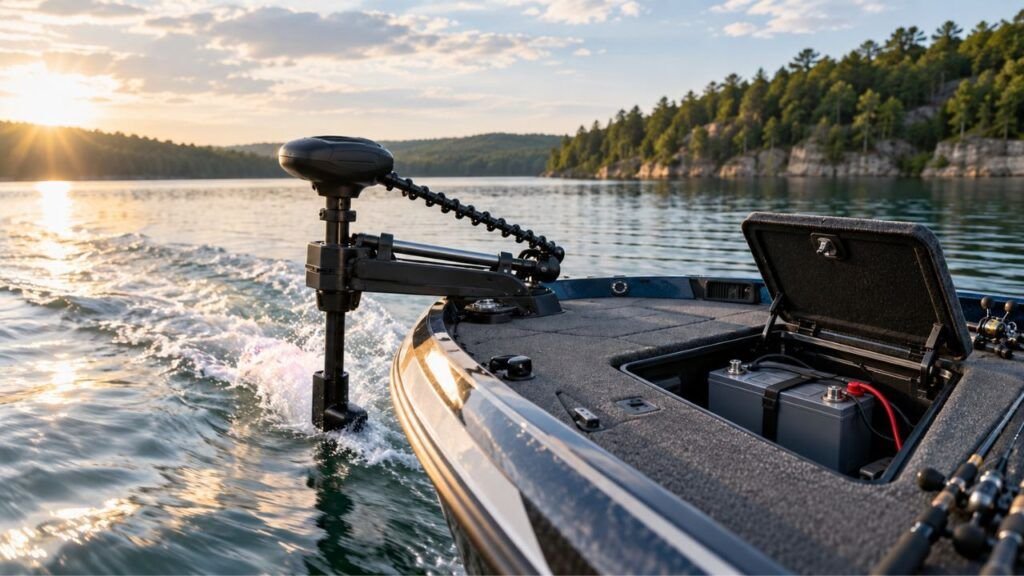
A lithium trolling motor battery drains faster at full speed because the motor pulls much more current to produce maximum thrust. As boat speed increases, water resistance also rises quickly, so the motor needs substantially more electrical power to keep pushing the boat faster.
That faster drain is usually normal, but extremely short runtime can indicate another problem. I’ll explain what happens at full throttle, how much runtime you can expect, and how to tell normal battery use from excessive drain.
Key Takeaways
- Full throttle usually produces the trolling motor’s highest electrical demand.
- A 55-lb 12V motor may approach about 50 amps at maximum output.
- Cutting throttle can extend runtime significantly, depending on motor design.
- Higher boat speeds create much greater resistance through the water.
- Lithium batteries maintain stronger voltage throughout most of their discharge.
- Fast drain does not mean the lithium battery is wasting energy.
- Unexpected shutdowns can indicate BMS, wiring, propeller, or battery issues.
- Moderate throttle is usually better for long fishing days.
Why Does a Lithium Trolling Motor Battery Drain Faster at Full Speed?
Turning your trolling motor to full speed asks it to produce maximum thrust. Producing that thrust requires considerably more electrical current from your lithium battery.
Think about the battery as your available energy supply. Your trolling motor controls how quickly that supply gets used.
At low trolling speeds, the motor may need relatively little current. Move the throttle toward maximum, and current demand can climb dramatically.
There is another factor happening at the same time. Your boat becomes harder to push as its speed increases.
Water creates resistance against the hull, propeller, and lower motor unit. That resistance rises quickly as your boat moves faster.
The result is simple:
Higher throttle → more current → more power consumption → shorter battery runtime.
This does not mean lithium batteries perform poorly at full speed. In many cases, the opposite is true.
Lithium batteries can maintain strong voltage while supplying substantial current. That allows your trolling motor to continue producing strong thrust until the battery reaches a much lower state of charge.
What Happens Electrically When You Turn the Motor to Full Speed?
Your battery does not suddenly lose capacity when you increase speed. Instead, your trolling motor starts taking energy from that capacity much faster.
Amp Draw Moves Toward the Motor’s Maximum
Every trolling motor has an electrical current requirement measured in amps.
At low settings, a motor might draw only a fraction of its maximum amperage. At full throttle, current can move close to the motor’s maximum draw.
For example, several common 12V 55-lb trolling motors have maximum current ratings around 50 to 52 amps.
That is very different from running the same motor around 10 or 20 amps.
Suppose you have a 100Ah lithium battery.
At an average 10A draw:
100Ah ÷ 10A = about 10 theoretical hours
At an average 50A draw:
100Ah ÷ 50A = about 2 theoretical hours
The battery has not become smaller. You are simply removing its stored energy much faster.
Also, avoid thinking of this as “50 amps per hour.”
The motor draws amps. Your battery stores capacity measured in amp-hours, or Ah.
Higher Speed Creates Much More Water Resistance
The electrical side is only part of the explanation.
Your trolling motor also needs to overcome resistance from the water.
Several things create that resistance:
- The boat hull moving through water
- The trolling motor’s lower unit
- Propeller loading
- Waves and chop
- Wind pushing against the boat
- River or tidal currents
Water drag generally increases rapidly as speed rises.
So, pushing your boat slightly faster can require considerably more effort than maintaining a slower cruising speed.
This is why the last portion of your throttle range can become expensive in terms of battery consumption.
You may use substantially more energy without gaining the same percentage of additional boat speed.
More Electrical Power Is Being Used Every Minute
Electrical power depends mainly on voltage and current.
A simplified formula is:
Power = Voltage × Current
If a 12V system is drawing about 50A:
12V × 50A = about 600 watts
Actual power varies because battery voltage changes during operation. Still, this simple calculation shows why full throttle consumes energy quickly.
At 20A, that same basic calculation gives:
12V × 20A = about 240 watts
Your motor could therefore be consuming much more than twice the power at the higher current level.
That difference adds up quickly during a long fishing trip.
How Much Faster Can Full Speed Drain a Lithium Trolling Motor Battery?
There is no universal runtime for every trolling motor. Motor design, boat weight, weather, current, battery condition, and throttle use all matter.
The following table shows an illustrative example for a 100Ah lithium battery. Always check your particular trolling motor’s actual current specifications.
| Throttle Use | Example Average Amp Draw | Theoretical 100Ah Runtime | Typical Use |
| Low trolling | 10–12A | About 8–10 hours | Slow trolling and positioning |
| Moderate use | 20–25A | About 4–5 hours | General fishing and movement |
| High power | 35–40A | About 2.5–3 hours | Wind, current, faster movement |
| Full throttle | Around 50A | About 2 hours | Maximum thrust and short runs |
These figures should be treated as planning examples, not guaranteed runtimes.
Your motor might consume more or less current at each setting. Some electronic variable-speed motors are also much more efficient at reduced speeds.
A 100Ah battery running a true 50A average load theoretically lasts around two hours.
Real-world runtime can differ because of:
- Battery usable capacity
- Actual motor amperage
- Wind and current
- Boat weight
- Propeller condition
- Water temperature
- Battery temperature
- Cable resistance
- Other connected electronics
- BMS protection limits
Most anglers also do not run continuously at one throttle setting.
You might run full power for ten minutes, troll slowly afterward, stop to fish, then use moderate thrust for positioning.
Your average amp draw throughout the day is therefore more useful than maximum current alone.
Why Lithium Makes Full-Speed Battery Drain Feel More Noticeable
Lithium behaves differently from traditional flooded lead-acid or AGM batteries. Those differences can make full-speed consumption surprisingly noticeable after switching batteries.
Lithium Holds Its Voltage Instead of Gradually Slowing Down
LiFePO4 batteries have a relatively flat discharge curve.
In simple terms, their voltage remains fairly stable through much of the battery’s usable charge.
That is useful for a trolling motor.
You may have strong thrust when the battery is nearly full. You can still have relatively strong thrust after using a substantial portion of its capacity.
A lead-acid battery behaves differently.
Its voltage normally declines more noticeably as it discharges. That falling voltage can make the trolling motor gradually feel weaker.
Lithium keeps feeding the motor strong voltage much longer.
Lead-Acid Often Feels Weaker as It Discharges
Imagine running a trolling motor at its highest setting with lead-acid batteries.
Early in the trip, the motor feels strong.
Several hours later, voltage has dropped. The motor may still be set to maximum, but its available performance can gradually decline.
That reduction can unintentionally reduce electrical demand.
Lithium does not usually give you that same slow decline.
It can continue delivering strong power deeper into the battery’s usable capacity.
So, when you keep the motor at full throttle, it can continue consuming substantial energy instead of gradually becoming sluggish.
Lithium Is Not Wasting Energy Faster
This distinction matters.
Seeing a lithium battery percentage drop quickly at full throttle does not automatically mean lithium is inefficient.
The motor is requesting a lot of power, and the battery is supplying it.
That strong output is actually one reason anglers like lithium batteries.
The battery can provide consistent trolling performance rather than slowly losing thrust throughout the day.
You are simply paying for that strong performance with faster energy consumption when you demand maximum power.
Why Full Throttle Often Gives Less Extra Speed Than You Expect
You might expect doubling your motor effort to double your boat speed. Boats do not normally behave that way.
As speed rises, the hull encounters increasingly greater resistance from the water.
That means moving from moderate throttle toward maximum can require substantially more electrical power while giving you a relatively modest increase in actual speed.
Your exact results depend on several variables.
These include:
- Hull shape
- Boat length
- Total weight
- Motor thrust
- Propeller design
- Motor depth
- Wind
- Current
- Water conditions
This is why I recommend finding your own boat’s comfortable cruising range.
Try running at several settings during calm conditions.
Watch your GPS speed and battery consumption if you have a battery monitor.
You may discover that reducing throttle slightly barely changes boat speed but noticeably reduces current draw.
That setting can become your efficient cruising sweet spot.
Save maximum thrust for situations where you actually need it.
What Else Makes the Battery Drain Even Faster at Full Speed?
Full throttle already places a substantial load on your battery. Additional resistance or electrical losses can make that demand even greater.
- Strong headwinds: Your motor needs more sustained thrust to maintain progress.
- River current: Fighting moving water increases the motor’s workload.
- Heavy boat load: Passengers, coolers, gear, and livewells add weight.
- Weeds around the prop: Vegetation can create significant additional resistance.
- Fishing line on the prop: Wrapped line can reduce propeller efficiency.
- Damaged propeller: Chips or deformation can waste available motor power.
- Choppy water: Constant changes in propeller loading can increase demand.
- Poor motor setup: Incorrect depth or positioning may reduce efficiency.
- Cold conditions: Low temperatures can reduce available battery performance.
- Extra electronics: Lights, pumps, and electronics consume additional battery capacity.
- Undersized wiring: Small cables can create excessive voltage drop.
- Long cable runs: Greater wire length creates additional electrical resistance.
- Loose connections: Poor connections waste energy and generate heat.
- Corroded terminals: Corrosion increases resistance within the circuit.
One or two of these issues may not seem significant.
Combine several of them with full throttle, however, and your expected runtime can drop noticeably.
Is Fast Battery Drain at Full Speed Normal or a Sign of a Problem?
Shorter runtime at maximum power is completely normal. However, unusually severe drain, overheating, or repeated shutdowns deserve closer inspection.
When Faster Drain Is Completely Normal
You probably have normal full-throttle consumption when:
- Runtime decreases predictably as throttle increases.
- The motor produces normal thrust.
- Battery current rises smoothly with throttle.
- The battery does not unexpectedly disconnect.
- Cables and connections remain reasonably cool.
- Runtime roughly matches your estimated average current draw.
For example, getting around two hours of continuous operation from a 100Ah battery under an actual 50A average load would not be surprising.
Most real fishing trips should last longer because continuous full throttle is uncommon.
When the Battery May Be Too Small
Battery capacity is not only about Ah.
Your lithium battery must also support your trolling motor’s required continuous discharge current.
Imagine your motor can pull 50A at maximum power.
A battery capable of delivering only 30A continuously could become a problem, even if its advertised capacity seems large enough.
The BMS may limit output or shut the battery down.
When selecting a lithium battery, check both:
Capacity in Ah
and
Maximum continuous discharge current
Give yourself enough capacity for runtime and enough current capability for maximum motor demand.
When the BMS May Be Cutting Power
Every quality lithium battery contains a Battery Management System, or BMS.
The BMS protects the battery from dangerous operating conditions.
It may disconnect output when it detects:
- Excessive current
- Very low cell voltage
- High temperature
- Low temperature on certain batteries
- Short circuits
- Other internal protection conditions
A BMS problem often feels different from normal battery drain.
For example, your trolling motor may work perfectly at speed three or four. Then it suddenly shuts down whenever you select maximum thrust.
That could indicate that the motor’s current demand is reaching the battery’s BMS limit.
It could also indicate a wiring or motor problem.
Do not automatically assume the battery has insufficient Ah capacity.
When Wiring Is Causing the Problem
Your trolling motor needs a clean electrical path between battery and motor.
Poor wiring creates resistance.
Resistance causes voltage drop and heat.
Check for:
- Loose battery terminals
- Corroded connections
- Damaged plugs
- Undersized wiring
- Excessively long cable runs
- Loose breaker connections
- Worn trolling motor receptacles
Pay particular attention when problems appear only under high throttle.
A weak connection might carry a small low-speed load without trouble. Put 40 or 50 amps through it, and the problem becomes obvious.
If a connection becomes unusually hot, stop using the system until you identify the cause.
How to Check Whether Your Trolling Motor Is Drawing Too Many Amps
You do not need to guess whether full-throttle drain is reasonable. A few basic checks can tell you whether the battery, motor, and wiring are behaving normally.
- Find your motor’s maximum amp specification. Check the owner’s manual or manufacturer’s specification sheet.
- Check your battery’s BMS rating. Confirm its continuous discharge rating exceeds the motor’s requirements.
- Fully charge the battery. Start testing from a known state of charge.
- Inspect every major connection. Look for corrosion, loose terminals, damaged plugs, or melted plastic.
- Check the propeller. Remove weeds and fishing line before testing performance.
- Watch current under different throttle settings. A shunt-based battery monitor can make this much easier.
- Compare calm and difficult conditions. Headwinds and current can substantially change your operating load.
- Watch for abnormal heat. Excessive heat at cables, plugs, or breakers can indicate resistance.
- Check BMS information when available. Bluetooth batteries may display current, state of charge, and protection events.
One important point applies specifically to lithium.
Do not depend entirely on voltage to estimate remaining capacity.
LiFePO4 voltage stays fairly flat through much of the discharge cycle.
A battery can therefore show reasonably strong voltage while having much less remaining capacity than you expect.
A quality shunt monitor or accurate BMS state-of-charge reading gives you a better picture.
How to Calculate Your Lithium Trolling Motor Runtime
Runtime calculations are useful, but you need the right numbers. The best estimate comes from usable battery capacity and your motor’s average, rather than maximum, current draw.
Use Amp-Hours When You Know Motor Current
The basic formula is:
Runtime = Usable Battery Capacity (Ah) ÷ Average Current Draw (A)
Suppose your lithium battery provides 100Ah of usable capacity.
If your trolling motor averages 20A:
100Ah ÷ 20A = about 5 hours
If it averages 40A:
100Ah ÷ 40A = about 2.5 hours
If it continuously averages 50A:
100Ah ÷ 50A = about 2 hours
These are theoretical figures.
Do not plan to arrive back at the boat ramp with exactly zero remaining capacity.
Wind may increase.
Current may become stronger.
You could need maximum thrust unexpectedly.
Keeping some battery reserve is a much safer approach.
Use Watt-Hours When Comparing Different Voltages
Amp-hours can become misleading when comparing different battery voltages.
A 12V 100Ah battery and 24V 100Ah battery do not contain equal amounts of energy.
Watt-hours provide a better comparison.
Use:
Watt-hours = Nominal Voltage × Amp-hours
Typical LiFePO4 examples are approximately:
- 12.8V × 100Ah = 1,280Wh
- 25.6V × 100Ah = 2,560Wh
- 38.4V × 100Ah = 3,840Wh
The 24V 100Ah example contains roughly twice the nominal energy of the 12V 100Ah example.
However, 24V and 36V batteries usually power larger motors with greater power demands.
So you still cannot determine trolling runtime from voltage alone.
Calculate Based on How You Actually Fish
Maximum-current calculations are useful for worst-case planning.
They are not always representative of a normal fishing day.
You might spend your trip like this:
- 15 minutes running near full power
- One hour moving at moderate throttle
- Several hours positioning at low speed
- Long periods with the motor stopped
- Short bursts correcting for wind
Your average current could therefore be far below maximum draw.
If your battery monitor records consumed amp-hours, check it after several normal trips.
That number gives you valuable real-world information about your specific fishing style.
You can then size your battery around actual use rather than guesswork.
Does a Variable-Speed Trolling Motor Save More Battery?
Variable-speed trolling motors can be especially useful when runtime matters.
Many modern motors electronically control the power sent to the motor. At lower throttle settings, they can supply only the amount of power needed for that selected output.
That can be much more efficient than operating an older motor design with less sophisticated speed control.
This matters because anglers spend far more time positioning and trolling than running maximum power.
A motor that operates efficiently at low and moderate settings can make a noticeable difference throughout an eight-hour fishing day.
However, variable speed does not make maximum thrust free.
Once you ask the motor for maximum output, electrical demand can still become substantial.
So even with an efficient motor, full throttle should be treated as your high-consumption setting.
Should You Run a Lithium-Powered Trolling Motor at Full Speed?
Using full throttle occasionally is generally part of normal trolling motor operation, provided your battery and motor are compatible.
The important part is checking your exact equipment.
Your lithium battery should:
- Match the trolling motor’s required voltage
- Supply enough continuous current
- Have sufficient Ah capacity
- Use a suitable BMS
- Be installed with correctly sized wiring
- Follow the battery manufacturer’s operating limits
Your trolling motor also needs to be approved for your chosen lithium setup.
This point is especially important with some older brushed trolling motors.
Certain manufacturers provide specific recommendations or maximum-throttle guidance when those motors are powered by lithium batteries.
Lithium maintains higher voltage longer than lead-acid batteries. That can expose some motors to sustained electrical conditions they were not originally designed around.
Do not assume every 12V lithium battery works identically with every 12V trolling motor.
Check the motor manufacturer’s lithium-battery guidance before regularly running full throttle.
How to Make a Lithium Trolling Motor Battery Last Longer
You usually do not need a larger battery immediately. Changing how the motor is used can make a surprisingly large difference.
- Use full throttle mainly for short moves or difficult conditions.
- Find the most efficient cruising setting for your boat.
- Reduce speed slightly when the extra speed gain becomes minimal.
- Start fishing trips with enough battery capacity available.
- Keep a reasonable reserve for unexpected wind or current.
- Match battery capacity to your normal fishing duration.
- Make sure the BMS supports maximum motor current.
- Remove fishing line and weeds from the propeller.
- Replace a badly damaged propeller.
- Avoid carrying unnecessary weight when possible.
- Keep terminals clean and properly tightened.
- Use appropriately sized marine wiring.
- Check plugs and breakers for excessive resistance.
- Use variable-speed control efficiently when available.
- Monitor consumed amp-hours instead of voltage alone.
- Avoid unnecessary electronics on the trolling motor battery bank.
You do not have to crawl around the lake at minimum speed all day.
The goal is simply to avoid using maximum electrical power when it offers little practical benefit.
Why Does the Battery Sometimes Shut Off Instead of Gradually Getting Weak?
Lithium batteries can behave differently near empty than lead-acid batteries.
A lead-acid trolling motor battery often gives you plenty of warning.
Voltage falls gradually, and the motor begins feeling increasingly weak.
LiFePO4 can maintain usable voltage much deeper into its discharge cycle.
You might therefore have strong trolling performance surprisingly late into the trip.
Then the battery’s BMS reaches its low-voltage protection threshold and disconnects output.
The change can feel sudden:
Strong motor → reduced remaining capacity → BMS cutoff
That does not necessarily indicate battery failure.
However, repeated shutdowns while plenty of charge remains deserve investigation.
Possible causes include:
- BMS overcurrent protection
- Battery discharge rating too low
- One weak or imbalanced cell
- Excessive voltage drop
- Loose electrical connections
- Propeller overload
- High battery temperature
- Motor electrical problems
If shutdown happens only at maximum throttle, check current capability and wiring first.
Final Verdict
A lithium trolling motor battery drains faster at full speed because maximum thrust demands much more electrical current. Higher boat speed also creates increasing water resistance, forcing the motor to work harder for every additional increase in speed.
Lithium itself is not wasting power. Its stable voltage actually helps your trolling motor maintain strong performance deeper into the battery’s charge. That can make high-speed consumption more noticeable than it was with lead-acid batteries.
For longer fishing days, use maximum thrust when it genuinely helps. Run moderate speeds when conditions allow, keep the prop and connections clean, and make sure your battery’s capacity and continuous-discharge rating match your motor.
If your battery drains predictably at full speed, that is usually normal. If it shuts off, overheats, or runs dramatically shorter than your calculations suggest, inspect the BMS rating, wiring, battery condition, and trolling motor before simply buying a bigger battery.
Related FAQs
Does Full Speed Drain a Trolling Motor Battery Twice as Fast?
Not necessarily. Full-speed consumption depends on how much current your particular motor draws at each throttle setting. A motor drawing 20A at moderate speed and 50A at maximum would consume capacity about 2.5 times faster at the higher load, but every motor has a different current curve.
How Long Will a 100Ah Lithium Battery Last at Full Speed?
A 100Ah lithium battery would theoretically last about two hours if your trolling motor continuously averages 50A. A motor averaging 40A could theoretically run around 2.5 hours, while real runtime varies with conditions, usable capacity, wiring, and motor load.
Why Does My Trolling Motor Work at Low Speed but Shut Off at High Speed?
High throttle may exceed the battery’s BMS current limit or expose voltage drop from weak wiring, loose connections, or damaged plugs. A heavily loaded propeller or battery with insufficient continuous-discharge capability can cause similar symptoms.
Does a Lithium Battery Make a Trolling Motor Run Faster?
Lithium can help a trolling motor maintain stronger and more consistent performance because battery voltage remains relatively stable during discharge. However, it does not automatically increase the motor’s rated thrust or guarantee a higher maximum boat speed.
Does a 24V Trolling Motor Drain a Battery Slower Than a 12V Motor?
Not automatically. A 24V system can deliver the same power using less current than a 12V system, but 24V motors are often larger and more powerful. Total battery energy in watt-hours and actual motor power consumption determine runtime more accurately.
Is 80% Throttle More Efficient Than Full Throttle?
It often can be a better choice for runtime because reducing throttle may lower current substantially while sacrificing relatively little boat speed. The exact difference depends on your motor controller, propeller, boat weight, hull design, wind, and water conditions.
Why Does My Lithium Battery Still Show High Voltage When It Is Nearly Empty?
LiFePO4 batteries maintain relatively stable voltage through much of their usable charge range. That makes voltage alone less reliable for estimating remaining capacity, so a BMS state-of-charge reading or shunt-based battery monitor is usually more useful.
Can Running a Trolling Motor at Full Speed Damage a Lithium Battery?
Full-speed use should not damage a properly matched lithium battery that can safely supply the motor’s current demand. Problems can occur when the battery’s BMS rating is too low, wiring is undersized, connections are poor, or the motor manufacturer places special limits on lithium use.
Why Is My Lithium Trolling Motor Battery Dying So Quickly?
First check how much current your motor actually draws. If runtime is much shorter than the battery’s Ah capacity and average amp draw suggest, inspect the propeller, wiring, terminals, BMS rating, connected electronics, battery health, wind, current, and total boat load.
Should I Get a Bigger Lithium Battery for More Full-Speed Runtime?
A higher-Ah battery can extend runtime if your existing battery is healthy and properly matched to the motor. However, first confirm that unusually short runtime is not being caused by excessive motor load, poor wiring, an undersized BMS, or unrealistic expectations from continuous full-throttle operation.

Ryan Carter writes practical battery guides focused on troubleshooting, everyday use, and smarter buying decisions. His experience with lithium batteries, RV and automotive power, and home backup systems helps readers choose reliable solutions with confidence.















