
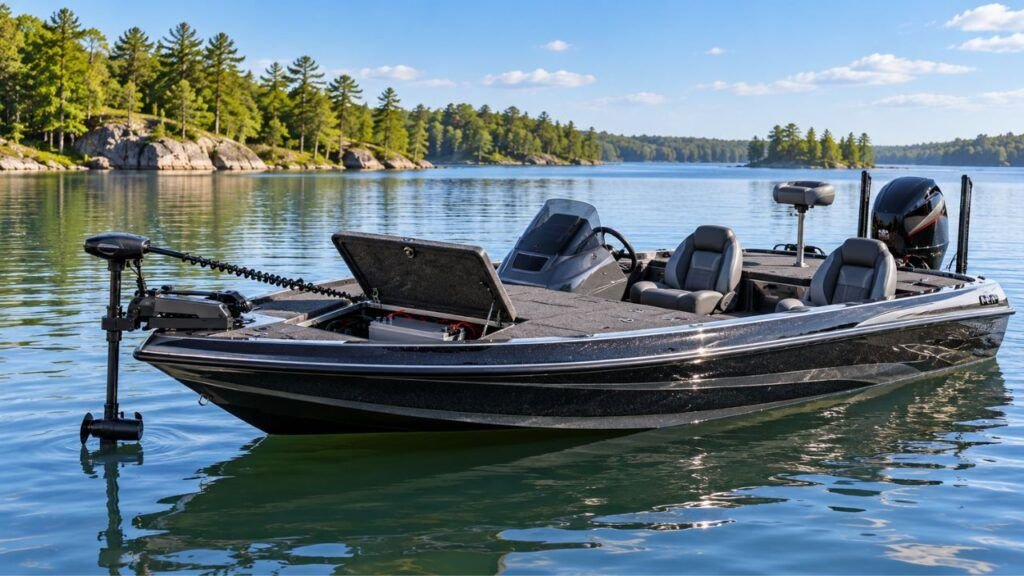
Yes, a trolling motor can run noticeably differently with lithium batteries. A lithium battery maintains steadier voltage as it drains, so the motor usually keeps more consistent speed and response throughout the day. However, lithium does not automatically increase the motor’s rated thrust.
The difference becomes easier to notice after several hours on the water. Below, I’ll explain what changes with speed, thrust, runtime, full-power use, battery cutoff, and compatibility.
Key Takeaways
- Lithium batteries keep trolling motor speed more consistent as they discharge.
- Lithium does not automatically increase the motor’s rated thrust.
- The motor may feel stronger later because voltage does not drop quickly.
- Lithium batteries reduce boat weight compared with lead-acid batteries.
- Some older brushed trolling motors need extra care with lithium batteries.
- Battery voltage and BMS current capacity must match your trolling motor.
- Lithium batteries can stay strong until nearly empty, then shut down suddenly.
Trolling Motor Performance With Lithium vs Lead-Acid Batteries
The biggest difference comes from how each battery supplies voltage while discharging. Lithium batteries maintain their operating voltage much longer than lead-acid batteries.
| What You Notice | Lead-Acid or AGM | LiFePO4 Lithium |
| Performance when fully charged | Strong | Strong |
| Speed as battery drains | Gradually decreases | Remains more consistent |
| Voltage during extended use | Drops progressively | Stays relatively steady |
| Late-day motor performance | Often feels weaker | Usually stays closer to earlier performance |
| Usable battery capacity | More limited | Greater usable portion |
| Battery weight | Heavy | Much lighter |
| Warning before empty | Gradual power loss | May remain strong until near cutoff |
| Compatibility concerns | Usually straightforward | Motor and BMS specifications matter |
This is why switching batteries can make the trolling motor feel different even when you keep the exact same motor.
Why Does a Trolling Motor Feel Different on Lithium?
Several things happen when you replace lead-acid batteries with lithium. Most differences come from steadier voltage rather than lithium somehow increasing the motor’s original power rating.
Lithium Maintains Voltage Longer
LiFePO4 batteries have a relatively flat discharge curve.
That simply means their voltage stays fairly steady through much of the battery’s usable charge.
Lead-acid batteries behave differently. Their voltage gradually declines as they discharge.
Your trolling motor feels that change because its electrical system receives progressively lower voltage.
With lithium, the motor receives a more consistent supply for much longer.
Motor Speed Stays More Consistent
This is probably the difference you’ll notice most.
Imagine starting your fishing day at speed setting four. With a lead-acid battery, that setting may feel noticeably weaker several hours later.
You may find yourself increasing the speed setting just to maintain the same boat movement.
A properly sized lithium battery usually changes that experience.
The trolling motor tends to maintain similar performance deeper into the battery’s charge. You spend less time compensating for a battery that gradually feels weaker.
There Is Less Voltage Sag Under Heavy Load
Higher trolling motor settings require more current.
Lead-acid batteries can experience more noticeable voltage sag when the motor demands substantial power, especially as the battery becomes discharged.
Lithium batteries generally handle sustained loads more consistently when correctly sized.
That can make acceleration and higher speed settings feel more predictable.
However, the battery still needs enough continuous discharge capability to handle your motor.
You Can Use More of the Battery’s Stored Energy
Lithium also provides more usable capacity than traditional lead-acid batteries in many real-world setups.
Lead-acid batteries generally benefit from avoiding very deep discharges if you want good battery life.
LiFePO4 batteries tolerate deeper discharge much better.
That does not mean every lithium battery automatically doubles your trolling motor runtime.
Actual runtime depends on:
- Battery capacity
- Motor amp draw
- Speed setting
- Boat weight
- Wind conditions
- Current strength
- Propeller condition
- Battery temperature
Still, greater usable capacity can make a noticeable difference during longer fishing trips.
Does a Lithium Battery Make a Trolling Motor Faster?
A lithium battery does not automatically make a trolling motor faster. What it usually does is help the motor maintain its expected performance longer.
This distinction matters.
Suppose your trolling motor has been running on an aging lead-acid battery. After several hours, voltage drops and the motor becomes noticeably weaker.
You replace that battery with lithium.
Now the motor stays responsive much later into the fishing day.
It may feel like lithium made your trolling motor faster, but the motor could simply be operating closer to its intended performance.
There is another factor involved too.
Lithium batteries are considerably lighter than comparable lead-acid batteries. Removing dozens of pounds from a smaller fishing boat can affect acceleration, draft, and handling.
Therefore, your boat itself might feel slightly quicker or more responsive.
That improvement comes primarily from reduced weight, not because the trolling motor suddenly gained additional rated power.
Does Lithium Increase Trolling Motor Thrust?
No, changing to lithium does not change your trolling motor’s official thrust rating.
A 55-pound thrust trolling motor does not suddenly become a 65-pound thrust motor because you installed a lithium battery.
What changes is how consistently the motor can access the electrical power it needs.
A lead-acid battery that has been running for several hours may no longer maintain the same voltage it provided earlier.
The motor can therefore feel weaker.
Lithium maintains voltage more consistently, so the motor may remain closer to its normal performance much longer.
Actual boat movement also depends on several other factors, including hull design, boat weight, wind, current, propeller condition, shaft position, and load distribution.
So, lithium can improve consistency without actually changing the motor’s rated thrust.
What Happens at Full Speed With a Lithium Battery?
Full-speed operation deserves extra attention because lithium can maintain high voltage for much longer. Whether that matters depends heavily on your trolling motor’s design.
Modern Lithium-Optimized and Brushless Motors
Many newer trolling motors are designed with modern battery systems in mind.
Brushless and lithium-optimized motors can generally make good use of lithium’s steady voltage characteristics when the battery meets manufacturer requirements.
In these setups, full-power operation tends to remain more consistent throughout the battery discharge.
You should still confirm battery voltage, current capability, wiring, and breaker requirements.
Lithium compatibility does not remove the need to follow the motor manufacturer’s electrical specifications.
Older Brushed Trolling Motors
Older brushed trolling motors deserve more caution.
Some were originally designed around traditional lead-acid batteries, which naturally lose voltage throughout their discharge cycle.
Lithium batteries can maintain higher voltage for much longer.
That means an older brushed motor running near maximum output can experience sustained electrical and thermal loads for longer periods.
Minn Kota, for example, recommends keeping applicable traditional brushed motors around 85% speed or below when using lithium batteries.
That recommendation should not be treated as a rule for every trolling motor made by every manufacturer.
Different motors have different voltage limits, electronics, and operating requirements.
Always Check Your Motor Manufacturer’s Lithium Guidance
Before switching batteries, check the manual or current manufacturer recommendations for your exact motor.
Look for lithium compatibility, maximum operating voltage, current requirements, and any full-speed limitations.
This matters especially if your trolling motor is older.
If the manufacturer specifically advises against lithium, I would follow that guidance rather than assuming all 12V batteries behave identically.
Can the Motor Actually Run Longer With Lithium?
Yes, a trolling motor can often run longer with lithium, especially when comparing batteries with similar rated amp-hour capacity.
The reason is mostly usable energy and voltage stability.
Lithium batteries can normally use a greater percentage of their stored capacity without the same concerns associated with deeply discharging lead-acid batteries.
You also don’t experience the same gradual performance decline.
A basic runtime estimate looks like this:
Approximate runtime = usable battery amp-hours ÷ motor amp draw
For example, a motor drawing 20 amps from 80 usable amp-hours could theoretically run around four hours.
Real-world conditions will change that result.
Trolling motors rarely pull exactly the same amperage throughout an entire fishing trip. Wind, current, steering, vegetation, boat load, and speed adjustments constantly change the electrical demand.
Full-speed operation can shorten runtime dramatically.
So, lithium can provide excellent runtime, but your driving habits still matter.
Why Can a Trolling Motor Suddenly Stop With a Lithium Battery?
Lithium batteries sometimes behave differently near their limits. Instead of slowly becoming weaker, the trolling motor may run normally until the battery’s protection system intervenes.
The BMS Reaches Low-Voltage Cutoff
Most quality LiFePO4 batteries include a Battery Management System, commonly called a BMS.
The BMS protects the cells from conditions such as excessive discharge, overcurrent, overheating, and charging problems.
When the battery reaches its low-voltage protection limit, the BMS can disconnect output.
Your trolling motor may therefore stop rather suddenly.
With lead-acid batteries, anglers often receive more obvious warning because motor performance gradually decreases.
Lithium can provide much less noticeable performance fade before reaching its protection threshold.
The Battery Cannot Supply Enough Continuous Amperage
Battery capacity and discharge capability are not the same thing.
This causes a lot of confusion.
A battery labeled 100Ah tells you how much capacity it stores. It does not automatically tell you how many amps the BMS can continuously deliver.
Suppose your trolling motor requires more current at full speed than the battery’s BMS allows.
The battery may shut down even though plenty of stored capacity remains.
Possible symptoms include:
- Motor shutting off at high speed
- Motor working normally at lower speeds
- Propeller stopping unexpectedly
- Intermittent operation
- Electronic steering problems
- GPS or position-holding features behaving strangely
Before buying a lithium battery, compare its continuous discharge rating with your motor’s maximum amp draw.
Give yourself some reasonable electrical headroom instead of choosing a battery right at the limit.
Loose Connections or Undersized Wiring Can Look Like a Battery Problem
Not every shutdown after switching to lithium is caused by the battery.
Loose terminals, corroded connections, undersized wiring, or poor connectors can create resistance.
That becomes much more noticeable when the trolling motor demands high current.
Check all connections if the motor works normally at low speed but struggles at higher settings.
Does the Motor Feel Different When the Lithium Battery Gets Low?
Yes, and this is one difference that catches some first-time lithium users by surprise.
Lead-acid batteries often give you a natural warning.
As the battery drains, the trolling motor gradually slows down.
You can usually feel that the battery is getting tired.
Lithium behaves differently.
The battery may maintain normal-looking motor performance through most of its usable capacity. Then, as it approaches its lower limit, performance can decline quickly or the BMS may shut the battery down.
This makes battery monitoring more useful.
A Bluetooth-enabled battery or separate battery monitor can show remaining charge more accurately than judging battery level by trolling motor speed alone.
That is especially valuable when you’re fishing farther from the launch ramp.
Does the Lighter Battery Change How the Boat Runs?
Lithium can change how your boat feels even when the trolling motor itself has not become more powerful.
Lead-acid deep-cycle batteries are heavy.
This becomes particularly noticeable with 24V and 36V trolling motor systems that require multiple batteries.
Replacing those batteries with lithium can remove a significant amount of weight.
Depending on the boat, you may notice:
- Slightly shallower draft
- Better weight distribution
- Easier acceleration
- More responsive handling
- Less stern or bow weight
- A small improvement in overall efficiency
The difference tends to be more noticeable in kayaks, jon boats, smaller fishing boats, and heavily loaded boats.
On a large boat, losing battery weight may be less dramatic.
Either way, don’t confuse lower boat weight with increased trolling motor thrust.
12V, 24V, and 36V Trolling Motors Still Need the Correct Voltage
Switching battery chemistry does not change the voltage your trolling motor needs. Always match the battery system to the motor’s rated voltage.
- 12V trolling motor: Use an appropriate 12V lithium setup.
- 24V trolling motor: Use an appropriate 24V battery or compatible 12V batteries wired in series.
- 36V trolling motor: Use an appropriate 36V battery or compatible 12V batteries wired in series.
- Never supply a motor with more system voltage than its rating.
- Series-connected batteries should be appropriately matched.
- Follow battery manufacturer instructions before connecting batteries in series.
- Do not mix lithium and lead-acid batteries within the same trolling motor series bank.
Pay attention to actual battery voltage too.
A battery sold as a “12V” LiFePO4 battery normally operates at a somewhat different voltage than a traditional 12V lead-acid battery.
Your trolling motor manufacturer should confirm whether that operating range is acceptable.
What to Check Before Switching Your Trolling Motor to Lithium
A little checking before buying the battery can prevent most compatibility problems.
- Confirm your trolling motor supports LiFePO4 batteries.
- Match the battery voltage with the motor’s required voltage.
- Find your trolling motor’s maximum amp draw.
- Check the battery BMS continuous discharge rating.
- Make sure the battery can handle maximum motor demand.
- Use properly sized marine-grade wiring.
- Install the correct circuit breaker or fuse.
- Make sure your charger supports LiFePO4 batteries.
- Check low-temperature charging protection for cold-weather fishing.
- Check manufacturer recommendations for older brushed motors.
- Consider a battery monitor or Bluetooth-enabled BMS.
- Secure the lighter battery properly inside the boat.
I would pay particular attention to the BMS rating.
People often shop entirely by amp-hours, but current capability is just as important when powering a high-draw trolling motor.
What Will You Actually Notice After Switching to Lithium?
The difference varies by boat and motor, but there are several changes you may notice during normal fishing.
- The motor feels stronger later in the day.
- Your selected speed feels more consistent.
- High-power operation feels more predictable.
- You make fewer throttle adjustments as the battery drains.
- The boat carries noticeably less battery weight.
- Runtime may improve with an appropriately sized battery.
- You get less gradual warning before the battery becomes empty.
However, don’t expect the switch to feel dramatic every time.
If your existing lead-acid battery is new, fully charged, and only used for short trips, both batteries may feel similar shortly after launching.
The lithium advantage becomes much easier to appreciate several hours later.
That is when a lead-acid battery may already be losing noticeable voltage while the lithium battery continues supplying relatively steady power.
When Might Lithium Not Make Much Difference?
Lithium is not automatically a life-changing upgrade for every angler.
If you normally fish for an hour or two, rarely drain your battery, and already have a healthy AGM setup, you may notice only a modest difference in motor behavior.
The same applies if you spend most of your time using very low trolling speeds.
You can still benefit from reduced battery weight, longer battery life, and lower maintenance.
However, the improvement in actual trolling motor performance may not feel dramatic.
Lithium tends to make the biggest difference for anglers who fish long days, use higher speeds regularly, run 24V or 36V systems, or frequently experience weakening performance from lead-acid batteries.
Final Verdict
Yes, a compatible trolling motor generally runs differently with lithium batteries, mainly because lithium provides steadier voltage throughout most of its discharge. The motor maintains its speed and response longer instead of gradually feeling weaker as the fishing day continues.
What lithium does not do is magically increase your trolling motor’s rated thrust. A 55-pound thrust motor remains a 55-pound thrust motor. The difference is that it can stay closer to its expected performance for longer.
For newer lithium-compatible motors, the switch can provide excellent performance, lower weight, and longer usable runtime. If you have an older brushed trolling motor, check its manufacturer’s lithium recommendations, operating voltage, and full-speed limitations before making the change.
Related FAQs
Can I Replace My Trolling Motor Lead-Acid Battery With Lithium?
In many cases, yes, but check your trolling motor’s lithium compatibility first. Match the correct voltage, verify the battery’s BMS can supply enough continuous current, and use a charger compatible with LiFePO4 batteries.
Will a 100Ah Lithium Battery Run a Trolling Motor Longer Than a 100Ah Lead-Acid Battery?
A 100Ah lithium battery can often provide more practical trolling motor runtime because more of its rated capacity is usable while maintaining stronger voltage. Actual runtime still depends heavily on motor amperage, speed, wind, current, and boat load.
Does Lithium Make a 55-Lb Thrust Trolling Motor More Powerful?
No. Installing lithium does not change a 55-pound thrust motor into a higher-rated motor. Lithium can help the motor maintain its normal performance longer, which may make it feel stronger later in the day.
Can a Lithium Battery Damage an Older Trolling Motor?
It can create problems with certain older motors if the battery’s operating voltage or sustained output falls outside the motor manufacturer’s recommendations. This is particularly important with some brushed trolling motors, so check your exact model before switching.
Why Does My Trolling Motor Shut Off at Full Speed With Lithium?
A common cause is the battery’s BMS reaching its continuous-current or overcurrent limit. Low battery protection, loose connections, undersized wiring, excessive resistance, or an improperly sized circuit breaker can also cause high-speed shutdowns.
Can I Run My Trolling Motor at 100% With Lithium?
That depends on your trolling motor. Many newer lithium-compatible motors can operate normally at full output, while some traditional brushed models have manufacturer-specific speed recommendations. Always follow the instructions for your exact motor.
Do I Need a Special Charger for a Lithium Trolling Motor Battery?
You should use a charger approved for your LiFePO4 battery or one with a dedicated lithium charging profile. Some multifunction chargers support both lead-acid and lithium batteries, but you should confirm the settings required by your battery manufacturer.
Is LiFePO4 the Best Type of Lithium Battery for a Trolling Motor?
LiFePO4 is widely used for trolling motors because it provides stable voltage, long cycle life, lower weight, and good thermal stability. However, the battery still needs the correct voltage, capacity, BMS rating, and marine suitability for your particular trolling motor.

Ryan Carter writes practical battery guides focused on troubleshooting, everyday use, and smarter buying decisions. His experience with lithium batteries, RV and automotive power, and home backup systems helps readers choose reliable solutions with confidence.















