
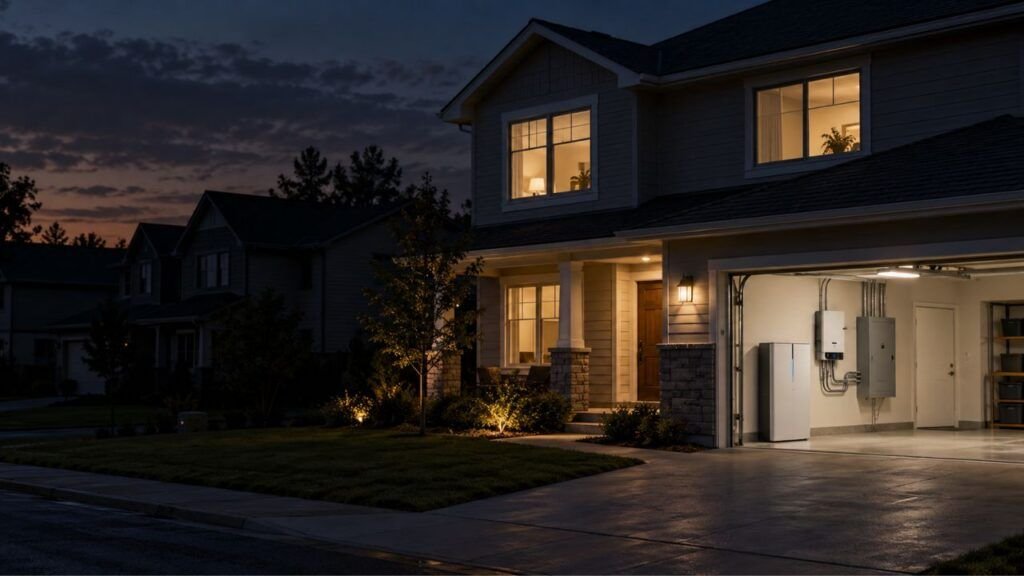
Yes, a home backup lithium battery can work without solar panels. A compatible system can charge directly from the utility grid and store electricity for later use. When an outage occurs, a properly configured backup system can use that stored power for selected household circuits.
You do not need rooftop solar just to use battery backup. However, there are important differences in runtime, recharging, costs, and outage protection. I will walk you through those details so you know exactly what to expect.
Key Takeaways
- A home lithium battery can charge directly from utility electricity.
- Solar panels are not required for basic battery backup operation.
- The system must be configured specifically for outage backup.
- Proper transfer equipment prevents electricity from feeding back into the grid.
- Battery capacity determines how much stored energy you have available.
- Inverter output determines how many appliances can run simultaneously.
- Without solar, the battery usually cannot recharge during a grid outage.
- Time-of-use electricity rates can sometimes make grid charging more useful.
- Solar can often be added later if your system supports expansion.
- Battery-only backup works best when you prioritize essential household loads.
How Does a Home Backup Lithium Battery Work Without Solar Panels?
A battery-only backup system uses your utility grid for charging. It stores that electricity until your home needs backup power.
The Utility Grid Charges the Battery
While grid power is available, electricity enters the battery system. The inverter-charger converts household AC electricity into battery-compatible DC electricity.
The lithium battery then stores that energy for later use. Its battery management system monitors charging conditions throughout the process.
Once the battery reaches its target charge level, charging slows or stops. The system can then remain ready until electricity is needed.
The Battery Stays Ready for an Outage
Most modern home batteries let you maintain a backup reserve. That reserve keeps a chosen percentage available for emergencies.
For example, you might reserve most battery capacity for outages. Other homeowners may use some capacity for daily energy management.
The exact options depend on your battery and control system.
The System Disconnects Your Home From the Grid
Backup systems must safely separate your house from utility power. This isolation is important whenever the electric grid goes down.
A backup gateway, transfer switch, or similar equipment handles this process. It prevents stored electricity from feeding into utility power lines.
Without proper isolation equipment, a battery may not provide outage backup.
The Inverter Powers Your Backed-Up Circuits
Lithium batteries store electricity as DC power. Most household appliances require AC power.
The inverter converts stored DC electricity into usable household AC electricity. Your backed-up circuits can then continue operating during the outage.
The exact number of circuits depends on your installation and system size.
The Battery Recharges When Grid Power Returns
Once utility service becomes stable again, normal operation resumes. The system can switch your home back to grid electricity.
It then starts replacing the energy used during the outage.
The important limitation is simple. Without solar or another approved charging source, the battery cannot normally refill while the grid remains unavailable.
Does Every Home Battery Provide Backup During a Blackout?
No. Owning a home battery does not automatically guarantee outage protection.
Some battery systems are installed only for energy management. They may charge when electricity is cheaper and discharge during expensive hours. However, they can still shut down during a utility outage.
For real blackout protection, your installation needs backup capability. That normally includes an appropriate inverter, isolation equipment, controls, and approved electrical connections.
This distinction matters when you compare systems.
Do not only ask whether a battery supports grid charging. Ask whether your exact installation will operate while utility power is unavailable.
What Can a Battery Do Without Solar and What Can’t It Do?
Solar panels mainly change where your stored electricity comes from. They are not required for the battery itself to store energy.
| Function | Battery Without Solar | Battery With Solar |
| Charge from utility power | Yes, when supported | Usually |
| Provide outage backup | Yes, when properly configured | Yes, when properly configured |
| Store electricity | Yes | Yes |
| Use off-peak grid power | Yes | Yes |
| Recharge from sunlight | No | Yes |
| Recharge during a long outage | Usually no | Possible during daylight |
| Reduce grid dependence | Limited | Greater potential |
| Support longer outages | Limited by stored energy | Better with adequate sunlight |
| Add more batteries later | Often | Often |
| Generate electricity onsite | No | Yes |
The main difference is therefore not basic battery operation. The bigger difference appears during long outages and everyday energy use.
Without solar, you start an outage with a limited energy reserve. With solar, favorable sunlight may replenish that reserve during the day.
How Long Will a Home Lithium Battery Last Without Solar?
Battery runtime depends on both stored capacity and household consumption. Two homes using identical batteries can experience very different runtimes.
Battery Capacity Determines Stored Energy
Battery storage is usually measured in kilowatt-hours, or kWh. A higher kWh rating generally means more stored electricity.
Common residential systems may offer capacities such as:
- 5 kWh
- 10 kWh
- 13.5 kWh
- 15 kWh
- 20 kWh or more
However, total rated capacity does not always equal usable capacity. System settings may preserve some energy for battery protection.
Your Household Load Determines Runtime
The easiest estimate uses this basic calculation:
Estimated runtime = usable battery capacity ÷ average electrical load
Suppose you have 10 kWh of usable battery energy. Your essential loads average about 500 watts, or 0.5 kW.
The basic calculation becomes:
10 kWh ÷ 0.5 kW = about 20 hours
Real-world runtime will usually be somewhat lower. Inverter losses, changing loads, temperature, and reserve settings affect the result.
Critical Loads Last Longer Than Whole-Home Loads
You can dramatically extend runtime by backing up essentials only.
Common critical loads include:
- Refrigerator
- Wi-Fi router
- Selected lights
- Security equipment
- Phone chargers
- Laptop chargers
- Sump pump
- Garage door controls
- Essential medical equipment
- Selected kitchen outlets
Large electrical appliances can consume stored energy very quickly.
Central air conditioners, electric dryers, water heaters, ovens, and EV chargers require considerably more power.
Running everything normally can turn a long backup window into several hours.
Starting Surge Can Matter as Much as Battery Capacity
Battery capacity tells you how much energy is stored. It does not tell you how much power the system can deliver instantly.
That second measurement is usually expressed in kilowatts.
Motors and compressors may require additional power while starting. Refrigerators, pumps, and air conditioners are common examples.
Your battery may still contain plenty of stored energy. However, an undersized inverter can shut down during a large surge.
Always consider both kWh capacity and kW output when sizing backup.
Can a Grid-Charged Home Battery Lower Your Electric Bill?
A battery without solar can sometimes reduce electricity costs. Whether it saves meaningful money depends heavily on your utility rate structure.
Time-of-Use Charging Can Reduce Peak-Rate Purchases
Some utilities charge different electricity prices throughout the day. Electricity may cost less overnight and more during peak periods.
A compatible battery can charge during cheaper hours. It can then discharge when utility electricity becomes more expensive.
This practice is commonly called load shifting or energy arbitrage.
Flat Electricity Rates Offer Less Savings
The calculation changes when electricity costs roughly the same all day.
Charging a battery and using that electricity later provides little pricing advantage. You also lose a small amount of energy during conversion.
In that situation, the battery is mainly an outage-protection investment.
That is completely reasonable if backup reliability is your priority.
Battery Efficiency Reduces the Savings Difference
No battery system stores and returns every watt perfectly.
Some electricity is lost while charging, storing, and converting power. Therefore, a small peak-to-off-peak rate difference may provide little savings.
Look at your actual utility rate before making financial assumptions.
Utility Programs May Add Additional Value
Some U.S. utilities offer programs specifically for home batteries.
Depending on your location, you might find:
- Virtual power plant programs
- Demand-response payments
- Utility battery incentives
- State energy-storage rebates
- Special time-of-use plans
Availability can change by state, utility, and enrollment period.
Check current local program terms before calculating your potential savings.
Benefits of Using a Home Lithium Battery Without Solar
A battery-only system can make sense even without rooftop solar. Its strongest advantages come from convenience and outage protection.
- You can get backup power without installing rooftop panels.
- Lithium batteries operate quietly compared with combustion generators.
- They produce no exhaust inside or around your home.
- You do not need to store gasoline for routine operation.
- Modern lithium batteries require little regular maintenance.
- Shaded roofs do not prevent battery-only installation.
- Roof condition becomes less important without solar panels.
- You can install storage before planning a future solar system.
- Some systems support scheduled off-peak grid charging.
- Battery backup can start without manual generator startup.
- Essential circuits can remain powered during short blackouts.
- Indoor monitoring apps make battery status easier to track.
A grid-charged battery should not automatically be called completely clean energy. Its environmental impact depends partly on how your regional grid produces electricity.
Limitations of a Home Battery Without Solar
Battery-only backup also has important limitations. Knowing them upfront prevents expensive surprises later.
- The battery stores electricity but does not generate electricity.
- Stored energy eventually runs out during extended outages.
- Grid charging becomes unavailable while the grid remains down.
- Large appliances can drain battery capacity very quickly.
- Whole-home backup may require several battery modules.
- Charging from the grid still adds electricity costs.
- Flat electricity rates may provide little bill savings.
- Charging and discharging involve some energy losses.
- Grid-charging rules can vary between utilities and systems.
- Installation costs may include significant electrical upgrades.
- High-output appliances require suitable inverter capacity.
- Multi-day outages may require another charging source.
These drawbacks do not make battery-only backup ineffective. They simply define what the system can realistically accomplish.
What Size Lithium Battery Do You Need Without Solar?
There is no single battery size that works for every home. Start with your actual backup goals instead of household square footage.
Decide What Must Stay Powered
First, list the appliances and circuits you cannot lose.
A refrigerator, router, lights, and security system require far less energy than unrestricted whole-home backup.
Separate your loads into three groups:
- Essential
- Useful but optional
- Nonessential during an outage
This simple step can save you from buying unnecessary capacity.
Estimate Your Energy Use in kWh
Next, estimate how much electricity those critical loads consume.
You can use appliance labels, smart plugs, energy monitors, or manufacturer specifications. Smart electrical panels may already provide useful consumption data.
Your utility bill also gives overall household consumption.
However, total monthly usage may exaggerate your actual emergency requirements.
Choose Your Desired Backup Time
Now decide how long the battery should support your essentials.
You may only need enough energy for:
- Four to six hours
- Overnight backup
- Twelve hours
- Twenty-four hours
- Two days or longer
Longer backup periods require greater battery capacity.
Check Continuous and Surge Power
Do not size the system using kWh alone.
Your inverter must handle the total power used simultaneously. It also needs enough short-term output for appliance starting surges.
This becomes especially important with:
- Well pumps
- Sump pumps
- Refrigerators
- Freezers
- Air conditioners
- Garage door openers
Ask your installer about both continuous output and surge capability.
Leave a Practical Energy Reserve
Avoid planning around every last percentage point of battery capacity.
Unexpected loads can appear during an outage. You may also want energy available if utility service disappears again.
Keeping a reserve gives you more operating flexibility.
Consider Recharge Time
Recharge speed matters more without solar than many homeowners realize.
Imagine using most of your battery during one outage. The grid returns briefly and fails again several hours later.
A slowly recharging system may not recover enough capacity between outages.
Check the maximum grid charging rate before buying.
Critical-Load Backup vs Whole-Home Backup Without Solar
You can configure battery backup around selected circuits or most household circuits. The right choice depends on your budget and outage expectations.
Critical-Load Backup
Critical-load systems focus only on the circuits you truly need.
Typical priorities include refrigeration, internet, lighting, and essential outlets. This setup generally stretches available battery capacity much further.
It can also reduce the inverter output required.
For many households, critical-load backup offers the best balance.
Whole-Home Backup
Whole-home systems allow more normal household operation during outages.
However, whole-home backup does not mean unlimited electricity.
High-power loads still need careful management. Running central HVAC, electric cooking, water heating, and EV charging together requires substantial output.
You may need multiple batteries for comfortable whole-home operation.
Smart Load Shedding
Some modern systems can control individual high-demand circuits automatically.
When demand becomes excessive, the controller temporarily disconnects lower-priority loads. That prevents the battery inverter from becoming overloaded.
Load shedding can also preserve energy for essential appliances.
It is especially useful when battery capacity cannot support everything simultaneously.
Can You Recharge the Battery During a Long Power Outage?
This question exposes the biggest weakness of battery-only backup. Without another power source, your stored energy is finite.
Without Another Power Source, Usually No
When the utility fails, your grid charging source disappears too.
The battery can continue supplying stored electricity until capacity becomes depleted. After that, it needs another compatible source before supplying more energy.
If the outage lasts longer than your stored reserve, power stops.
Solar Can Provide Daytime Recharging
Solar panels can change this situation considerably.
A properly designed solar-plus-storage system may produce electricity during daylight. It can power household loads and recharge your battery.
This can extend outage protection from hours into multiple days.
Actual performance still depends on weather, solar size, and consumption.
Some Systems Can Work With a Generator
Certain home battery systems can integrate with compatible generators.
The generator may support loads directly or recharge the battery. However, this capability should never be assumed.
Generator compatibility depends on:
- Battery model
- Inverter design
- Control system
- Transfer equipment
- Generator output quality
- Manufacturer-approved configuration
Never connect a generator to battery equipment without verified compatibility.
Can You Add Solar Panels Later?
Yes, many homeowners can start with battery backup and add solar later.
However, future solar compatibility should be checked before buying the battery.
Some systems integrate easily with future rooftop solar. Others may require different inverters, gateways, wiring, or control equipment.
If future solar is part of your plan, ask about:
- Supported solar inverter types
- Maximum solar input
- AC-coupled compatibility
- DC-coupled compatibility
- Battery expansion limits
- Solar charging during outages
- Required future electrical upgrades
Planning ahead can prevent expensive equipment replacement later.
Home Battery Without Solar vs Solar Battery vs Generator
Each backup approach solves a slightly different problem. The best choice depends on your expected outage duration and priorities.
| Factor | Battery Only | Solar + Battery | Generator |
| Outage backup | Yes, when configured | Yes, when configured | Yes |
| Recharge during grid outage | Normally no | Possible with sunlight | Yes, while fuel remains |
| Noise | Very low | Very low | Noticeable |
| On-site exhaust | None | None | Yes |
| Fuel storage | No | No | Usually |
| Automatic backup | Common | Common | Common with standby units |
| Multi-day resilience | Limited | Better potential | Strong with fuel supply |
| Time-of-use shifting | Possible | Possible | No |
| Regular maintenance | Low | Low | Higher |
| Future energy production | No | Yes | No |
| Best use | Short-to-medium outages | Backup plus energy independence | Extended outage coverage |
Battery-only backup works well when convenience matters most.
Solar-plus-storage becomes more attractive when you want renewable recharging. A generator remains useful when outages may continue for several days.
Some homeowners combine these options for greater resilience.
What Does a Battery-Only Home Backup System Cost in 2026?
Home battery prices vary considerably across the United States. Capacity is only one part of the total installed price.
Battery and Inverter Cost
Larger battery capacities generally cost more.
Higher inverter output also increases system cost. Whole-home systems may require several battery modules and larger supporting equipment.
A typical residential installation can easily reach five figures.
Avoid comparing systems only by battery purchase price.
Backup and Electrical Equipment
Your installation may also require:
- Backup gateway
- Automatic transfer equipment
- Critical-load panel
- Smart electrical panel
- New breakers
- Additional wiring
- Service upgrades
- Load-management equipment
An older electrical panel can significantly change the final project cost.
Labor, Permits, and Inspection
Permanent home battery installations normally require professional electrical work.
Labor prices differ between states and metro areas. Local permitting, inspection, and fire-code requirements can also affect cost.
Get an itemized quote rather than comparing battery hardware alone.
Are There Tax Credits or Incentives for a Standalone Battery in 2026?
Federal incentive information has changed significantly for U.S. homeowners.
The previous Residential Clean Energy Credit under Section 25D included qualifying standalone battery storage. However, that homeowner credit ended for expenditures made after December 31, 2025.
Therefore, you should not automatically subtract the old 30% federal credit from a new 2026 battery installation.
Other incentives may still exist where you live.
Possible options include:
- State battery programs
- Utility rebates
- Virtual power plant payments
- Demand-response incentives
- Special storage programs
- Local clean-energy incentives
Program rules can change frequently.
Check your current state and utility requirements before calculating payback.
Is a Lithium Home Battery Safe to Use Without Solar?
Solar panels do not determine whether your home battery is safe. Proper equipment, installation, protection, and location matter far more.
Look for a Listed Residential Energy Storage System
For permanent residential systems, look for recognized safety certifications and listings.
UL 9540 is an important system-level safety standard for stationary energy storage systems. It evaluates the complete system rather than only individual battery cells.
Ask installers which listings apply to your exact equipment.
Follow Local Electrical and Fire Requirements
Residential battery installations must satisfy applicable local requirements.
These may cover:
- Battery location
- Clearances
- Electrical protection
- Disconnects
- Equipment listings
- Garage installations
- Indoor installations
- Multiple battery units
Local building and fire authorities may interpret requirements differently.
Use a Qualified Installer for Permanent Systems
Whole-home battery installations involve high electrical power.
They also interact with your electrical panel and utility connection. This is not the same as plugging a portable battery into an outlet.
A qualified installer can verify transfer equipment, wiring, protection, and permits.
Professional installation also helps ensure your backup operates correctly when needed.
Who Should Consider a Home Battery Without Solar?
Battery-only backup can be a practical choice for several homeowners.
It may suit you if:
- Your area experiences frequent short blackouts.
- You want refrigeration to remain powered during outages.
- Internet access is important during power interruptions.
- You want quieter backup than a fuel generator provides.
- Your roof receives too much shade for solar.
- Your roof needs replacement before adding panels.
- You cannot install solar because of property constraints.
- You plan to add solar in several years.
- Your utility offers useful time-of-use pricing.
- You want automatic backup for selected essential circuits.
- You prefer low routine maintenance.
- You want battery monitoring through an app.
The strongest reason is usually reliability rather than energy independence.
When Does Battery-Only Backup Not Make Much Sense?
A battery without solar is not ideal for every household.
It may provide poor value when:
- You need unrestricted whole-home power for several days.
- Your main goal is generating your own electricity.
- Your electricity price stays nearly identical all day.
- Local outages are extremely rare.
- Your essential loads exceed affordable battery output.
- You expect unlimited runtime from one stored charge.
- You cannot accommodate required installation equipment.
- Another backup option meets your needs much more cheaply.
- You are buying only because you expect the old federal credit.
- Your chosen battery cannot support planned future solar expansion.
Do not buy the largest system automatically.
Buy the system that matches the outage problem you actually have.
How to Decide if Battery-Only Backup Is Right for Your Home
Before requesting quotes, answer these questions for yourself.
- Which appliances must remain powered during an outage?
- How many hours of backup do you realistically need?
- How much usable battery capacity will those loads require?
- What continuous inverter output will your appliances need?
- Which appliances have significant starting surges?
- Do you want critical-load or whole-home backup?
- How frequently does your local utility experience outages?
- Does your utility offer time-of-use electricity pricing?
- Are any battery incentives currently available locally?
- Will you add rooftop solar later?
- How will the battery recharge during prolonged outages?
- Does the system include actual blackout backup capability?
- Will your electrical panel require upgrades?
- How quickly can the battery recharge after an outage?
- What warranty applies to your battery and inverter?
If you can answer these questions, comparing systems becomes much easier.
Final Verdict
Yes, a home backup lithium battery can work very well without solar panels. Utility electricity can charge the battery and keep stored energy available for emergencies.
The most important part is choosing the right system configuration. A battery must be properly installed for blackout operation, not simply grid charging.
For short and moderate outages, battery-only backup can be convenient and quiet. It works especially well when you focus on essential household circuits.
Its biggest weakness appears during prolonged outages. Without solar, generator support, or another compatible charging source, the battery eventually runs empty.
If you expect frequent multi-day outages, consider future solar expansion. Otherwise, a properly sized grid-charged lithium battery can provide dependable emergency power without installing a single solar panel.
Related FAQs
Can You Charge a Home Lithium Battery From the Grid?
Yes, many home lithium batteries support direct charging from utility electricity. The inverter-charger converts grid electricity and stores it inside the battery for later use.
Will a Home Battery Work When the Power Grid Goes Down?
It will if the battery system is specifically installed for outage backup. Proper transfer and isolation equipment must disconnect your home safely from utility lines.
Does a Battery Without Solar Recharge During an Outage?
Normally, no. If the utility grid is unavailable and no other compatible charging source exists, the battery cannot replenish the electricity used during that outage.
Can a Home Battery Power an Entire House Without Solar?
Yes, some systems can support whole-home loads without solar. However, battery capacity, inverter output, appliance demand, and runtime determine how practical whole-home backup will be.
How Long Will a 10 kWh Battery Run a House?
Runtime depends on your electrical load. A 10 kWh usable battery supplying an average 500-watt load could theoretically provide around 20 hours before accounting for losses and reserve settings.
Can a Tesla Powerwall Work Without Solar Panels?
Yes, a Powerwall can operate without solar in supported grid-connected configurations. However, your exact installation must include the proper backup equipment if you expect outage protection.
Can You Add Solar to a Home Battery Later?
Often, yes. Many battery systems support future solar expansion, but compatibility depends on the battery, inverter architecture, control equipment, and manufacturer requirements.
Can a Generator Recharge a Home Lithium Battery?
Some systems support generator charging, while others do not. Always confirm approved generator integration with the battery manufacturer or qualified installer before connecting equipment.
Is a Battery Worth It Without Solar on a Flat Electricity Rate?
It can still be worthwhile for outage protection. However, flat electricity pricing provides little opportunity to save money by charging during cheaper off-peak periods.
Does a Standalone Home Battery Qualify for the Federal Tax Credit in 2026?
The previous Section 25D Residential Clean Energy Credit ended for expenditures after December 31, 2025. State, local, and utility battery incentives may still be available in 2026.
Is LiFePO4 Good for Home Backup Power?
Yes, LiFePO4 is widely used for home energy storage because it offers long cycle life, strong thermal stability, low routine maintenance, and dependable daily operation.

Ryan Carter writes practical battery guides focused on troubleshooting, everyday use, and smarter buying decisions. His experience with lithium batteries, RV and automotive power, and home backup systems helps readers choose reliable solutions with confidence.















