
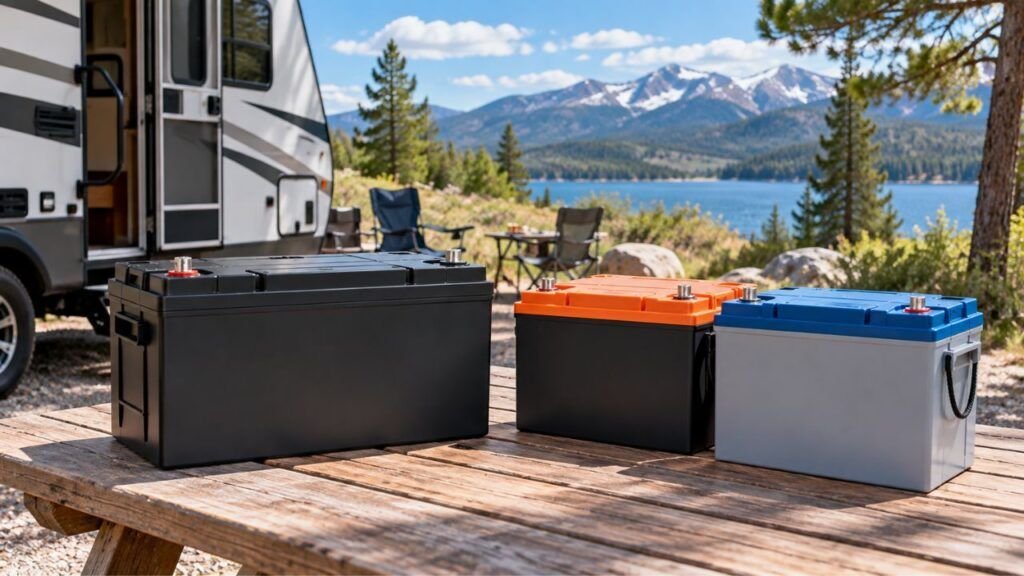
One large lithium battery is usually better for RV owners who want simpler wiring and easier monitoring. Multiple smaller batteries are often better when you need flexible placement, easier handling, redundancy, or greater modularity. The right choice also depends on BMS discharge limits, inverter demand, available space, and your future expansion plans.
Below, I’ll compare both setups using real RV situations. You’ll see where each option performs better and what specifications matter before you buy.
Key Takeaways
- One 200Ah battery and two 100Ah batteries offer similar stored capacity.
- One large battery usually requires fewer cables and connection points.
- Multiple batteries provide better placement flexibility inside tight RV compartments.
- Multiple batteries may retain partial power after one battery disconnects.
- BMS discharge ratings can matter more than battery amp-hours.
- Parallel batteries require careful wiring for balanced current sharing.
- Adding another lithium battery later requires manufacturer compatibility.
- Your inverter size should influence your battery configuration decision.
One Large RV Lithium Battery vs Multiple Smaller Batteries at a Glance
Both arrangements can provide nearly identical energy capacity. However, their installation, current capability, redundancy, and serviceability can differ considerably.
| Factor | One Large Lithium Battery | Multiple Smaller Lithium Batteries |
| Total capacity | Similar when total Ah matches | Similar when combined Ah matches |
| Wiring | Simpler | More complex |
| Connection points | Fewer | More |
| BMS units | Usually one | One inside each battery |
| Inverter support | Depends on single BMS rating | Combined capability may be higher |
| Redundancy | Entire bank depends on one battery | Partial capacity may remain |
| Installation | Requires one larger space | Flexible placement options |
| Handling | Heavier single battery | Easier individual lifting |
| Monitoring | Usually simpler | Several batteries may need monitoring |
| Expansion | Less modular | Usually more modular |
| Replacement | Larger portion gets replaced | Individual battery may be replaced |
| Parallel balancing | Not externally required | Important |
| Extra hardware | Usually less | More cables, fuses, and possibly busbars |
| Best for | Simple, permanent installations | Flexible and modular installations |
Neither column automatically wins every category. Your RV’s electrical system determines which advantages actually matter.
Do One Large Battery and Several Smaller Batteries Provide the Same Capacity?
For equal voltage and total amp-hours, their theoretical stored energy is essentially comparable.
For example, consider these two 12-volt battery banks:
One 200Ah battery:
200Ah total capacity.
Two 100Ah batteries connected in parallel:
100Ah + 100Ah = 200Ah total capacity.
Both arrangements provide roughly the same total stored energy when their nominal voltages match.
Using a typical 12.8V LiFePO4 rating:
200Ah × 12.8V = approximately 2,560Wh.
The battery count itself doesn’t determine how long your RV runs.
Your actual runtime depends on appliance consumption, inverter efficiency, battery limits, temperature, and charging availability.
The same principle applies to larger RV systems.
One 300Ah battery can have similar stored energy to three 100Ah batteries. One 400Ah battery can likewise resemble four 100Ah units.
However, equal capacity doesn’t mean equal electrical performance.
That’s where BMS ratings become particularly important.
Advantages of One Large Lithium Battery in an RV
A large battery mainly gives you a cleaner electrical installation. You have fewer separate components to connect, monitor, and troubleshoot.
Simpler Wiring and Fewer Connection Points
One battery normally needs one main positive connection and one negative connection.
Multiple batteries require additional interconnect cables or busbar connections.
Every extra connection introduces another place where resistance can develop. Terminals also need correct tightening and occasional inspection.
Fewer connections can therefore make troubleshooting noticeably easier.
You also avoid wondering whether current is sharing evenly between several batteries.
For an RVer wanting a straightforward system, this simplicity has real value.
Easier BMS Monitoring
Most modern RV lithium batteries contain their own Battery Management System.
The BMS monitors factors such as:
- Cell voltage
- Charge conditions
- Discharge conditions
- Temperature
- Excessive current
- Low-voltage protection
With one battery, you only have one internal BMS.
Bluetooth-equipped batteries also give you one battery connection to monitor.
With several batteries, each battery may report slightly different information.
That doesn’t make a multi-battery system difficult to operate. However, troubleshooting can require checking individual batteries separately.
A dedicated battery shunt can still provide better whole-bank monitoring.
Cleaner Installation When the Compartment Fits
One large lithium battery can create a very tidy installation.
There’s one battery case, fewer cables, and less interconnection hardware.
However, don’t assume one battery always saves usable RV space.
The battery still needs to physically enter your compartment.
A 300Ah battery might fit the compartment dimensions once installed. Yet it may not fit through the exterior access door.
You also need space around:
- Terminals
- Cables
- Fuses
- Disconnect switches
- Mounting hardware
- Service access
Measure the compartment opening before measuring the floor space.
That’s an easy detail to miss while shopping online.
Less Parallel-Bank Balancing to Worry About
Parallel lithium banks work best when each battery sees similar resistance.
That means cable lengths, connection points, and conductor sizes matter.
With one battery, there is no external battery-to-battery current-sharing issue.
The internal BMS still manages the cells inside the battery.
However, you don’t need to design balanced current paths between battery cases.
That removes one important installation variable.
When One Large Battery Is Best for High-Power Loads
A large battery can work extremely well with a powerful RV inverter.
But the amp-hour rating doesn’t tell the whole story.
You need to check the battery’s:
- Continuous discharge current
- Peak discharge current
- BMS current limit
- Recommended inverter size
Suppose two different 200Ah batteries both store similar energy.
One may have a 100A continuous BMS.
Another may support 200A continuously.
Their usable capacity could look similar on paper. Their ability to run a large inverter would be very different.
Always compare the BMS rating before choosing your battery.
Disadvantages of One Large RV Lithium Battery
- One BMS shutdown can disconnect your entire battery bank.
- Larger batteries can be awkward to lift into compartments.
- Large cases may not fit existing RV battery boxes.
- Removing one large battery can require considerably more effort.
- Replacing it means replacing a large portion of your system.
- You cannot distribute its capacity around irregular storage areas.
- Future expansion may require another equally large battery.
- One failure can remove all available off-grid battery power.
These disadvantages don’t automatically make large batteries unreliable.
They simply increase how much your RV depends on one battery.
Advantages of Multiple Smaller Lithium Batteries in an RV
Multiple batteries offer modularity instead of simplicity. This arrangement becomes attractive when space, handling, redundancy, or current capability matters more.
Partial Redundancy if One Battery Shuts Down
This is one of the strongest arguments for several batteries.
Imagine your RV has two 100Ah batteries connected properly in parallel.
If one battery develops a problem and disconnects, the other may remain available.
You haven’t necessarily lost your entire battery bank.
However, there’s an important limitation.
The remaining battery must still support whatever load you’re running.
Suppose both batteries were powering a large inverter together.
If one battery suddenly disconnects, the remaining battery receives much more load.
Its BMS may shut down if the new current exceeds its limit.
So multiple batteries can provide redundancy, but not unlimited redundancy.
Essential loads may continue while heavy loads need to stop.
Easier to Fit Around Tight RV Compartments
Several small cases can sometimes fit where one large battery cannot.
That matters in:
- Travel trailers
- Camper vans
- Class B motorhomes
- Under-bed compartments
- Dinette storage areas
- Existing dual-battery boxes
Two 100Ah batteries may fit side-by-side through a narrow opening.
One physically larger 200Ah or 300Ah battery might not.
This flexibility can determine the entire system layout.
Just avoid spreading batteries around the RV without proper planning.
Long cable runs can create additional voltage drop and installation complications.
Easier to Lift, Install, and Replace
Lithium is lighter than comparable lead-acid capacity, but large batteries remain heavy.
Two smaller batteries divide that weight between separate lifts.
That matters when you’re reaching into a low compartment.
It also helps when batteries must pass through narrow exterior doors.
Later maintenance becomes easier too.
Removing one 100Ah battery is usually easier than wrestling with one very large battery.
More Modular Capacity
Smaller batteries can make staged upgrades possible.
You might initially install one compatible 100Ah battery.
Later, you might increase the bank to 200Ah.
A further expansion could provide additional capacity.
This approach spreads your spending across different upgrades.
However, don’t assume you can add batteries indefinitely.
Battery manufacturers set limits on parallel configurations.
Battery age and model compatibility also matter.
We’ll cover those issues shortly.
Multiple BMS Units May Increase Available Battery-Side Current
This advantage often gets overlooked.
Imagine two batteries, each supporting substantial continuous discharge current.
When properly connected in parallel, they may share a high inverter load.
That can provide more combined current capability than another battery using one lower-rated BMS.
However, don’t simply multiply BMS ratings yourself and assume the result.
Actual allowable parallel discharge depends on the battery design.
Always check the manufacturer’s parallel specifications.
Disadvantages of Using Multiple Smaller Lithium Batteries
- Additional batteries require more cables and connection points.
- Parallel wiring must encourage balanced current sharing.
- More positive battery branches may require individual protection.
- Busbars may be needed for cleaner current distribution.
- Loose connections can create resistance and unwanted heating.
- Different batteries may not share current perfectly.
- More BMS units may require additional monitoring.
- Extra wiring hardware consumes valuable compartment space.
- Battery manufacturers may limit parallel bank size.
- Adding significantly older or newer batteries may be restricted.
- Troubleshooting can take longer with several individual batteries.
A properly designed parallel bank can work very well.
The important part is building it as a system, not just adding batteries.
BMS Current May Matter More Than Battery Size for Your RV Inverter
Many RV battery comparisons focus almost entirely on amp-hours. That overlooks one specification that becomes critical with powerful inverters: BMS discharge current.
Amp-Hours Tell You Energy, Not Maximum Power
Amp-hours help describe how much electrical charge a battery stores.
They don’t directly tell you how much current it can safely supply.
The internal BMS controls that limit.
For example, a battery might be rated at:
- 200Ah capacity
- 100A continuous discharge
- Higher short-duration peak current
Another 200Ah battery could support considerably more continuous current.
Their runtimes may be similar at modest loads.
Their high-power capabilities may be completely different.
Why a 2,000W Inverter Changes the Decision
A 2,000W inverter can require substantial battery-side current.
For a simplified example:
2,000W ÷ 12.8V = about 156A before inverter losses.
After accounting for conversion losses, battery current can be higher.
A battery with only a 100A continuous BMS could therefore become the limiting component.
Now consider two compatible batteries sharing that load.
If their design allows sufficient combined discharge current, that setup may support the inverter more comfortably.
Alternatively, one large battery with a higher-current BMS may handle everything alone.
This is why comparing only 200Ah versus 2 × 100Ah isn’t enough.
You need both energy capacity and discharge capability.
What Happens if One Battery BMS Trips?
Here’s another detail worth understanding.
Suppose two batteries are sharing a 160A load.
Each battery might contribute roughly part of that current.
If one battery suddenly disconnects, the other receives much more demand.
The remaining battery may then exceed its BMS current limit.
That can trigger another shutdown.
This is why redundancy is most useful for keeping smaller essential loads running.
Think lights, water pumps, refrigeration controls, fans, and electronics.
Don’t assume one remaining battery can continue powering every appliance normally.
How Multiple RV Lithium Batteries Should Share Current
Parallel lithium banks need more thought than simply joining terminals together. The objective is giving each battery a similar electrical path.
Balanced Parallel Connections Matter
Electricity follows paths according to their resistance.
If one battery has a shorter or lower-resistance path, it may work harder.
Over time, uneven loading can create inconsistent cycling between batteries.
Proper designs commonly use balanced connections or busbars.
Correct cable sizing is also important.
The goal is keeping battery-to-system resistance reasonably equal.
You don’t need to become an electrical engineer to understand this.
Just avoid improvising parallel wiring without following approved diagrams.
Each Battery Adds Another Protected Branch
Multiple batteries create multiple sources of substantial electrical current.
Proper circuit protection becomes increasingly important.
Depending on the battery system and manufacturer instructions, individual battery branches may require their own protection.
The bank also needs appropriately sized main protection.
Never choose fuse sizes using battery capacity alone.
Cable size, inverter demand, equipment ratings, and battery specifications all matter.
For a major RV battery installation, professional assistance can be worthwhile.
Follow the Battery Manufacturer’s Parallel Limit
Not every lithium battery allows unlimited parallel expansion.
Some products support several batteries.
Others limit the number considerably.
Certain batteries may not support parallel operation at all.
That’s why the battery manual matters before purchase.
A label saying “12V LiFePO4” doesn’t mean every 12V LiFePO4 battery can be connected together.
Check the exact model’s approved configuration first.
Can You Mix Different Lithium Batteries in an RV Bank?
Mixing lithium batteries requires caution because battery compatibility extends beyond nominal voltage.
Ideally, parallel batteries should follow the manufacturer’s requirements for model, chemistry, capacity, BMS design, and state of charge.
Different capacities can behave differently under load.
Different BMS ratings can also create uneven shutdown behavior.
Battery age introduces another variable because older batteries may have changed capacity and internal resistance.
Even two batteries labeled 12V can have different operating specifications.
That doesn’t mean every mixed lithium bank automatically fails.
It means you shouldn’t assume compatibility without manufacturer approval.
When possible, use matching batteries designed to operate together.
Is Adding Another Lithium Battery Later Really That Simple?
Expansion sounds easy because lithium batteries are often marketed as modular. In practice, planning the final bank early can prevent several problems later.
Why Staged Expansion Sounds Attractive
Starting small can reduce your initial RV upgrade cost.
You might discover that 100Ah handles most weekend trips.
Later, longer boondocking trips may justify another battery.
That flexibility can be genuinely useful.
Why Battery Age Matters
Lithium batteries gradually change as they accumulate cycles and calendar age.
An older battery may not behave exactly like a new one.
Capacity, internal resistance, and BMS behavior may differ.
Some manufacturers allow adding newer matching batteries within specific conditions.
Others impose tighter requirements.
Instead of following a universal “six-month” or “one-year” rule, follow your battery manufacturer’s instructions.
Plan the Final Bank Before Buying the First Battery
Even if you’re starting with one battery, design for the future.
Check:
- Maximum allowed parallel batteries
- Future compartment space
- Busbar capacity
- Main cable capacity
- Fuse requirements
- Charger capacity
- Solar charging capability
- DC-to-DC charger output
- BMS compatibility
That preparation can prevent replacing perfectly good electrical components later.
Which Setup Takes Up Less Space in an RV?
One large battery often needs less surrounding connection hardware between battery cases. However, smaller batteries can use awkward RV storage spaces more efficiently.
The important distinction is total volume versus usable fit.
A large battery may have an attractive footprint on paper.
Yet it may not pass through your compartment opening.
Several smaller batteries may occupy slightly more total area but fit perfectly.
Also leave room for the electrical hardware around them.
Your installation may require space for cables, busbars, fuses, disconnects, and terminal covers.
Cable routing matters too.
Large inverter cables are thick and don’t bend sharply without space.
Measure the entire installation, not just the battery case.
One Heavy Battery vs Several Lighter Batteries
Weight isn’t only about how many pounds your RV carries.
You also need to consider how those pounds enter the compartment.
One large battery may be difficult to lower into under-bed storage.
It can also be awkward to maneuver through exterior access doors.
Several smaller batteries divide the lifting weight into manageable pieces.
On the other hand, multiple batteries usually require more mounting hardware.
Whichever setup you choose, secure every battery properly for travel.
An RV experiences vibration, potholes, cornering forces, and sudden braking.
Battery placement should also respect your RV’s available payload and axle limits.
Don’t assume spreading batteries around automatically improves weight distribution.
Which Option Costs Less?
Compare the complete installed system rather than battery prices alone.
- Battery purchase price
- Cost per usable watt-hour
- Battery interconnect cables
- Cable lugs
- Busbars
- Battery-level circuit protection
- Main fuse protection
- Disconnect switches
- Mounting hardware
- Monitoring equipment
- Professional installation costs
- Future expansion expenses
- Replacement costs after a battery failure
One large battery often saves money on auxiliary hardware.
Multiple smaller batteries may reduce the cost of replacing one failed module.
However, battery pricing changes frequently.
Compare complete systems using similar features and specifications.
Which Charges Faster: One Large Battery or Multiple Smaller Batteries?
Battery count alone doesn’t determine charging speed. Charging time depends on total capacity, allowable charge current, and your RV’s charging equipment.
Total Capacity Still Has to Be Replaced
Suppose both battery banks contain about 2,560Wh of energy.
After using 1,500Wh, roughly that energy must be restored.
Having two battery cases doesn’t magically reduce the missing energy.
Charging time depends largely on available charging power.
Battery Charge-Current Limits Can Differ
Batteries have maximum recommended charging currents.
A larger battery might accept substantial charging current.
Multiple smaller batteries may also share available charging current.
Again, actual performance depends on the battery specifications.
Don’t assume one configuration automatically charges faster.
Your RV Charger May Be the Real Bottleneck
Often, your charging equipment matters more than battery architecture.
Possible charging sources include:
- RV converter/charger
- Solar charge controller
- DC-to-DC alternator charger
- Inverter/charger
- Generator-powered charger
- Shore-power charging
Installing 400Ah of lithium capacity won’t help charging speed if your charger is very small.
Large banks may simply take longer to recover.
Size storage and charging capacity together.
One Large vs Multiple Smaller Batteries for Different RV Owners
Different RV lifestyles reward different battery characteristics. Here are several common situations where one configuration becomes more practical.
Weekend Camper With Little Inverter Use
A weekend camper usually doesn’t need elaborate redundancy.
Lights, water pumps, fans, and device charging create modest demand.
If one correctly sized battery fits your compartment, simplicity usually wins.
A single battery can keep installation clean and easy.
Boondocker With Solar
Boondockers depend much more heavily on their battery system.
You may run refrigeration, internet equipment, fans, electronics, and inverter appliances daily.
Multiple batteries can provide useful modularity and partial redundancy.
One high-capacity battery can still work perfectly.
The better choice depends heavily on charging capability and physical space.
RV With a Large Inverter
Start by checking BMS current.
Don’t begin with battery count.
A single high-capacity battery with a strong BMS can be excellent.
Several parallel batteries may also provide substantial combined current capability.
Match the battery system to the inverter’s real DC demand.
Travel Trailer With a Tight Battery Compartment
This situation often favors smaller batteries.
Existing battery boxes may already accommodate two standard-size cases.
A larger high-capacity battery could require major compartment modifications.
Measure before assuming bigger is easier.
Full-Time RVer Who Depends on Battery Power
Full-time RVers benefit more from redundancy and serviceability.
Losing the entire battery bank can disrupt refrigeration, internet access, lighting, and everyday appliances.
Multiple batteries may therefore provide useful flexibility.
However, a reliable large battery paired with backup charging can also work well.
RVer Who Never Plans to Expand
If you already know your final capacity, one large battery becomes attractive.
You avoid extra interconnect wiring and future compatibility concerns.
Just confirm its BMS supports your largest expected loads.
Choose One Large Lithium Battery If…
- You already know your final required battery capacity.
- One battery fits through your compartment opening.
- Its BMS supports your inverter comfortably.
- You want fewer cables and electrical connections.
- Simple monitoring is important to you.
- You don’t expect major future expansion.
- You want straightforward troubleshooting.
- Your battery compartment suits one large case.
Choose Multiple Smaller Lithium Batteries If…
- One large battery won’t fit your available compartment.
- You want lighter individual batteries for easier installation.
- Partial battery redundancy matters during off-grid travel.
- Your batteries support approved parallel operation.
- Your system benefits from additional discharge-current capability.
- You want modular capacity within manufacturer limits.
- Your existing compartment already supports multiple batteries.
- Replacing smaller individual batteries would be easier.
What to Check Before You Buy Either Setup
- Total battery-bank capacity in Ah and Wh
- RV electrical-system voltage
- Inverter continuous wattage
- Inverter surge requirement
- Battery continuous BMS discharge rating
- Battery peak discharge limit
- Maximum battery charging current
- Maximum permitted parallel battery count
- Battery case dimensions
- Battery weight
- Compartment opening dimensions
- Terminal and cable clearance
- RV available payload
- Converter/charger compatibility
- Solar charge-controller compatibility
- DC-to-DC charger compatibility
- Required cable sizes
- Busbar requirements
- Fuse and disconnect requirements
- Rules for adding batteries later
Don’t buy solely from the amp-hour number printed on the listing.
Look at the entire electrical system.
Final Verdict: One Large Lithium Battery or Multiple Smaller Batteries for Your RV?
For many RV owners, one properly sized large lithium battery is the cleaner choice. You get simpler wiring, fewer connections, easier monitoring, and fewer parallel-bank concerns. If its BMS comfortably handles your inverter and the battery fits properly, there’s little reason to complicate the system.
Multiple smaller lithium batteries make more sense when you need flexible placement, easier lifting, modular capacity, or partial redundancy. They can also provide strong inverter support when their combined discharge capability and parallel configuration are properly designed.
My advice is to avoid choosing based on amp-hours alone. Compare capacity, BMS current, inverter demand, compartment fit, charging capability, and manufacturer-approved configurations together. Once those pieces line up, the better choice for your RV usually becomes obvious.
Related FAQs
Here are short answers to several common questions RV owners ask when comparing large and modular lithium battery banks.
Is One 200Ah Lithium Battery Better Than Two 100Ah Batteries for an RV?
One 200Ah battery is usually simpler because it needs less external wiring and only one BMS to monitor. Two 100Ah batteries can be better when you want easier handling, flexible placement, partial redundancy, or greater combined discharge capability.
Will Two 100Ah Lithium Batteries Last Longer Than One 200Ah Battery?
Two 100Ah batteries and one 200Ah battery should offer similar runtime when their total usable energy and operating conditions are comparable. Their service life depends more on cell quality, temperature, charging, discharge rates, depth of discharge, and battery management than battery count.
Can Two 100Ah Lithium Batteries Supply More Current Than One 200Ah Battery?
They sometimes can, but you need to compare actual BMS discharge specifications. Two parallel batteries may provide greater combined current capability, while some 200Ah batteries already have high-current BMS units capable of supporting large inverter loads alone.
What Happens if One Lithium Battery Fails in a Parallel RV Battery Bank?
The remaining battery may continue powering the RV after the failed battery disconnects or gets isolated. However, the remaining battery must support the entire load, so high inverter demand could exceed its BMS limit and cause another shutdown.
Can I Add a Second Lithium Battery to My RV Later?
You often can if your battery manufacturer permits parallel expansion. Ideally, the additional battery should meet the required model, capacity, voltage, BMS, state-of-charge, and age guidelines before you connect it to the existing bank.
Do Parallel Lithium Batteries Need to Be the Same Brand and Size?
Using matching batteries is generally the safest and easiest approach. Mixing brands, capacities, ages, or BMS designs can affect current sharing and system behavior, so only combine different batteries when their manufacturers specifically approve that configuration.
Is One 300Ah Battery Better Than Three 100Ah Batteries?
One 300Ah battery usually provides simpler wiring and monitoring. Three 100Ah batteries provide easier handling, flexible placement, modular replacement, and potentially greater combined discharge capability. The better choice depends on BMS ratings, inverter demand, physical space, and your need for redundancy.
Do Multiple Lithium Batteries Charge Evenly in Parallel?
Properly matched batteries with balanced parallel wiring should share charging reasonably well. Unequal cable resistance, battery differences, poor connections, or different states of charge can affect current sharing, so follow the battery manufacturer’s recommended parallel wiring method.

Ryan Carter writes practical battery guides focused on troubleshooting, everyday use, and smarter buying decisions. His experience with lithium batteries, RV and automotive power, and home backup systems helps readers choose reliable solutions with confidence.















