
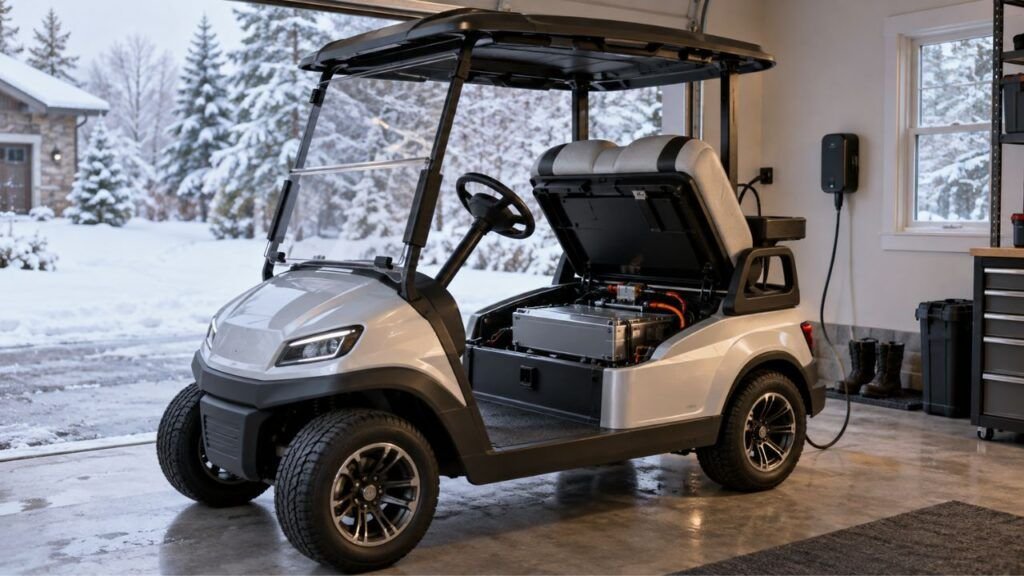
Yes, a lithium golf cart battery needs some winter maintenance. However, it needs much less attention than a traditional lead-acid battery. Your main jobs are protecting it from unsafe cold-weather charging, preventing unnecessary power drain, and following the correct storage procedure.
In this guide, I’ll explain how cold affects your battery, how to store it safely, and what to do before using your cart again in spring.
Key Takeaways
- Lithium golf cart batteries need winter preparation but very little routine maintenance.
- Avoid charging below the battery manufacturer’s approved temperature.
- Many lithium batteries stop charging around 32°F through their built-in BMS.
- Winter storage charge recommendations vary between battery manufacturers.
- Never assume 50%, 60%, or 100% storage charge applies universally.
- Turn off accessories that can slowly drain the battery during storage.
- TOW mode is useful on some carts but not required on every model.
- A dry, protected storage location makes winter battery care much easier.
- Check the battery occasionally during several months of storage.
- Always follow your battery and golf cart owner’s manuals first.
Does a Lithium Golf Cart Battery Really Need Winter Maintenance?
A lithium golf cart battery does not need traditional winter battery servicing. You do not need to add water, equalize cells manually, or regularly clean acid corrosion.
That is one major advantage of switching from lead-acid batteries.
However, lithium batteries still need proper winter preparation.
Cold temperatures can affect charging, range, and battery management systems. Long periods of inactivity can also allow accessories to drain power slowly.
So, I would describe lithium batteries as low-maintenance rather than maintenance-free.
Your winter care mainly involves four things:
- Charging at a safe temperature
- Choosing the correct storage charge level
- Reducing unnecessary electrical drain
- Keeping the battery in a suitable storage environment
These steps are simple, but they can prevent frustrating problems later.
What Does Cold Weather Do to a Lithium Golf Cart Battery?
Cold temperatures affect lithium batteries differently during driving and charging. Understanding that difference helps you avoid unnecessary worry and accidental battery damage.
Cold Weather Can Temporarily Reduce Driving Range
Your golf cart may not travel as far during very cold weather.
Cold temperatures slow the chemical reactions inside lithium battery cells. Internal resistance also increases as temperatures drop.
You may notice slightly shorter range or weaker acceleration.
That does not automatically mean your battery is failing.
Performance usually improves again after the battery warms up.
For example, a cart that normally travels 35 miles may deliver less range during a freezing winter day. Once temperatures rise, much of that lost performance usually returns.
Charging in Cold Weather Needs More Attention
Charging is more temperature-sensitive than simply using the battery.
Many LiFePO4 golf cart batteries should not accept a normal charge when their internal cell temperature falls below approximately 32°F.
Charging very cold lithium cells can create unwanted lithium deposits inside them. Over time, that can permanently reduce battery performance.
This is why cold-weather charging deserves more attention than cold-weather driving.
Your BMS May Stop Charging Automatically
Most quality lithium golf cart batteries include a Battery Management System.
The BMS monitors important conditions such as:
- Cell voltage
- Battery temperature
- Charging current
- Discharging current
- Overcharging
- Excessive discharge
If the battery becomes too cold for safe charging, the BMS may block the charger.
That can look like a battery problem at first.
However, the system may simply be protecting the cells.
Do not repeatedly reset or bypass temperature protection. Move the cart somewhere warmer and let the battery reach an acceptable charging temperature.
Winter Care Depends on How You Use Your Golf Cart
A golf cart driven every weekend needs different winter care from one stored for four months. Start by deciding how long your cart will remain unused.
| Winter Situation | Battery Care Needed | Charging Approach | Storage Preparation |
| Cart used several times weekly | Minimal | Charge within approved temperature range | Normal shutdown may be enough |
| Cart unused for 1 to 3 weeks | Light preparation | Maintain suitable charge | Turn off unnecessary accessories |
| Cart stored several months | Full winter preparation | Follow manufacturer storage SOC | Use approved storage procedure |
| Cart stored in freezing garage | Extra cold precautions | Warm battery before charging | Monitor temperature and charge |
| Cart stored in heated garage | Easier storage | Follow normal charging guidance | Check charge periodically |
The biggest mistake is treating short winter breaks and long storage equally.
If you drive regularly, you mainly need to manage charging temperature.
If you store the cart for months, parasitic drain and storage charge become equally important.
How Much Charge Should a Lithium Golf Cart Battery Have for Winter Storage?
There is no single storage percentage that works for every lithium golf cart battery. This is one area where generic online advice can cause confusion.
Why You Often See 40% to 60% Recommended
Many lithium battery storage guides recommend a moderate state of charge.
You may commonly see recommendations around 40% to 60%.
Keeping lithium cells at a moderate charge can reduce long-term stress during extended storage.
That recommendation makes sense for many stand-alone lithium battery designs.
However, a golf cart battery is often part of a larger electrical system.
Its BMS, monitoring system, display, or vehicle electronics may continue using small amounts of energy.
That changes the storage strategy.
Why Some Manufacturers Recommend a Full Charge
Some golf cart battery manufacturers recommend charging their packs to 100% before winter storage.
Their reasoning may include ongoing BMS power consumption and system calibration needs.
A full charge can also provide more reserve capacity during several months of inactivity.
This does not mean every lithium battery should be stored fully charged.
It means the correct storage level depends on your specific battery.
Follow Your Battery Manufacturer’s Storage Instructions
Instead of choosing a random percentage, check your battery manual.
Look specifically for:
- Recommended storage state of charge
- Maximum storage duration
- Storage temperature range
- Recharge intervals
- Storage or sleep mode instructions
If your battery manufacturer says 50%, use 50%.
If it says 100%, use 100%.
Your battery’s documentation should take priority over generic recommendations.
Can You Charge a Lithium Golf Cart Battery Below 32°F?
Many lithium golf cart batteries should not be charged when their internal temperature falls below approximately 32°F. However, the exact limit depends on the battery manufacturer.
If your battery is too cold, use one of these approaches:
- Move the golf cart into a warmer garage.
- Allow the battery to warm naturally.
- Use the battery’s approved self-heating function.
- Check temperature through the battery app when available.
- Wait until the battery reaches its approved charging range.
One point often causes confusion.
Battery temperature matters more than outdoor air temperature.
Imagine your golf cart sat outside overnight at 18°F.
The afternoon temperature rises to 38°F.
That does not mean the battery instantly becomes 38°F internally.
The cells may still be cold enough for the BMS to block charging.
Give the battery enough time to warm before connecting the charger.
Do Self-Heating Lithium Golf Cart Batteries Need Winter Maintenance?
A self-heating lithium battery makes winter charging easier. However, it does not eliminate winter maintenance completely.
A built-in heater warms the battery cells before normal charging begins.
That can be especially useful if your golf cart stays in an unheated garage.
Self-heating batteries make sense in colder parts of the United States where temperatures frequently remain below freezing.
However, different heating systems operate differently.
Some heaters use incoming charger power.
Others may draw energy from the battery itself.
The temperature that activates heating can also vary.
You still need to follow your manufacturer’s storage instructions, charging limits, and long-term maintenance recommendations.
Think of self-heating as a convenience feature, not permission to ignore winter battery care.
Should You Leave a Lithium Golf Cart Battery Plugged In All Winter?
Do not assume every lithium golf cart should remain plugged into its charger all winter.
Some battery and charger systems are designed for extended connection. Others specifically recommend disconnecting the charger after charging finishes.
That means both pieces of advice can be correct depending on the system.
A lithium charger should not automatically be treated like a traditional battery maintainer.
Before leaving the charger connected for several months, check:
- Battery storage instructions
- Charger manufacturer’s recommendations
- Automatic shutoff behavior
- Long-term maintenance mode
- Temperature limits
If the manufacturer tells you to disconnect the charger after charging, do that.
If the complete battery system supports long-term plugged-in storage, follow those instructions instead.
Avoid creating your own charging routine when the manufacturer already provides one.
Should You Put the Golf Cart in TOW Mode for Winter?
TOW mode can reduce electrical activity on some golf carts during storage. However, not every lithium golf cart uses the same switch arrangement.
TOW Mode Works for Some Golf Carts
Many traditional golf carts include a RUN/TOW switch.
Moving the switch to TOW can disconnect certain controller functions and reduce electrical drain.
That makes it useful during service, transportation, and storage on compatible models.
Some Lithium Carts Use Different Storage Systems
Newer lithium carts may use other systems instead.
Your cart might have:
- RUN/STORAGE mode
- Battery sleep mode
- Main battery power switch
- Electronic disconnect
- Dedicated storage setting
Some systems may even require a switch to remain in a specific operating position.
That is why universal TOW mode advice can be misleading.
Check the Cart Manual Before Changing Modes
Do not choose a switch position based only on another owner’s golf cart.
Find the storage section in your owner’s manual.
Then follow the exact shutdown process for your cart.
The correct procedure should reduce battery drain without interfering with the BMS.
Do You Need to Disconnect the Lithium Battery for Winter?
You do not always need to physically disconnect a lithium golf cart battery during winter storage.
Some batteries have built-in sleep or storage modes that already reduce power consumption.
Others may require a master disconnect.
The correct approach depends on the battery and cart design.
Before disconnecting anything, consider whether these devices remain powered:
- Stereo systems
- USB outlets
- LED lighting systems
- GPS trackers
- Voltage reducers
- Digital dashboards
- Bluetooth modules
- Aftermarket accessories
These devices can create parasitic drain.
Parasitic drain is different from battery self-discharge.
A lithium battery naturally loses only a small amount of charge while sitting unused. However, vehicle electronics can consume significantly more energy over several months.
That is why turning off unnecessary loads matters.
If your manufacturer recommends disconnecting the battery, follow its procedure carefully.
Do not disconnect integrated OEM battery systems unless the manual allows it.
Where Should You Store a Lithium Golf Cart Battery During Winter?
A dry, protected location is generally best for winter storage. Temperature matters, but moisture protection and correct charging are equally important.
A Dry Garage Is Better Than Outdoor Exposure
Indoor storage protects your golf cart from repeated exposure to:
- Snow
- Ice
- Rain
- Road salt
- Standing water
- Large temperature swings
You do not necessarily need a fully heated garage.
A dry and protected garage is already much better than leaving the cart exposed outdoors.
Does the Battery Need to Stay Above Freezing?
Not necessarily.
Many lithium batteries can safely sit or discharge at temperatures below freezing.
However, their charging temperature range is usually more restrictive.
This distinction matters.
A battery sitting at 25°F may be perfectly safe in storage while still being too cold to charge.
Check the storage temperature specification for your battery.
Do not assume its charging, operating, and storage temperature limits are identical.
Should You Remove the Battery and Bring It Indoors?
You usually do not need to remove the battery if the golf cart can stay somewhere protected.
Large lithium golf cart packs can also be heavy and difficult to handle safely.
Some are integrated directly into the vehicle.
Battery removal may make sense when:
- The cart must remain outdoors
- Temperatures become extremely low
- The battery is designed for easy removal
- The manufacturer recommends indoor storage
If removal is required, follow the manufacturer’s lifting and disconnect instructions.
Never move a large battery pack using the cables or terminals.
Simple Lithium Golf Cart Winter Maintenance Checklist
Winterizing a lithium golf cart does not need to become complicated. Use this checklist as a starting point, then adjust it using your owner’s manual.
- Read your battery’s winter storage instructions.
- Inspect the battery case for visible damage.
- Check cables and battery connections.
- Confirm the current state of charge.
- Charge to the manufacturer’s recommended storage level.
- Confirm the battery is warm enough before charging.
- Turn the ignition key off.
- Shut down unnecessary accessories.
- Select the approved storage or TOW mode.
- Disconnect the battery only when specifically recommended.
- Unplug the charger if required.
- Store the cart somewhere dry and protected.
- Record the battery’s starting charge level.
- Check the battery periodically during storage.
If you complete those steps, you have covered most winter storage risks.
How Often Should You Check the Battery During Winter Storage?
You usually do not need to inspect a lithium golf cart battery every week.
For long-term winter storage, checking it every one to three months is a reasonable general approach.
Your battery manufacturer may recommend a different schedule.
During each check, look at:
- Battery state of charge
- BMS warnings
- Battery temperature
- Moisture around the battery area
- Loose or damaged wiring
- Physical battery damage
If your battery has Bluetooth monitoring, checking SOC can take only a few seconds.
Still, do not assume an app completely replaces physical inspection.
Rodents, moisture, or damaged cables can create problems the app cannot show.
Do Lithium Golf Cart Battery Terminals Need Winter Maintenance?
Lithium batteries do not experience the same acid corrosion problems as flooded lead-acid batteries.
That means terminal maintenance is generally easier.
However, you should still inspect connections before and after winter storage.
Look for:
- Loose cable lugs
- Damaged insulation
- Moisture
- Discoloration
- Melted plastic
- Unusual heat marks
Do not randomly tighten battery terminals as hard as possible.
Overtightening can damage threaded inserts or terminal hardware.
Use the torque specification listed by the battery manufacturer.
Can You Drive a Lithium Golf Cart During Winter?
Yes, many lithium golf cart batteries can operate during cold weather. Their allowable discharge temperature is often lower than their charging temperature.
Cold-Weather Driving Is Usually Easier Than Charging
Many lithium batteries can discharge below freezing without immediate damage.
That does not mean every battery has the same operating limit.
Check the lowest approved discharge temperature for your specific pack.
Your BMS may automatically limit output if temperatures become extreme.
Expect Less Range on Very Cold Days
Cold weather can temporarily reduce available energy.
Other winter conditions can reduce range too.
These include:
- Low tire pressure
- Heavy passenger loads
- Steep hills
- Heated accessories
- Headlights
- Wind
- Snow-covered surfaces
If your range drops somewhat during freezing weather, do not immediately assume the battery needs replacement.
Compare its performance again after temperatures rise.
Let the Battery Warm Before Charging
Suppose you drive your golf cart outside for several hours.
You return to an unheated garage while temperatures remain below freezing.
The battery may still be too cold to charge safely.
Let it warm first.
If your battery app shows cell temperature, use that information instead of guessing.
Is Winter Range Loss a Sign Your Lithium Battery Is Failing?
Some winter range loss is normal with lithium golf cart batteries.
You should become more concerned when performance remains poor after the battery returns to a moderate temperature.
Normal cold-weather behavior may include:
- Slightly shorter driving range
- Reduced performance during extreme cold
- Charging delayed by BMS protection
- Range returning as temperatures warm
Possible battery problems may include:
- Severe range loss even in warm conditions
- Repeated BMS shutdowns
- Inability to reach normal charge
- Persistent warning codes
- Battery swelling
- Unusual heating
- Sudden power loss under normal loads
Temperature-related range loss is usually temporary.
A genuinely deteriorating battery continues performing poorly after conditions normalize.
Common Winter Maintenance Mistakes to Avoid
Lithium batteries are easy to maintain, but a few winter mistakes can create unnecessary problems.
- Charging a cold battery without checking temperature first
- Assuming every battery needs a 50% storage charge
- Assuming every battery should be stored at 100%
- Leaving powered accessories connected for several months
- Selecting TOW mode without checking the cart manual
- Using a lead-acid charger on an incompatible lithium battery
- Storing the battery almost completely discharged
- Ignoring manufacturer storage instructions
- Assuming self-heating means no maintenance is needed
- Leaving the cart outdoors when protected storage is available
Avoiding these mistakes matters more than performing complicated maintenance procedures.
Lithium vs. Lead-Acid Golf Cart Battery Winter Maintenance
Lithium batteries generally require less winter maintenance than flooded lead-acid batteries. The table below shows where the biggest differences appear.
| Winter Maintenance Task | Lithium Battery | Flooded Lead-Acid Battery |
| Check water levels | No | Yes |
| Add distilled water | No | Yes |
| Equalization charging | Usually no | Sometimes required |
| Sulfation concern | No | Yes |
| Cold charging restrictions | Important | Different limitations |
| Storage charge | Manufacturer-specific | Usually fully charged |
| BMS temperature protection | Usually yes | Usually no |
| Terminal inspection | Yes | Yes |
| Parasitic drain protection | Important | Important |
| Overall winter maintenance | Low | Higher |
Lithium wins mainly because there is less hands-on servicing.
Its biggest winter limitation is temperature-sensitive charging.
Once you understand that difference, lithium winter care becomes straightforward.
How to Bring a Lithium Golf Cart Battery Out of Winter Storage
Do not immediately jump into a long first drive after several months of storage. A quick inspection helps catch problems before they leave you stranded.
Inspect the Cart Before Turning Everything On
Start with a basic visual inspection.
Look around the battery compartment for:
- Damaged wiring
- Loose connections
- Moisture
- Dirt buildup
- Rodent damage
- Physical battery damage
If anything looks burnt, swollen, or severely damaged, stop before charging.
Check Battery Temperature and State of Charge
Next, check the battery’s current charge level.
If the battery has been sitting in a freezing garage, check its temperature too.
Do not immediately charge a cold battery simply because spring has arrived.
Wait until the battery reaches its approved charging temperature.
Return the Cart to Normal Operating Mode
Reverse the storage procedure recommended by your manufacturer.
That may involve:
- Switching from TOW to RUN
- Leaving battery sleep mode
- Turning the master battery switch on
- Reconnecting approved accessories
- Restoring normal controller operation
Use your owner’s manual when you are unsure.
Charge and Test Before a Longer Drive
Charge the battery normally once temperatures are safe.
Then take the cart for a short test drive.
Confirm that:
- Acceleration feels normal
- Battery percentage displays correctly
- No BMS warnings appear
- Charging behaves normally
- The cart does not shut down unexpectedly
A short first drive gives you time to spot problems safely.
When Should You Consider a Heated Lithium Golf Cart Battery?
A self-heating battery becomes especially useful when you regularly use your golf cart during freezing weather.
It makes the most sense when:
- Your cart stays in an unheated garage.
- Winter temperatures regularly fall below freezing.
- You depend on the cart throughout winter.
- Moving the cart somewhere warmer is difficult.
- You frequently need to recharge after cold-weather driving.
You may not need a heated battery if the cart stays in a heated garage all winter.
The best choice depends on how often cold temperatures interfere with charging.
Final Verdict
Yes, a lithium golf cart battery needs winter maintenance, but the process is simple. Most of your attention should go toward safe charging temperatures, correct storage charge, and preventing unnecessary electrical drain.
The most important rule is not a specific percentage or switch position. Follow the winter storage instructions for your exact battery and golf cart. Different lithium systems use different charging, storage, and shutdown procedures.
Prepare the battery properly before winter, check it occasionally, and restart it carefully in spring. Those basic habits can help protect performance and extend battery life for years.
Related FAQs
Does a Lithium Golf Cart Battery Need to Be Removed for Winter?
Usually not. You can generally leave the battery installed if the golf cart is stored somewhere dry and the manufacturer allows installed storage. Remove it only when conditions or battery instructions make removal necessary.
Can I Leave My Lithium Golf Cart Outside All Winter?
You can in some situations, but protected indoor storage is better. Outdoor exposure creates greater temperature swings, moisture, snow, ice, and other conditions that can make winter battery care harder.
What Percentage Should I Store My Lithium Golf Cart Battery At?
There is no universal percentage. Some manufacturers recommend partial charge, while others recommend full charge before long storage. Always follow the storage SOC specified for your battery.
Can a Lithium Golf Cart Battery Freeze?
Lithium batteries tolerate cold better than many people expect, but extremely low temperatures still reduce performance. The more important concern is usually attempting to charge the battery while its cells remain below the approved charging temperature.
Can I Charge My Lithium Golf Cart at 30°F?
Many standard lithium golf cart batteries should not be charged at 30°F unless they include approved low-temperature charging or self-heating protection. Check your specific battery temperature limits before charging.
Should I Put My Golf Cart in TOW Mode for Winter Storage?
Use TOW mode only if your golf cart manufacturer recommends it for storage. Some modern lithium carts use storage mode, sleep mode, RUN/STORAGE switches, or another shutdown procedure instead.
Should I Disconnect My Lithium Golf Cart Battery During Winter?
Not always. Some batteries can remain connected while using their built-in storage mode. Disconnect the pack only when your battery or golf cart manufacturer specifically recommends that storage procedure.
Can I Leave My Lithium Golf Cart Plugged In All Winter?
Only if your battery and charger are designed for long-term connection. Some manufacturers allow it, while others recommend disconnecting the charger after reaching the proper storage charge.
How Often Should I Charge a Stored Lithium Golf Cart Battery?
The correct interval varies by manufacturer. Check the charge every one to three months as a general guideline, then recharge when your battery’s storage instructions say it is necessary.
Do Lithium Golf Cart Batteries Lose Range in Winter?
Yes, cold weather can temporarily reduce lithium battery range. Internal resistance increases and available capacity may decrease, but performance usually improves after the battery warms.
Can I Drive a Lithium Golf Cart Below Freezing?
Many lithium batteries can discharge below freezing even when charging is restricted. Check the battery’s minimum operating temperature because discharge limits vary between manufacturers.
Do I Need a Heated Lithium Battery for My Golf Cart?
You probably do not need one if your cart stays somewhere warm. A heated battery becomes more useful when you regularly drive and recharge the golf cart during freezing weather.
Why Won’t My Lithium Golf Cart Battery Charge When It Is Cold?
The BMS may be blocking charging because the battery is below its safe charging temperature. Let the battery warm up naturally or use its approved heating system before trying again.
Is a Lithium Golf Cart Battery Better Than Lead-Acid in Winter?
Lithium generally requires less winter maintenance and avoids problems such as watering and sulfation. However, lithium batteries still need careful temperature management while charging in freezing conditions.
How Do I Wake Up a Lithium Golf Cart Battery After Winter Storage?
Follow the manufacturer’s startup procedure, restore the normal operating mode, check battery temperature and charge level, then recharge safely before taking the cart on a longer drive.

Ryan Carter writes practical battery guides focused on troubleshooting, everyday use, and smarter buying decisions. His experience with lithium batteries, RV and automotive power, and home backup systems helps readers choose reliable solutions with confidence.















