
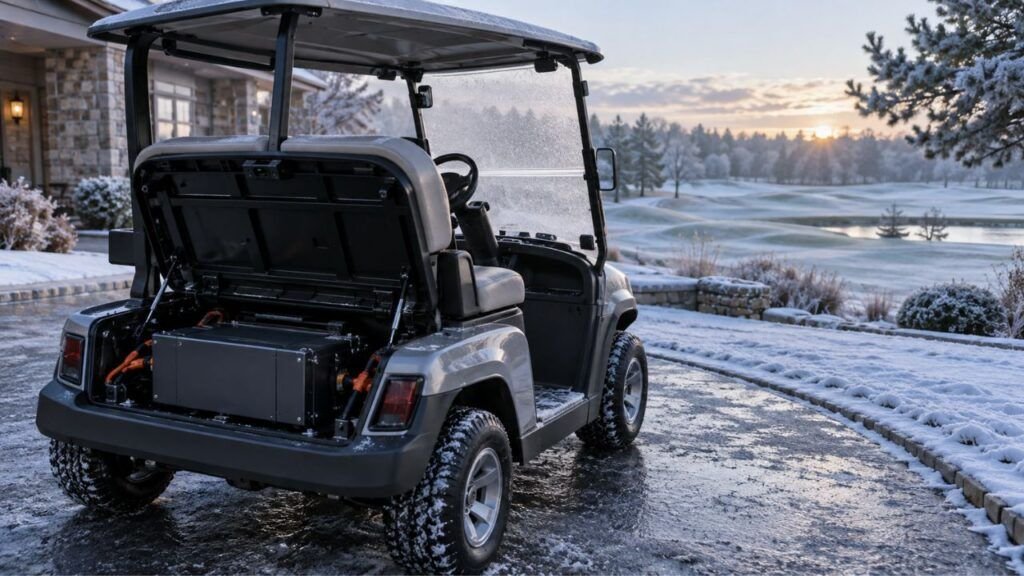
A golf cart lithium battery loses range in cold weather because low temperatures slow the battery’s internal chemical reactions and increase electrical resistance. The battery can still contain energy, but less of that energy becomes easily usable. Voltage also drops more under heavy loads, which can make the cart stop sooner.
If your golf cart suddenly travels fewer miles during winter, that does not automatically mean the battery is failing. Below, I’ll explain what cold weather does to lithium batteries, what range loss is normal, and what you can do to improve winter performance.
Key Takeaways
- Cold temperatures temporarily reduce usable lithium battery capacity.
- Internal resistance increases as the battery cells become colder.
- Voltage can drop faster during acceleration, hills, and heavy loads.
- The BMS may trigger low-voltage protection sooner in cold conditions.
- Most cold-weather range loss improves after the battery warms.
- Tire pressure, accessories, terrain, and driving habits also affect winter range.
- Charging limits are usually stricter than cold-weather driving limits.
- Always follow your battery manufacturer’s temperature specifications.
Why Does a Golf Cart Lithium Battery Lose Range in Cold Weather?
Cold temperatures make the electrochemical processes inside lithium battery cells less efficient. Lithium ions cannot move through the battery as easily as they can at warmer temperatures.
That creates two noticeable changes.
First, the battery temporarily provides less usable energy. Second, its internal electrical resistance increases.
The increased resistance becomes especially noticeable when your golf cart needs substantial power. Accelerating, climbing hills, or carrying several passengers creates a much higher current demand.
A warm battery can usually handle these demands with relatively stable voltage. A very cold battery experiences a larger voltage drop under the same load.
Your golf cart may therefore reach its low-voltage protection point sooner.
The battery can still contain some stored energy when this happens. However, that energy becomes difficult to deliver safely under the current conditions.
This is why cold-weather range loss is better described as a reduction in usable capacity, rather than the battery suddenly losing all its stored electricity.
What Actually Happens Inside a Lithium Battery When It Gets Cold?
Several changes happen inside a cold LiFePO4 battery at the same time. Together, they reduce the amount of useful power available for driving.
Lithium-Ion Movement Slows Down
A lithium battery produces power by moving lithium ions between internal materials.
Cold temperatures slow this process.
Think about how many liquids become thicker and move more slowly when cold. A lithium battery is more complicated than that example, but the basic result is similar.
The battery has to work harder to move ions efficiently.
That means it cannot release stored energy as easily as it could at comfortable temperatures.
Internal Resistance Increases
Every battery has some internal electrical resistance.
That resistance normally wastes a small amount of energy while the battery delivers power.
Cold temperatures increase this resistance.
As resistance rises, the battery becomes less efficient at supplying high amounts of current.
You may barely notice this while driving slowly on level pavement.
Press the accelerator hard or climb a steep hill, however, and the difference can become much more obvious.
Voltage Drops More Under Load
Battery voltage does not remain perfectly constant while driving.
When the motor suddenly requests substantial current, battery voltage drops temporarily. This is commonly called voltage sag.
Cold temperatures can make that voltage sag stronger.
You may notice it most while:
- Accelerating quickly
- Driving uphill
- Carrying several passengers
- Pulling additional weight
- Driving through soft or rough terrain
- Using oversized tires
- Running the cart at higher speeds
The battery may show normal voltage when the cart is parked.
Once you press the accelerator, however, voltage can fall considerably.
This sometimes makes owners believe their battery gauge or BMS is malfunctioning.
In reality, the battery may simply be reacting to the combination of cold cells and high current demand.
The BMS May Reach Low-Voltage Protection Earlier
Your lithium golf cart battery normally includes a Battery Management System, or BMS.
The BMS watches important conditions such as:
- Cell voltage
- Pack voltage
- Current
- Battery temperature
- Charging conditions
- Discharging conditions
If cell voltage drops below a safe limit, the BMS can disconnect the battery.
Cold-weather voltage sag can make that protection happen sooner than expected.
For example, your battery might still contain usable energy while resting. Heavy acceleration could temporarily pull one cell below the BMS protection threshold.
The BMS may then shut the pack down to protect it.
That does not necessarily mean your battery was completely empty.
Does Cold Weather Actually Reduce Battery Capacity or Just the Available Range?
Cold weather mainly reduces how much battery capacity you can practically use at that moment. The actual situation is slightly more complicated than simply saying the battery “loses capacity.”
A lithium battery stores energy chemically.
When temperatures become very low, the internal reactions needed to release that energy become slower and less efficient.
Some energy may therefore remain inside the battery even after your golf cart can no longer use it effectively.
This explains something many owners notice during winter.
You may park the cart after experiencing weak performance or low battery readings. Later, the battery warms and suddenly appears to have recovered some charge.
The battery did not recharge itself.
Instead, warmer cells became better able to provide the energy already stored inside them.
For practical purposes, though, the result is the same while you’re driving.
Less usable energy means fewer miles per charge.
How Much Golf Cart Range Can You Lose in Cold Weather?
There is no single percentage that applies to every lithium golf cart battery. Battery design, temperature, capacity, state of charge, motor load, and driving conditions all influence the final range.
| Battery or Weather Condition | What You May Notice | Likely Effect on Range |
| Around 60°F to 80°F | Normal power and voltage behavior | Close to normal range |
| Around 40°F to 60°F | Slightly higher resistance | Usually a modest change |
| Around 32°F to 40°F | Greater voltage sag under load | More noticeable range reduction |
| Well below 32°F | Reduced usable capacity and stronger voltage sag | Range may drop significantly |
| Below the battery’s discharge limit | BMS protection may activate | Cart may stop operating |
Treat this table as a general guide rather than an exact prediction.
Two batteries with the same voltage and amp-hour rating can perform differently during cold weather. Cell design, BMS programming, battery construction, and discharge rate all matter.
Your particular battery’s specifications are therefore more useful than a universal winter-range percentage.
Why Does My Battery Gauge Drop Faster in Cold Weather?
Your battery gauge can appear to fall faster during cold-weather driving because voltage changes more dramatically under load.
This can be confusing with lithium batteries because many battery meters use voltage, current measurements, or internal calculations to estimate remaining charge.
Suppose your battery shows 65% while the cart is parked.
You accelerate uphill and demand substantial current. The cold battery experiences stronger voltage sag, and the displayed percentage may suddenly fall.
Stop the cart for several minutes, and the reading may rise again.
That does not mean energy disappeared and returned.
The voltage simply recovered after the heavy electrical load was removed.
Bluetooth battery apps can provide better information on some systems. However, even sophisticated state-of-charge estimates are not perfectly immune to temperature changes.
Look at overall driving behavior rather than one momentary percentage reading.
Why Your Range Can Be Worse Even When the Battery Is Not the Only Problem
Cold weather affects more than the battery. Several changes around your golf cart can increase energy consumption at exactly the same time.
- Lower tire pressure: Tire pressure normally drops as temperatures fall. Underinflated tires create additional rolling resistance and make the motor work harder.
- Cabin heaters and heated accessories: Heated seats, heaters, lights, USB devices, and other accessories consume energy that could otherwise move the cart.
- Steep terrain: Hills require substantially more motor current. That can exaggerate cold-weather voltage sag.
- Extra passengers: Additional weight increases the amount of energy needed for acceleration and climbing.
- Cargo: Heavy equipment, tools, coolers, or supplies reduce efficiency.
- Wet or soft ground: Mud, snow, grass, and soft surfaces increase rolling resistance.
- Aggressive tires: Larger or more aggressive tires usually require more energy than standard golf cart tires.
- Higher speeds: Faster driving increases motor demand and can shorten range.
- Hard acceleration: Repeated full-throttle acceleration places large current demands on cold cells.
This matters when troubleshooting.
If your winter range has fallen, don’t immediately assume every missing mile came from the battery.
A slightly colder battery combined with low tire pressure, extra accessories, and harder terrain can create a much larger overall range reduction.
Is Cold-Weather Range Loss Permanent?
Normal cold-weather range loss is usually temporary.
If temperature is the main problem, battery performance should improve after the cells warm.
You may notice longer range, stronger acceleration, and less voltage sag once temperatures return to normal.
Cold itself is therefore not automatically evidence of permanent battery damage.
However, some winter-related situations can cause lasting problems.
These include:
- Charging the cells below their approved temperature
- Repeatedly draining the battery excessively low
- Leaving the battery deeply discharged during storage
- Ignoring severe cell imbalance
- Operating outside the manufacturer’s temperature limits
- Using an incompatible charger
The easiest test is simple.
Compare your golf cart’s range again during moderate temperatures.
If its normal range returns, cold weather was probably the main cause.
If performance remains poor after the battery warms, something else deserves investigation.
Can You Drive a Lithium Golf Cart Below Freezing?
Many lithium golf cart batteries can discharge below 32°F, but you should check your specific battery before doing so.
The safe discharging temperature is usually lower than the safe charging temperature.
Some LiFePO4 batteries are designed to provide power at temperatures around 0°F or even lower. Other battery systems can have different limits.
Do not assume every lithium battery uses the same specifications.
Your owner’s manual, battery label, or BMS app should show the approved operating range.
Also remember that “can operate” does not mean “performs normally.”
A battery may safely provide power below freezing while still offering noticeably less driving range.
Why Charging a Cold Lithium Golf Cart Battery Is Different From Driving It
Charging and discharging create different chemical conditions inside lithium cells. That’s why a battery may safely power your cart at a temperature where the BMS refuses to accept charging.
Why Charging Below Freezing Can Damage LiFePO4 Cells
Charging a lithium battery when its cells are too cold can cause lithium to deposit improperly inside the cell.
This process is often called lithium plating.
Repeated or severe lithium plating can permanently reduce battery capacity. It can also create internal safety problems.
That’s why you should not bypass a low-temperature charging restriction.
If your charger refuses to operate on a freezing morning, protection may be working exactly as designed.
What the Low-Temperature BMS Cutoff Does
Many lithium batteries use a temperature sensor connected to the BMS.
When battery temperature falls below the programmed charging limit, the BMS blocks charging current.
Once the battery warms sufficiently, charging can normally resume.
An important detail is battery temperature versus outdoor temperature.
Your weather app might show 30°F while the battery cells remain warmer inside a garage.
The opposite can also happen.
A cold-soaked battery may remain below its safe charging temperature even after outdoor air begins warming.
When available, check battery temperature through the manufacturer’s app rather than relying only on outside temperature.
What a Self-Heating Lithium Battery Changes
Self-heating batteries contain heating elements designed to warm the cells before charging.
When conditions are too cold, incoming charger power can first warm the battery.
Charging begins once the cells reach an acceptable temperature.
This can be extremely convenient if you regularly charge in an unheated garage.
However, a heating system does not make cold weather irrelevant.
A self-heating battery can still experience some performance reduction while operating in very cold conditions.
Its biggest advantage is making safe winter charging easier.
How to Get More Golf Cart Range in Cold Weather
You cannot completely eliminate the effect of cold temperatures. You can, however, reduce unnecessary losses and make your available range more predictable.
- Start longer trips with enough battery charge.
- Keep the cart sheltered whenever practical.
- Park in a garage instead of exposed outdoor areas.
- Charge only within the battery’s approved temperature range.
- Keep tires properly inflated.
- Check tire pressure more often during winter.
- Reduce unnecessary electrical accessories.
- Avoid repeated hard acceleration.
- Drive at moderate speeds when maximum range matters.
- Plan extra battery reserve for hills.
- Reduce unnecessary cargo.
- Check battery temperature through the BMS app when available.
- Inspect battery terminals and cable connections periodically.
- Follow your specific battery manufacturer’s cold-weather limits.
One of the easiest improvements is simply keeping your cart sheltered overnight.
A battery that starts the morning warmer usually performs better than one that has spent hours exposed to freezing air.
Should You Warm the Battery Before Driving?
Keeping the battery moderately warmer before driving can improve cold-weather performance.
The safest approach is storing your cart inside a garage or another protected area.
You do not need to make the battery hot.
You simply want to avoid unnecessary cold soaking when practical.
Battery cells also produce some heat naturally while delivering current. This means a battery can sometimes perform slightly better after some normal driving.
However, don’t aggressively accelerate or deliberately place heavy loads on the battery just to warm it.
That creates unnecessary electrical stress.
You should also avoid improvised heating methods.
Do not place household heaters directly against the battery. Don’t wrap heating equipment around the battery unless it was specifically designed and approved for that purpose.
Use manufacturer-approved heating features whenever active warming is necessary.
Is a Heated Lithium Golf Cart Battery Worth It for Cold Climates?
A heated lithium battery is most useful when cold temperatures regularly interfere with charging. It can be especially convenient for owners who use their golf carts throughout winter.
A Heated Battery Makes Sense If…
- You regularly charge inside an unheated garage.
- Winter temperatures frequently fall below freezing.
- You drive your cart throughout winter.
- Moving the cart somewhere warmer is difficult.
- You frequently encounter low-temperature charging lockouts.
- You want automatic cold-weather charging protection.
You Probably Do Not Need One If…
- Your garage remains above the charging temperature limit.
- You rarely use the golf cart during winter.
- Your local winters remain relatively mild.
- You can easily move the cart somewhere warmer before charging.
- Your current battery already provides reliable winter performance.
A heated battery can improve convenience, but it isn’t necessary for everyone.
Consider your charging environment before paying more for that feature.
How to Tell Whether the Lost Range Is Just Cold Weather or a Battery Problem
The timing of the problem can tell you a lot. Normal cold-weather range loss usually improves when temperatures rise, while mechanical or battery problems tend to remain.
| What You Notice | More Likely Explanation |
| Range drops mainly during cold days | Normal temperature-related reduction |
| Range returns after warming | Temporary cold-weather effect |
| Voltage falls during hills or acceleration | Cold resistance or high current demand |
| Charger refuses to work while battery is cold | BMS low-temperature protection |
| Percentage rises again after stopping | Voltage recovery or SOC estimation |
| Range remains poor during warm weather | Battery or golf cart problem |
| One cell reaches low voltage much sooner | Possible imbalance or weak cell |
| Cart shuts down under normal loads when warm | Battery, BMS, controller, or wiring issue |
| Range gradually declines throughout the year | Battery aging or another efficiency problem |
Temperature-related problems normally follow temperature.
If your golf cart performs poorly during a freezing morning but behaves normally after warming, the battery is probably responding to cold.
Problems that remain during warm weather deserve closer attention.
What to Check If Your Winter Range Suddenly Becomes Much Shorter
A sudden range reduction deserves a systematic check. You can eliminate several common causes before assuming the battery needs replacement.
1. Check Battery Temperature
Start with battery temperature if your BMS app displays it.
A very cold pack will naturally behave differently from a warm one.
2. Confirm the Battery Was Fully Charged
Don’t assume the battery completed charging overnight.
A low-temperature BMS cutoff may have prevented charging entirely.
Check the actual state of charge before starting your trip.
3. Look for BMS Warnings
Your battery app may show:
- Low-temperature protection
- Low-voltage protection
- Cell imbalance
- Overcurrent protection
- Charging restrictions
These warnings can quickly narrow down the problem.
4. Check Your Tire Pressure
Cold weather frequently lowers tire pressure.
Even a few underinflated tires can increase rolling resistance.
Check pressure against the golf cart or tire manufacturer’s recommendation.
5. Reduce Accessory Loads
Temporarily switch off unnecessary electrical accessories.
If range improves noticeably, your battery may simply be supporting more winter loads than usual.
6. Consider Your Driving Conditions
Ask yourself whether anything else changed.
Are you:
- Carrying more passengers?
- Driving through wet grass?
- Using larger tires?
- Climbing more hills?
- Driving faster?
- Running a heater?
Several small changes can quickly add up.
7. Inspect Battery Connections
Loose or corroded connections create resistance.
Lithium batteries need clean, secure electrical connections just like other high-current systems.
If you aren’t comfortable inspecting high-current wiring, have a technician check it.
8. Compare Performance After Warming
This is one of the most useful tests.
Drive the cart again when the battery has warmed into a moderate temperature range.
If normal range returns, temperature was likely responsible.
9. Get the Battery Checked If Performance Stays Poor
Persistent poor range in warm conditions deserves proper diagnosis.
Possible causes include:
- Aging cells
- Cell imbalance
- Incorrect SOC calibration
- Wiring resistance
- Controller problems
- Motor problems
- Brake drag
- Tire issues
Don’t replace an expensive lithium battery until the entire system has been considered.
Does a Larger Lithium Battery Lose Less Range in Winter?
A larger battery still experiences the same basic cold-weather chemistry.
However, it gives your golf cart a larger energy reserve.
Suppose two carts experience a similar percentage reduction in usable energy. The cart starting with more watt-hours will usually have more usable miles remaining.
That can make winter range loss feel less restrictive.
This does not mean amp-hours alone determine range.
You also need to consider battery voltage.
For example, comparing a 48V 100Ah battery and another battery based only on amp-hours can be misleading.
Energy capacity is better understood using watt-hours.
A simplified calculation is:
Voltage × Amp-hours = Watt-hours
Motor efficiency, vehicle weight, tire size, controller settings, terrain, and speed then determine how far those watt-hours actually take you.
Lithium vs Lead-Acid Golf Cart Range in Cold Weather
Both lithium and lead-acid golf cart batteries are affected by cold temperatures. Their chemistry, voltage behavior, charging requirements, and management systems are different.
| Cold-Weather Factor | LiFePO4 Lithium | Lead-Acid |
| Capacity affected by cold | Yes | Yes |
| Voltage affected under load | Yes | Yes |
| Built-in BMS protection | Usually | No integrated BMS |
| Low-temperature charging concerns | Important | Different charging behavior |
| Maintenance requirements | Low | Higher |
| Weight | Lower | Higher |
| Voltage during discharge | Relatively stable | Drops more progressively |
| Cold-weather range | Can decrease | Can also decrease significantly |
Lithium doesn’t become immune to cold simply because it usually performs better than older battery technology.
A better expectation is this:
Lithium remains an efficient golf cart battery chemistry, but winter temperatures still reduce available performance.
How to Protect Your Lithium Golf Cart Battery During Winter Storage
Winter storage can influence how the battery behaves when you return to your golf cart. The correct storage procedure depends on your particular battery, so follow its manual first.
- Follow the manufacturer’s recommended storage state of charge.
- Do not assume every lithium battery needs the same storage percentage.
- Avoid storing the battery deeply discharged.
- Disconnect unnecessary accessories if instructed.
- Use storage or TOW mode when your golf cart supports it.
- Keep the battery and compartment dry.
- Protect terminals from accidental contact.
- Check battery charge periodically during long storage.
- Watch for parasitic loads from controllers or accessories.
- Follow the manufacturer’s minimum storage temperature.
- Recharge only when the cells are within the approved temperature range.
You may see different storage percentages recommended online.
That is normal because battery manufacturers do not all use identical cells, BMS programming, or storage procedures.
Your battery manual should take priority over a generic recommendation.
Final Verdict
A golf cart lithium battery loses range in cold weather because colder cells become less efficient at delivering their stored energy. Lithium-ion movement slows, internal resistance increases, and voltage drops more sharply when your motor demands high current.
The good news is that this range loss is usually temporary.
If performance returns after the battery warms, you probably aren’t dealing with a failed battery. Focus on proper charging temperatures, tire pressure, reasonable driving habits, and keeping the cart sheltered when possible.
If poor range continues during warm weather, investigate further. A weak cell, incorrect state-of-charge reading, wiring problem, drivetrain issue, or aging battery may be responsible instead.
Related FAQs
How Much Range Does a Lithium Golf Cart Battery Lose in Winter?
There is no fixed percentage for every lithium golf cart battery. Actual range loss depends on cell temperature, battery design, state of charge, motor demand, terrain, tire pressure, speed, and other loads.
Does a Lithium Golf Cart Battery Lose Charge Just Sitting in the Cold?
Cold temperatures can reduce temporarily available capacity, but that is different from rapid self-discharge. The BMS, controller, Bluetooth module, converter, or connected accessories may also create small parasitic loads while the cart sits.
Will My Lithium Golf Cart Battery Return to Normal Range When It Warms Up?
Usually, yes. If the reduced range is caused entirely by cold temperatures, usable capacity and voltage performance normally improve as the battery warms. Continued poor range in warm weather may indicate another problem.
Can I Charge My Lithium Golf Cart Battery at 32°F?
It depends on your battery’s specifications. Many LiFePO4 batteries restrict charging around freezing because charging cold cells can cause lithium plating. Follow your manufacturer’s minimum charging temperature instead of assuming 32°F is safe for every battery.
Can I Drive My Golf Cart When the Temperature Is Below 32°F?
Many lithium golf cart batteries can discharge below 32°F, although their available range will usually decrease. Check your battery’s approved discharge temperature because cold-operating limits vary between manufacturers and models.
Does a Self-Heating Lithium Battery Improve Winter Range?
A self-heating battery primarily helps by warming cells before cold-weather charging. Keeping cells warmer may also improve available performance, but self-heating does not guarantee full warm-weather driving range in extremely cold conditions.
Why Does My Golf Cart Shut Off on Hills in Cold Weather?
Climbing a hill creates high motor current. Cold cells have greater internal resistance, so voltage can sag sharply under that load. If a cell reaches the BMS low-voltage threshold, the battery may temporarily shut down.
Why Does My Battery Percentage Go Back Up After I Stop the Cart?
Heavy acceleration can temporarily lower battery voltage and affect the displayed state of charge. Once the load disappears, voltage recovers, so your gauge or BMS app may show a higher percentage again.
Why Does My Golf Cart Feel Slower When the Battery Is Cold?
Cold cells cannot deliver high current as efficiently as warm cells. Increased internal resistance and voltage sag can therefore make acceleration feel weaker, especially when climbing hills or carrying additional weight.
Should I Keep My Golf Cart Lithium Battery Warm During Winter?
Keeping the battery protected from extreme cold can improve available performance and simplify charging. A garage or sheltered storage area is usually preferable to leaving the cart exposed, but always remain within the manufacturer’s storage recommendations.
Is Winter Range Loss a Sign That My Lithium Battery Needs Replacement?
Not by itself. Range loss that appears during cold weather and disappears after warming is generally normal. Consider battery testing if reduced range continues during moderate temperatures or if the BMS reports persistent cell or voltage problems.
Can Low Tire Pressure Really Reduce Golf Cart Range in Winter?
Yes. Tire pressure normally falls when temperatures drop, and underinflated tires create additional rolling resistance. That forces the motor to consume more energy, making an already reduced winter battery range even shorter.

Ryan Carter writes practical battery guides focused on troubleshooting, everyday use, and smarter buying decisions. His experience with lithium batteries, RV and automotive power, and home backup systems helps readers choose reliable solutions with confidence.















